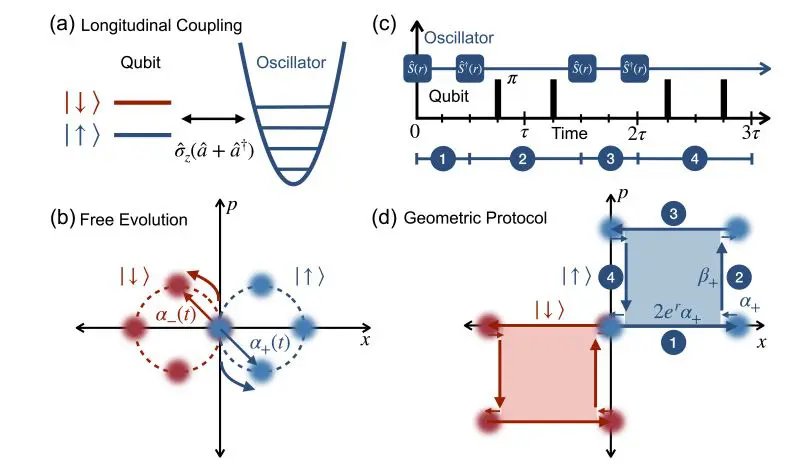
Quantum sensors promise unprecedented precision, but achieving sensitivities beyond established limits remains a significant challenge, and a team led by Nishchay Suri from Lawrence Berkeley National Laboratory, Zhihui Wang from NASA Ames Research Center, and Tanay Roy from Fermi National Accelerator Laboratory now demonstrates a breakthrough in this field. They present a novel sensing protocol for systems coupling quantum bits (qubits) and oscillators, which surpasses the standard quantum limit by cleverly exploiting a geometrical phase, a property linked to the area enclosed within the oscillator’s quantum behaviour. This approach amplifies the signal through a process called squeezing, enabling sensitivities previously unattainable, and importantly, functions independently of the oscillator’s initial state, making it compatible with advanced quantum technologies like high-temperature or error-corrected qubits. The team’s method proves robust against common sources of noise and opens doors to high-precision measurements of forces, couplings, and calibration in diverse quantum systems, representing a substantial step towards next-generation sensing capabilities.
Geometrical Phase Sensing with Superconducting Qubits
The approach maps the applied force onto a shift in the qubit’s energy levels through their coupling, manifesting as an accumulation of geometrical phase during the qubit’s evolution, allowing for precise inference of the weak force. The team demonstrates that this sensing scheme surpasses the standard quantum limit, achieving a sensitivity that scales favourably with the number of qubits. A key achievement is the development of a theoretical framework for optimising the qubit-oscillator coupling and measurement parameters to maximise sensing sensitivity, incorporating the effects of decoherence and thermal noise for practical implementation. Furthermore, the research explores the potential to detect non-classical motion of the oscillator, opening avenues for exploring fundamental quantum phenomena and developing advanced quantum technologies.
Geometric Phase Estimation with Quantum Systems
This research details a method for enhancing the precision of measurements using quantum systems by utilising carefully designed sequences of quantum operations to accumulate a geometric phase sensitive to parameters of interest. This geometric phase arises from the path a quantum system takes in parameter space, acting as a memory of its trajectory, and is central to the research, focusing on systems where qubits and oscillators interact. Key concepts include dispersive coupling, where the qubit and oscillator interact weakly, and quantum operations such as displacement, squeezing, and rotation. Displacement shifts the oscillator’s state, squeezing reduces uncertainty in one property at the expense of another, and rotation alters the oscillator’s phase.
The research explores how these operations, combined with free evolution and transformations, can be used to enhance measurement precision. Researchers investigate scenarios where the qubit and oscillator are weakly coupled, using sequences of operations to accumulate a geometric phase sensitive to the parameters of interest. These sequences involve applying a drive to the resonator, allowing the system to evolve freely, and reversing the displacement. The accumulated geometric phase is proportional to the displacement and the dispersive coupling, allowing for precise estimation of these parameters.
Geometric Phase Sensing Beyond Standard Limits
This research demonstrates a new quantum sensing protocol for systems where qubits and oscillators interact, achieving sensitivities beyond the standard quantum limit. By encoding signals in the geometrical phase of the oscillator, and amplifying this phase through squeezing, the team developed a method that is remarkably independent of the initial state of the oscillator. This independence is particularly valuable as it allows the protocol to function effectively with high-temperature or error-corrected states, increasing its practicality for real-world applications. The protocol exhibits robustness against qubit noise, a common source of error in quantum systems. Researchers successfully applied this method to measure forces and precisely calibrate couplings in circuit electrodynamics architectures, surpassing the limitations of conventional sensing techniques. This advancement opens new possibilities for high-precision measurements and expands the potential of quantum metrology, offering a pathway towards more sensitive and reliable quantum sensors.
🗞 Quantum Sensing using Geometrical Phase in Qubit-Oscillator Systems
🧠 ArXiv: https://arxiv.org/abs/2511.21983