Storing complex quantum states presents a significant challenge in the development of quantum technologies, but researchers are now demonstrating new methods for reliable quantum memory. Anubhab Sur from the University of Houston, Qiujiang Guo from Zhejiang University, and Rubem Mondaini from the University of Houston, detail a process for ‘freezing’ the evolution of a quantum system, effectively creating a stable memory by transitioning it to a specifically designed Hamiltonian. This approach, utilising what the team terms Emergent Hamiltonians, uniquely preserves both the local and global characteristics of the stored quantum state, unlike other methods which often disrupt these properties. The researchers demonstrate the ability to store complex multi-qubit states, including fragile configurations like Bell products and globally distributed GHZ states, offering a pathway towards more robust and reliable quantum information storage and processing.
Emergent Hamiltonians Simplify Many-Body Quantum Systems
Scientists are tackling a fundamental challenge in quantum physics: understanding and controlling the behavior of complex systems with many interacting particles. This research focuses on developing a simplified description of these systems, known as an emergent Hamiltonian, which captures the essential physics without computationally intractable calculations. This approach is crucial because directly solving the equations governing these systems is often impossible. The team investigates systems composed of hard-core bosons, particles that cannot occupy the same location simultaneously, which simplifies the mathematical analysis.
They aim to find a simpler Hamiltonian that accurately describes the original, complex system by focusing on the most important interactions and approximations. This involves calculating the emergent Hamiltonian using a series expansion, a technique that provides an approximate solution by considering only the most significant terms. The research models the system as a lattice, a regular grid where particles can move between neighboring sites. Scientists consider both nearest-neighbor and next-nearest-neighbor hopping, describing how particles move across the lattice. By carefully analyzing the interactions, they identify key terms in the emergent Hamiltonian, such as those representing particle flow and density-assisted hopping.
This allows them to create a simplified model that captures the essential behavior of the original system. This work provides a pathway to understanding complex quantum systems, with potential applications in quantum simulation and materials science. The emergent Hamiltonian can be used to simulate the behavior of the original system on a quantum computer, offering insights into the properties of materials with strong interactions between electrons. This approach also has implications for quantum information processing, potentially leading to the design of new quantum technologies.
Emergent Hamiltonian Freezes Quantum State Evolution
Scientists have developed a novel method for storing quantum information by effectively ‘freezing’ the evolution of quantum states. This technique utilizes an Emergent Hamiltonian, a specifically designed Hamiltonian that stabilizes the quantum state at a particular moment in time. This offers a potential alternative to existing methods like many-body localization and quantum error correction. The team begins with a quantum state evolving under an initial Hamiltonian and then rapidly switches to the Emergent Hamiltonian, effectively halting the evolution. This freezing is achieved by constructing the Emergent Hamiltonian as a series expansion dependent on time, incorporating interactions between particles.
Researchers demonstrate that, while the full expansion can be complex, the initial terms govern the short-time dynamics, potentially yielding a physically realizable Hamiltonian. This locality is crucial, as it allows for indefinite storage of the quantum state, limited only by experimental imperfections. To implement this protocol, scientists focus on pausing the quantum dynamics with high precision without requiring the qubits to enter an idle state. By carefully selecting the initial Hamiltonian, they ensure that the time-evolved state becomes an eigenstate of the Emergent Hamiltonian. Experiments successfully employed this method to store maximally entangled multi-qubit states, including fragile, globally distributed GHZ states, which are notoriously difficult to initialize and maintain in quantum devices. The study demonstrates that this technique preserves both local and global properties of the quantum state, unlike some other storage methods that primarily focus on local preservation.
Freezing Quantum States for Extended Storage
Scientists have achieved a breakthrough in storing quantum information by developing a method to freeze the evolution of many-body quantum states, effectively preserving them for extended periods. This work addresses a fundamental challenge in quantum computing, which requires the ability to reliably store and retrieve complex quantum states. The team demonstrates that by evolving a system initialized in a simple state and then ‘quenching’ it to a specifically designed Hamiltonian, they can indefinitely store the quantum information, limited only by experimental imperfections. Experiments reveal that this method uniquely preserves both local and global properties of the stored quantum state, unlike other approaches such as many-body localization.
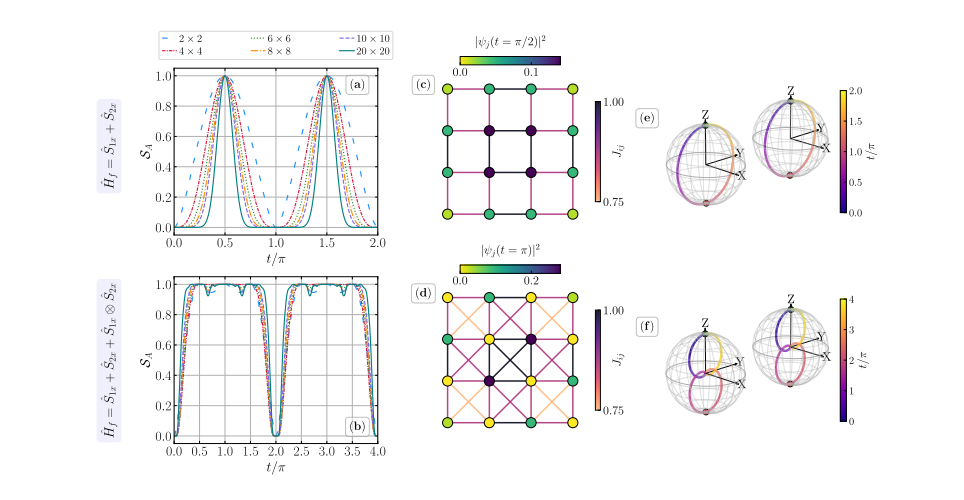
The researchers successfully demonstrated the storage of maximally multi-qubit states, including fragile, globally distributed GHZ states, which are notoriously difficult to initialize in quantum devices. Specifically, starting from a simple state, the team achieved peak entanglement, indicating a highly entangled state with equal contributions from each entangled pair. The data shows that by freezing the dynamics at specific times, the system transitions to a maximally entangled state. This approach bypasses the need for extensive circuit complexity, even with limited connectivity, offering a significant advantage over conventional methods.
Extending this work to two dimensions, the researchers derived an Emergent Hamiltonian, which allows for the creation and storage of entangled states in a 2D lattice. While obtaining exact solutions becomes more challenging in higher dimensions, the team demonstrates the feasibility of approximating the Emergent Hamiltonian and maintaining the ability to store quantum information. This advancement opens new avenues for building more robust and scalable quantum computers by providing a practical method for long-term quantum data storage.
Emergent Hamiltonians Stabilize Entangled Quantum States
This research demonstrates a novel approach to storing highly entangled quantum states, achieving a form of robust quantum memory. Scientists have shown that by employing an ‘Emergent Hamiltonian’ framework, it is possible to stabilize complex states, including those composed of multiple Bell states or fragile GHZ states, which are notoriously difficult to initialize and maintain in quantum devices. The core of this method involves evolving a system and then ‘freezing’ its state by switching to a specifically designed Hamiltonian, effectively creating a stable configuration that preserves both local and global properties of the original state. The team further revealed that these Emergent Hamiltonians, while originating from simpler systems, exhibit characteristics reminiscent of quantum chaotic systems, displaying complex operator structures.
Importantly, the research acknowledges that practical implementation faces limitations due to decoherence, a fundamental challenge in quantum computing. However, the authors suggest that the duration of stable storage can be extended by tuning the energy gap within the system, offering a potential pathway to mitigate the effects of decoherence. Future work will focus on investigating whether these Emergent Hamiltonians adhere to the eigenstate thermalization hypothesis, a key concept in understanding the behaviour of complex quantum systems, and exploring the extent to which ergodicity plays a role in their stability. This framework offers a valuable design tool, allowing manipulation of the system’s eigenspectrum through the choice of the initial Hamiltonian.
🗞 From Bell Products to GHZ: Quantum Memories via Emergent Hamiltonians
🧠 ArXiv: https://arxiv.org/abs/2510.01117