

Quantum technologies are poised to revolutionise numerous fields, yet widespread public understanding remains limited, creating a critical need to introduce these concepts at earlier educational stages. Apekshya Ghimire, Jaya Shivangani Kashyap, and colleagues at the University of Pittsburgh, alongside Emily Edwards from Duke University, Diana Franklin from the University of Chicago, and Chandralekha Singh from the University of Pittsburgh, investigate how teachers perceive and experience the introduction of quantum concepts into their classrooms. Their research focuses on teachers’ engagement with the QuanTime programme and other related activities designed to promote quantum literacy in students from grades four to twelve. The team’s findings demonstrate that these activities are readily integrated into existing curricula with minimal preparation, receiving positive feedback from both pre-high and high school teachers, and importantly, hold significant promise for inspiring a more diverse and future-ready workforce in the rapidly expanding field of quantum information science and technology.
Quantum Education, Challenges and Effective Strategies
This document synthesizes research on quantum education for K-12 teachers and students, focusing on the need for quantum literacy, the challenges of teaching these concepts, and effective implementation strategies. The research identifies a growing demand for a workforce skilled in quantum technologies, suggesting early exposure can spark interest and prepare students for future careers. Understanding quantum mechanics is also becoming increasingly important for general scientific literacy and enhances computational thinking abilities, with connections to physics, chemistry, computer science, and even the arts. However, teaching quantum concepts presents significant challenges.
Quantum mechanics deals with phenomena vastly different from everyday experience, making it difficult for students and teachers to grasp abstract ideas like superposition and entanglement. Traditional explanations rely on advanced mathematics inaccessible to most K-12 students, and many teachers lack the necessary background knowledge and pedagogical skills. A shortage of age-appropriate, engaging curriculum materials further complicates implementation. Research highlights several effective strategies. Using analogies and metaphors, such as comparing superposition to coin flips or entanglement to linked boxes, can help students visualize abstract concepts, though acknowledging their limitations is crucial.
Engaging students in thought experiments, like Schrödinger’s cat, stimulates critical thinking, while presenting the historical development of quantum mechanics provides context. Emphasizing what happens in quantum systems, rather than how it happens mathematically, and utilizing interactive simulations and visualizations, such as PhET simulations and Quirk, are also beneficial. Hands-on activities and demonstrations prove particularly effective. Demonstrating polarization of light introduces the concept of quantum states, while single-photon experiments illustrate wave-particle duality. Quantum-inspired games and puzzles, like Qupcakery and QueueBits, make learning fun, and exploring connections between quantum mechanics and art, such as wave interference patterns, can make the subject more accessible.
Computational approaches, including quantum computing simulators like IBM Quantum Experience and Microsoft Q#, and visual programming languages like Scratch, allow students to explore quantum algorithms and programming concepts. Crucially, investing in teacher professional development, including content knowledge enhancement, pedagogical training, curriculum development support, and collaborative learning communities, is essential for successful implementation. Survey data reveals that teachers often lack confidence in teaching quantum concepts, particularly at the pre-high school level, but recognize the value of interdisciplinary connections and support inquiry-based learning. Resources like PhET Simulations, Quirk, IBM Quantum Experience, Microsoft Q#, Wonders of Physics, Canon Lab, and Atomic Rainbows and Exploring Spectra offer valuable tools for educators. The key takeaways emphasize the benefits of early exposure, prioritizing conceptual understanding over mathematical rigor, investing in teacher professional development, developing engaging curriculum materials, fostering collaboration, addressing misconceptions, and embracing interdisciplinary connections.
Teacher Perceptions of Quantum Education Program Implementation
This study investigated how teachers perceive QuanTime, a program designed to introduce quantum concepts into K-12 classrooms, and related activities. Teachers were divided into groups teaching grades 4-8 and 9-12 to assess the program’s effectiveness across different age groups. A comprehensive survey, featuring 12 Likert-scale questions and 14 open-ended prompts, gathered detailed feedback on teachers’ experiences and perceptions. Approximately two-thirds of responding teachers implemented QuanTime activities, demonstrating strong initial adoption. Analysis revealed distinct preferences between the groups.
High school teachers favoured activities like Wave-Particle Duality and Electron Transitions, aligning with their curriculum’s complexity, while pre-high school teachers showed greater interest in Art and Polarization, suggesting these topics were more accessible for younger learners. Teachers consistently highlighted the ease of integrating QuanTime into existing curricula and the minimal preparation required, demonstrating its practicality for busy educators. The study pioneered a resource designed for immediate classroom use, offering adaptable tools requiring no specialized training or extensive preparation. The activities covered foundational quantum topics, including wave-particle duality, electron transitions, quantum entanglement, polarization, and quantum games, allowing teachers to select content appropriate for their grade level.
Background materials and implementation guides supported teachers with limited prior experience in quantum physics, ensuring accessibility. Inspired by initiatives like the “Hour of Code,” the study emphasized accessible, interactive learning in quantum science. By analyzing teacher feedback and observing implementation patterns, the research provides valuable insights into effective strategies for fostering quantum literacy and inspiring the next generation of scientists and engineers.
Teachers Integrate Quantum Concepts Into Classrooms
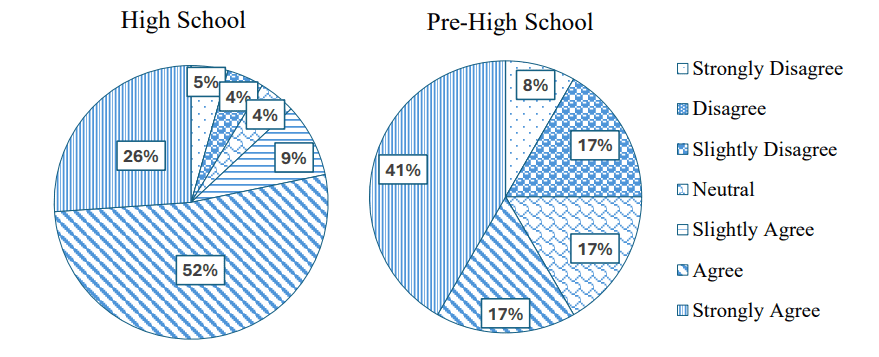
This study investigated how pre-high and high school teachers integrate quantum concepts into their classrooms using QuanTime and other activities, aiming to cultivate a future workforce in quantum information science and technology. Approximately two-thirds of responding teachers implemented quantum activities, with high school teachers favouring demonstrations like Wave-Particle Duality and Electron Transitions, while pre-high school teachers showed strong interest in Art and Polarization. Teachers reported that these activities were easily integrated into existing curricula and required minimal preparation, enhancing accessibility. The research team analyzed responses from 12 Likert-scale questions, ranging from 1 to 7, to assess teacher perceptions and engagement.
Results demonstrate that teachers largely agreed with the value of introducing quantum concepts, with average scores exceeding 4 for both pre-high and high school groups across most statements. High school teachers consistently reported slightly higher average scores than their pre-high school counterparts, indicating a generally more positive response. However, statements concerning preparation time and support received lower average scores, hovering around 4. 0. The data reveal that teachers did not perceive a substantial need for additional preparation or support, suggesting the activities are effectively designed for easy classroom integration.
Teachers expressed future interest in repeating the activities, averaging 6. 2 for high school and 5. 9 for pre-high school teachers. These findings suggest that the pre-college quantum-related activities are teacher-friendly and can be confidently utilized without extensive additional resources.
Teacher Adoption of Early Quantum Activities
This research demonstrates the positive reception of QuanTime and related activities among teachers in both pre-high and high school settings, indicating their potential as valuable tools for early-age quantum education. Approximately two-thirds of responding teachers implemented these activities, with high school teachers favouring explorations of wave-particle duality and electron transitions, while pre-high school teachers showed particular interest in art and polarization. Teachers consistently highlighted the ease of integrating these activities into existing curricula and the minimal preparation required, suggesting accessibility for educators. The findings suggest that these hands-on, interactive approaches are perceived as useful for introducing complex quantum concepts in a tangible and accessible manner, sparking student interest and facilitating classroom discussions. While this study does not measure direct student learning outcomes, the consistency of positive teacher responses indicates a promising pathway for engaging students with quantum science from a young age. Teachers also expressed confidence in conducting the activities, and many noted the potential for these experiences to serve as a first step in developing longer-term engagement with quantum concepts.
👉 More information
🗞 Investigating High School and Pre-High School Teachers’ Perceptions and Experiences Introducing Quantum Concepts: A Survey of QuanTime and other Quantum-related Activities
🧠 ArXiv: https://arxiv.org/abs/2510.15785

