

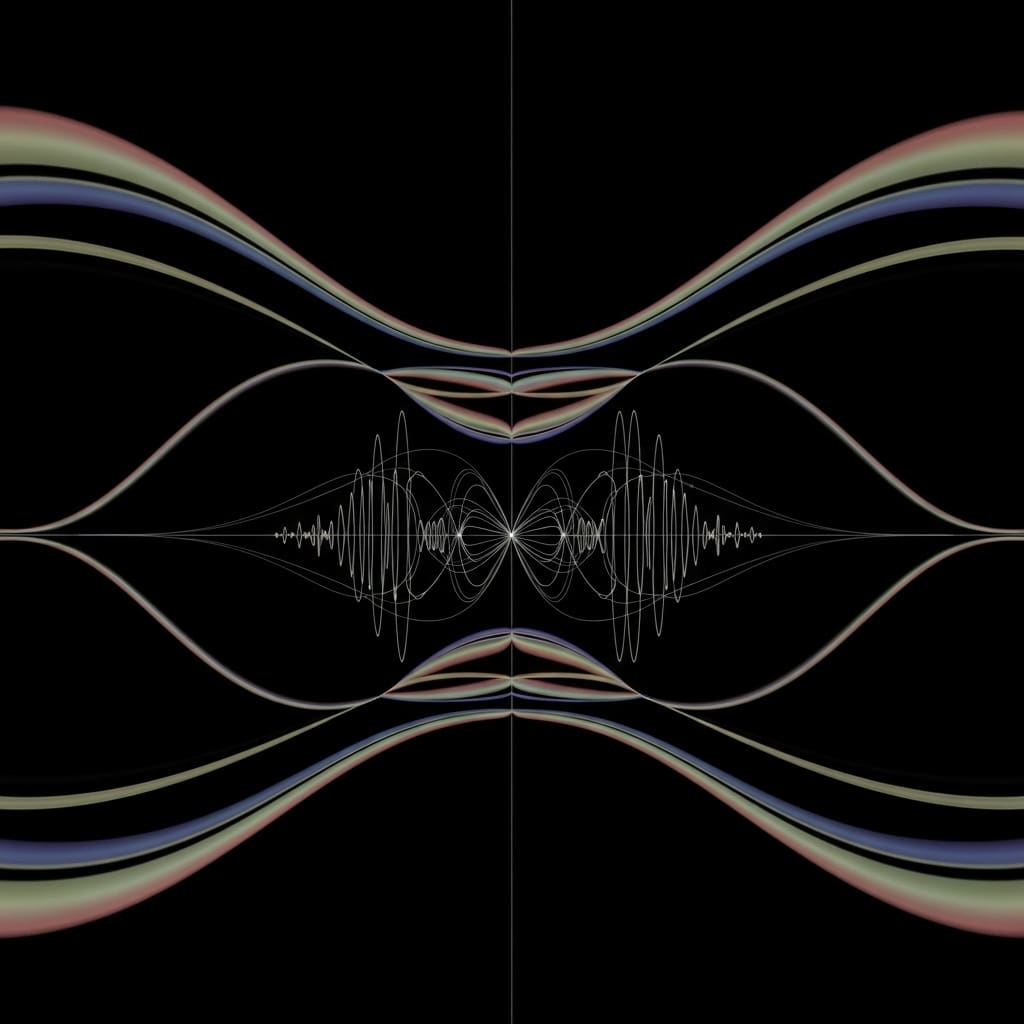
Scientists are increasingly focused on altermagnetic materials, a fascinating class of magnets possessing spin-split electronic bands, but proving this unique band structure exists as a fundamental property has remained a significant hurdle. Now, Taichi Terashima (National Institute for Materials Science), Yuya Hattori (National Institute for Materials Science), and David Graf (National High Magnetic Field Laboratory) et al. have presented compelling evidence for this in the altermagnet CrSb. Their comprehensive quantum oscillation study, combining high-field measurements with advanced calculations, reveals multiple oscillation frequencies stemming from four distinct spin-non-degenerate bands , definitively demonstrating a spin-split Fermi surface in CrSb and opening new avenues for exploring its potentially groundbreaking electronic behaviour.
The study unveils a detailed picture of the electronic behaviour within CrSb, moving beyond theoretical predictions to provide experimental validation of its altermagnetic characteristics. Researchers meticulously combined experimental techniques with advanced computational modelling to achieve these results. The team’s DFT+U calculations, crucially including spin-orbit coupling, were essential for interpreting the observed quantum oscillation frequencies and accurately mapping the spin-split Fermi surface.
This combined approach allowed for a robust and detailed characterisation of the material’s electronic behaviour. Detailed analysis revealed that bands-1 and -2 feature tubular Fermi surfaces along the ΓA line, coupled with closed pockets at the A point, aligning with previous ARPES studies. In contrast to a recent claim of closed Fermi surfaces, the team’s findings support the existence of open, tubular sheets, further solidifying the understanding of CrSb’s electronic topology. The band-3 and -4 Fermi surfaces also exhibit unique characteristics, contributing to the complex pattern of quantum oscillations observed.
This precise mapping of the Fermi surface is a significant advancement in the field of altermagnetism. This work opens exciting avenues for exploring the potential of altermagnets in spintronic applications. CrSb, as a metallic compound with a well-defined altermagnetic order and a g-wave symmetry, presents a promising platform for investigating spin-dependent phenomena. The definitive confirmation of the spin-split Fermi surface through quantum oscillations provides a crucial benchmark for theoretical models and paves the way for designing novel devices based on altermagnetic materials. Furthermore, the techniques employed in this study can be extended to other candidate altermagnets, accelerating the discovery and characterisation of materials with tailored electronic properties and functionalities, potentially revolutionising the field of magnetism and spintronics.
CrSb Crystal Growth and High-Field Magnetotransport Measurements reveal
Electrical currents were applied along the c-axis for flux-grown crystals and the a-axis for CVT-grown crystals, optimising resistivity measurements. Consistent results were obtained from samples grown via both methods, with detailed analysis focusing on a flux-grown crystal exhibiting a residual resistivity ratio (RRR) of 6.8 and a CVT-grown crystal with an RRR of 9.8. To further characterise the material, magnetic torque measurements were performed on additional flux-grown crystals using a micro cantilever at NIMS. Fully relativistic electronic band-structure calculations, including spin-orbit coupling (SOC), were conducted using the PBE-GGA potential within the DFT+U scheme with the Wien2k code.
This computational work was essential, as SOC alters cyclotron orbits by creating gaps at crossing points on the Fermi surface. The team identified tubular Fermi sheets along the ΓA line and closed pockets at the A point for bands-1 and -2, aligning with existing angle-resolved photoemission spectroscopy (ARPES) studies. Researchers then connected experimental observations to theoretical predictions by utilising the Onsager relation, which links quantum-oscillation frequency (F) to the cross-sectional area (A) of the Fermi surface: F = (ħ/2πe)A. The temperature and magnetic-field dependence of the quantum-oscillation amplitude were described using the Lifshitz, Kosevich formula, detailed in supplementary materials. Analysis of raw resistivity data, with polynomial backgrounds subtracted, revealed discernible SdH oscillations in both crystal types, subsequently analysed via Fourier transforms to identify frequencies α, β, δ, ε, and ζ. The ζ oscillation was particularly prominent in magnetic torque data, while low-frequency peaks were carefully excluded as potential artefacts.
CrSb exhibits spin-split Fermi surface via oscillations observed
These groundbreaking results firmly establish a foundation for exploring the novel electronic properties inherent to altermagnetic materials and represent a significant step forward in understanding complex magnetic systems. Specifically, samples exhibited residual resistivity ratios (RRR) of 6.8 and 9.8, demonstrating high sample quality and facilitating accurate measurements of the quantum oscillations. Measurements of magnetic torque, performed using a micro cantilever, further corroborated the quantum oscillation data, providing complementary insights into the electronic band structure. Fully relativistic electronic band-structure calculations, employing the DFT+U scheme with spin-orbit coupling (SOC), were crucial for interpreting the experimental observations.
The inclusion of SOC was essential, as it modifies cyclotron orbits by creating gaps at the crossing points of Fermi surface sheets on nodal planes, accurately reflecting the behaviour observed in CrSb. Data shows the Fermi level is intersected by four spin-non-degenerate bands, meticulously labelled bands-1 through -4 in order of increasing energy. The identification of these distinct bands, coupled with the observed oscillation frequencies, provides definitive proof of the g-wave symmetry predicted for the altermagnetic order in CrSb. CrSb Fermi Surface Mapping via Oscillations.
👉 More information
🗞 Altermagnetic spin-split Fermi surfaces in CrSb revealed by quantum oscillation measurements
🧠 ArXiv: https://arxiv.org/abs/2601.19105
