The creation of strongly correlated multi-photon states represents a significant hurdle in developing advanced quantum technologies, yet achieving deterministic generation has proved elusive due to the weak nonlinear properties of most optical systems. Jia-Qi Li, alongside Anton Frisk Kockum from Chalmers University of Technology and Xin Wang from Xi’an Jiaotong University, now demonstrates a scalable architecture for producing these correlated states through cascaded inelastic scattering within a nonlinear waveguide. The team introduces the concept of a ‘pseudo-giant atom’ to describe the non-local scattering potential arising from bound states, enabling unidirectional and fully controllable photon conversion without unwanted backscattering. This innovative approach automatically sorts photons by their distinct group velocities, creating a programmable superposition of spatially and temporally isolated components and opening new possibilities for on-demand generation of complex multi-photon resources applicable to quantum simulation, precision measurement, and scalable quantum networks.
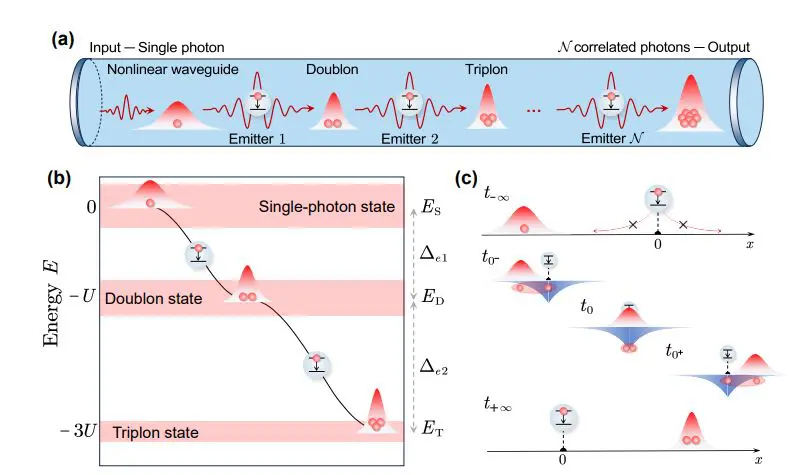
Researchers propose a scalable architecture for producing correlated few-photon entangled states via cascaded inelastic scattering in a nonlinear waveguide. When a single photon interacts with a far-detuned excited two-level emitter, it coherently converts into a propagating doublon, a bound photon pair with unusual dispersion characteristics. This doublon can subsequently interact with another excited emitter to further convert into a triplon, and so on, establishing a photon-number amplification cascade.
Waveguide Quantum Electrodynamics and Strong Coupling
This collection of references details research focused on the fundamental principles of quantum optics, quantum information, and related areas of physics. The work explores strong coupling between light and matter, particularly within cavities or waveguides, and investigates the ultrastrong coupling regime. A major focus is waveguide quantum electrodynamics, examining the interaction of single photons with quantum emitters embedded in waveguides. The research also encompasses generating, manipulating, and detecting entangled photons for applications in quantum communication, computation, and sensing, including sources of entangled photons and the creation of cluster states.
Further areas of investigation include many-body quantum systems, nonlinear optics, topological photonics, quantum simulation, and the behaviour of open quantum systems. Researchers explore single-photon transport, atom-waveguide interactions, non-reciprocity, and chiral photonics within waveguide quantum electrodynamics. The work also addresses quantum information and entanglement, including entangled photon sources, cluster states, NOON states, quantum repeaters, quantum key distribution, and multipartite entanglement. Investigations extend to many-body quantum systems, such as the Bose-Hubbard model, and the use of quantum systems for simulation.
Theoretical tools and software, including QuTiP and QuSpin, are also prominent within the collection. Key trends and emerging areas highlighted by the references include the integration of quantum emitters with waveguides, pushing the boundaries of strong and ultrastrong coupling, utilizing topological photonics for quantum information, employing waveguides for quantum simulation, and developing advanced theoretical tools. This comprehensive collection represents a significant overview of current research in quantum optics, waveguide quantum electrodynamics, and quantum information processing, highlighting exciting progress and the potential for developing new quantum technologies.
Efficient Multi-Photon Entanglement via Giant Atoms
This research establishes a novel approach to generating multi-photon entangled states, achieved through cascaded inelastic scattering within a nonlinear waveguide. Scientists demonstrated that far-detuned two-level emitters can efficiently mediate photon-number upconversion, overcoming limitations inherent in resonant scattering techniques. A key theoretical development was the introduction of the ‘pseudo-giant atom’ formalism, which describes the non-local scattering potential and explains how multi-photon states reshape light-matter interactions. Through implementation using engineered giant atoms, the team achieved unidirectional and highly efficient photon conversion, alongside programmable state synthesis resulting in spatially and temporally isolated photon-number states.
The resulting spatiotemporally entangled states offer promising avenues for quantum-enhanced metrology, specifically through the deterministic creation of NOON states, and for distributed quantum computing using time-bin encoded multi-photon graph states. This work bridges the fields of quantum nonlinear optics and correlated many-body physics, providing a scalable platform for exploring complex photonic matter. The authors acknowledge that the current proposal is most readily implemented in superconducting circuits, building upon existing architectures of capacitively coupled transmons. Future research directions include investigating similar phenomena in nonlinear continuous waveguides and exploring nonlinear dynamics in systems exhibiting photon-photon interactions.
🗞 Generating spatially separated correlated multiphoton states in nonlinear waveguide quantum electrodynamics
🧠 ArXiv: https://arxiv.org/abs/2511.14281