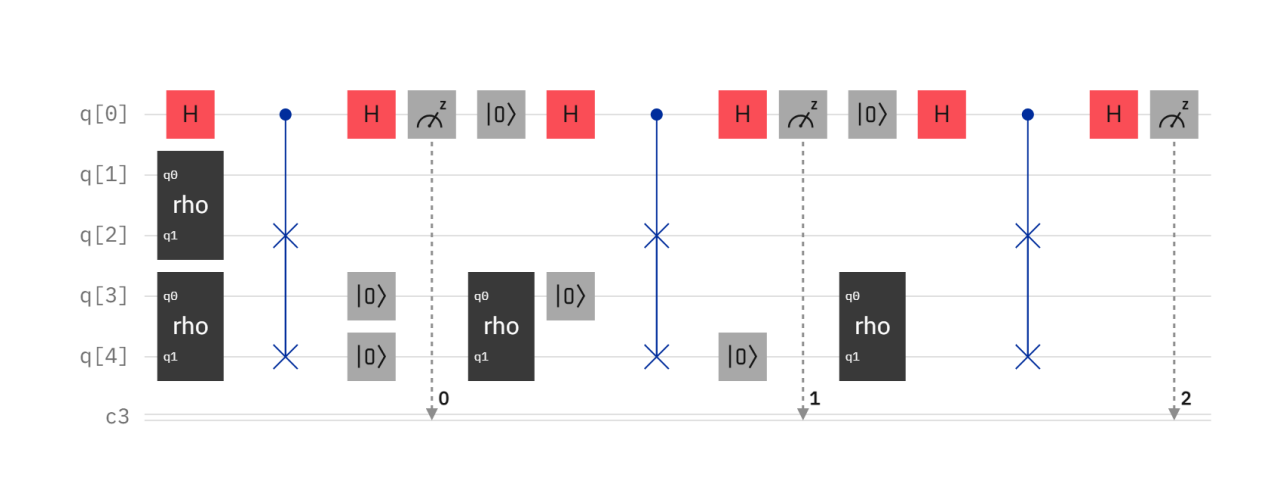
Characterising the properties of quantum states presents a significant challenge in modern physics, with applications ranging from information science to statistical mechanics. Xiao Shi, Jiyu Jiang, and colleagues at The Hong Kong University of Science and Technology (Guangzhou), along with Xian Wu, Jingu Xie, Hongshun Yao, and Xin Wang, now demonstrate a new method for efficiently estimating these properties, specifically quantum state moments. Their research introduces a framework that dramatically reduces the resources needed for accurate estimation, utilising a technique called qubit reuse to achieve near-optimal performance. This advance enables the detailed characterisation of quantum states with fewer physical qubits and operations, and the team validates its utility by accurately determining a state’s maximum eigenvalue and implementing virtual cooling techniques, ultimately paving the way for more powerful quantum spectroscopy on existing and near-term quantum hardware.
Rényi Entropy Estimation via Trace Powers
Scientists have developed a new algorithm for efficiently estimating integer Rényi entropy, a crucial measure of quantum information, providing a more complete characterization of quantum states. The algorithm leverages the ability to estimate the trace of powers of a density matrix, achieved through carefully designed quantum circuits, state preparation, and measurement, and is designed to scale efficiently with the size of the quantum system and the order of the Rényi entropy calculation. Experiments conducted on a 133-qubit superconducting quantum processor, preparing a Gibbs state using precisely controlled quantum operations, demonstrate that the algorithm achieves the standard quantum limit, confirming its efficiency and scalability. The error in the Rényi entropy estimation exhibits only a weak dependence on the system size, suggesting the algorithm can be applied to larger quantum systems, and comparison with theoretical predictions confirms the algorithm’s accuracy. This work provides an efficient and scalable method for estimating integer Rényi entropy, with potential applications in quantum state characterization, error correction, machine learning, and many-body physics.
Efficient Quantum State Moment Estimation via Reuse
Scientists have created a novel framework for efficiently estimating quantum state moments, essential for advancements in quantum information science, statistical mechanics, and many-body physics. Recognizing the limitations of existing methods, the team pioneered a technique that reuses qubits to simultaneously estimate a full hierarchy of moments for an m-qubit state, enabling the estimation of quantities crucial for characterizing quantum states and calculating Rényi entropies. The core of this work involves a circuit designed for simultaneous moment estimation, requiring only 2m+1 physical qubits and a number of quantum operations scaling with the moment order, achieving a near-optimal sample complexity. Researchers demonstrated the utility of estimated moments by showing their ability to tightly bound a state’s maximum eigenvalue and applied the technique to quantum virtual cooling, enabling access to low-energy states of the Heisenberg model. To validate the method’s practicality, the team experimentally measured higher-order Rényi entropy on a superconducting quantum processor, demonstrating its viability on near-term hardware, and established an information-theoretic lower bound, proving that the developed scheme achieves a logarithmic factor above the minimum required copies of the quantum state for accurate estimation. This innovative approach provides a scalable and resource-efficient route to quantum system characterization and spectroscopy, paving the way for advancements in near-term quantum technologies.
Efficient Quantum State Moment Estimation Achieved
Scientists have developed a new framework for efficiently estimating the properties of quantum states, achieving significant reductions in the resources required for analysis. This work introduces a method for simultaneously estimating multiple moments of a quantum state using a minimal number of qubits, a crucial advancement for near-term quantum computing, efficiently reusing qubits, requiring only two state registers (2m qubits) plus a single ancilla qubit for an m-qubit state. The team demonstrated the ability to estimate the full hierarchy of moments, as well as arbitrary polynomial functionals, with a circuit depth scaling with the order of the moment being estimated, achieving a near-optimal sample complexity. To validate the theoretical framework, the team performed extensive numerical simulations and a proof-of-principle experiment on a superconducting quantum processor, confirming the validity of the protocols and demonstrating their utility in determining tight bounds on the maximum eigenvalue of an unknown quantum state. Furthermore, by implementing the method within the Quantum Virtual Cooling algorithm for the Heisenberg model, they successfully inferred thermal expectation values at effectively lower temperatures, and measured the second- to fourth-order Rényi entropy on a superconducting quantum device, demonstrating a scalable and resource-optimal route to characterizing nonlinear properties of quantum states on near-term quantum hardware.
Efficient State Moment Estimation via Quantum Computation
This research presents a new framework for efficiently estimating nonlinear properties of quantum states, addressing a significant challenge in areas like information science and statistical mechanics. The team developed a method for simultaneously estimating a complete hierarchy of state moments and polynomial functionals, alongside their observable-weighted counterparts, without substantial resource demands, attaining a near-optimal sample complexity. Demonstrating practical viability, the researchers successfully measured Rényi entropy, from the second to the fourth order, on a superconducting processor, closely matching theoretical predictions after error mitigation. This work resolves a long-standing problem in quantum property estimation and offers a new approach to designing qubit-efficient algorithms. The authors acknowledge limitations inherent in near-term hardware and suggest future work focusing on integrating advanced error mitigation techniques and exploring hardware-aware optimizations of the circuits used.
🗞 Near-Optimal Simultaneous Estimation of Quantum State Moments
🧠 ArXiv: https://arxiv.org/abs/2509.24842