The pursuit of stable Majorana zero modes, essential components for building fault-tolerant quantum computers, faces significant hurdles in creating platforms that combine a substantial energy gap, precise control, and resistance to imperfections. Xiao-Hong Pan, Si-Qi Yu, and Li Chen, working with colleagues at Tsung-Dao University and beyond, now demonstrate a promising new approach. Their research validates a novel platform leveraging the Meissner effect within an insulator nanowire partially covered by a superconductor, creating a spatially varying shift that selectively triggers a phase transition. This mechanism crucially separates the transition from the interface between the materials, enabling strong superconductivity while preventing disruptive changes to the energy gap, and ultimately paving the way for robust Majorana modes in hybrid systems.
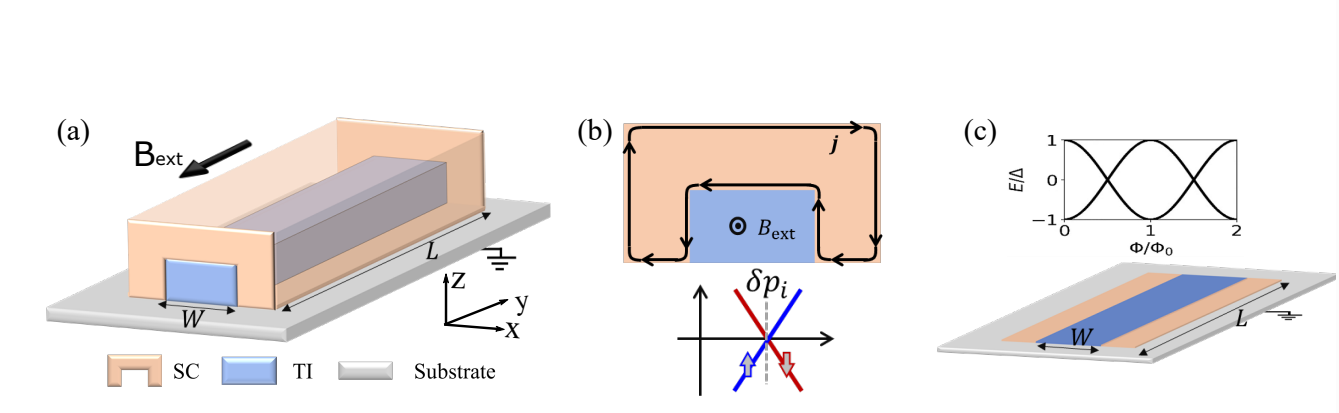
Scientists successfully demonstrated a system that simultaneously achieves a large superconducting gap, high tunability, and resilience to disorder, overcoming a significant challenge in the field. The research centers on a topological insulator nanowire partially covered by a superconductor and placed on an electrostatic gate, subjected to an external magnetic field. Experiments reveal that the Meissner effect, the expulsion of magnetic fields from a superconductor, induces spatially varying Doppler shifts on the topological insulator’s surface.
Specifically, calculations demonstrate a significantly larger momentum shift on the bottom surface of the nanowire compared to the surfaces in contact with the superconductor. This engineered anisotropy is crucial, as it spatially separates the phase transition from the superconductor/topological insulator interface, preventing detrimental band renormalization that could close the superconducting gap. The team employed a combination of supercurrent simulations, self-consistent Schrödinger-Poisson calculations, and large-scale tight-binding models to validate the platform’s robustness. Results show that the induced magnetic field distribution and diamagnetic currents are as predicted by theoretical models, confirming the effectiveness of the Meissner effect in generating the desired anisotropic Doppler shift. Band structure analysis reveals that the momentum shift on the bottom surface is substantially larger than on other surfaces, creating the necessary conditions for a robust topological phase transition. This breakthrough delivers a practical pathway toward realizing robust Majorana zero modes in superconductor/topological insulator hybrid systems, paving the way for advancements in quantum computing and materials science.
Spatial Phase Transition Confines Majorana Modes
This research demonstrates that by leveraging the Meissner effect, a spatially varying Doppler shift can be induced on a topological insulator nanowire, generating a highly anisotropic effective g-factor. This anisotropy selectively drives a phase transition localized on the nanowire’s bottom surface and spatially separates it from the superconducting interface, avoiding detrimental band renormalization and maintaining a robust superconducting gap. The key achievement lies in spatially separating the ingredients necessary for realizing Majorana zero modes, magnetism and superconductivity, through this engineered anisotropy. This separation circumvents the need for a delicate balance between these competing factors, allowing for a robust topological phase with a large energy gap even under relatively weak external fields. Comprehensive simulations, including supercurrent calculations and tight-binding models, validate the platform’s robustness in both idealized and realistic device environments. This work establishes a promising pathway toward realizing robust topological superconductivity and advancing the development of fault-tolerant quantum technologies.
Diamagnetic Localization of Majorana Zero Modes
This research presents a comprehensive investigation into realizing Majorana zero modes within a hybrid nanowire system, focusing on a semiconductor nanowire coupled with a conventional superconductor. Scientists demonstrate that the Meissner effect creates a spatial confinement potential for these modes, shielding them from scattering caused by imperfections in the nanowire. Detailed theoretical calculations, utilizing the Bogoliubov-de Gennes equation, incorporated the Meissner effect and spatial variations in the superconducting potential. Experiments involving fabricated InAs nanowires with Al superconducting contacts revealed zero-bias peaks, a hallmark of Majorana zero modes, demonstrating their robustness against variations in gate voltage, indicating topological protection. Spatial mapping of conductance further confirmed the localization of these modes. The research emphasizes the increased robustness of the Majorana zero modes to disorder compared to previous designs, a significant contribution to the field, and represents a step forward in the quest to realize topological quantum computation.
🗞 Robust Majorana Platform Driven by a Meissner-Induced Anisotropic Doppler Shift
🧠 ArXiv: https://arxiv.org/abs/2509.24686