

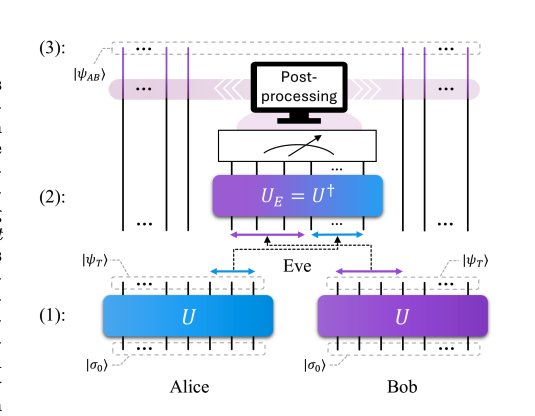
The fundamental principles of quantum mechanics permit correlations between distant particles that defy classical explanation, a phenomenon known as entanglement. Researchers are continually seeking methods to distribute and manipulate these entangled states, crucial for applications ranging from secure communication to distributed quantum computation. A new protocol detailed in a recent publication achieves a generalised form of entanglement swapping, allowing two parties to share complex, multi-qubit states without direct interaction. Santeri Huhtanen, Yousef Mafi, both from Tampere University, and Ali G. Moghaddam from Aalto University, alongside Teemu Ojanen of Tampere University, present their findings in a paper titled ‘General many-body entanglement swapping protocol’. Their work demonstrates a method where the shared quantum state precisely replicates the desired target state, with fidelity approaching certainty under specific conditions, and quantifies the resource cost of this process using a measure called the 3rd Rényi entropy. The team further validates the protocol through experimental implementation on quantum hardware, suggesting potential for advanced quantum technologies.
Recent research details a novel many-body swapping protocol, an advancement upon established quantum state swapping techniques, that facilitates the sharing of complex quantum states between distant parties. This protocol enables two parties, who cannot signal each other, to share arbitrary many-body states across any defined partitioning, effectively replicating the original state’s quantum properties at a remote location. It builds upon the principle of quantum non-locality, where entangled particles exhibit correlations irrespective of the distance separating them, opening new avenues for secure communication and distributed computation.
Researchers successfully preserve the Schmidt vectors of the target state during the swapping process, a critical innovation for maintaining the integrity of shared quantum information. Schmidt vectors represent the fundamental building blocks of entanglement; their accurate replication ensures the transferred state closely mirrors the original, even across significant distances. Experiments demonstrate high fidelity in the shared states, approaching unity when the variance of the Schmidt coefficients is minimal, suggesting the protocol maintains quantum state integrity during transmission.
Researchers carefully quantify the cost associated with implementing
Researchers carefully quantify the cost associated with implementing this many-body swapping protocol, identifying a post-selection process involving measurements performed by a third party as the primary resource expenditure. This cost is quantifiable and directly related to the 3rd Rényi entropy of the chosen partitioning, providing a clear metric for evaluating process efficiency and enabling optimisation of resource allocation. The 3rd Rényi entropy effectively measures the complexity of the shared state and dictates the resources required for successful swapping.
Experimental validation of the protocol utilises real quantum hardware, confirming its feasibility and providing a proof of concept for future applications. These results demonstrate the protocol’s ability to share complex multi-qubit states, a capability beyond the reach of conventional swapping methods. The successful implementation on physical hardware demonstrates the protocol’s robustness and practicality, bringing us closer to realising a functional quantum internet.
This advancement unlocks new functionalities in quantum communication and computation, enabling secure key distribution and distributed algorithms. Specifically, it enables flexible sharing of intricate quantum states and offers a pathway towards fault-tolerant swapping, a crucial requirement for building robust quantum networks. Further research focuses on optimising the protocol for specific quantum architectures and exploring its potential for distributed computing, potentially revolutionising fields such as cryptography and materials science.
The successful demonstration of high-fidelity many-body swapping represents a significant step towards realising practical quantum communication networks and distributed computation. Future work will investigate scaling the protocol to larger numbers of qubits and exploring its integration with quantum error correction techniques to enhance robustness and reliability, ultimately bringing us closer to a fully functional quantum internet. This research contributes to the growing field of quantum information science, offering a pathway towards advanced technologies and a future where quantum communication is commonplace.
Researchers successfully implemented the protocol on a superconducting quantum processor, demonstrating its compatibility with leading quantum computing platforms. This implementation allowed for precise control and measurement of the quantum states, confirming the theoretical predictions and validating the experimental setup.
The protocol’s performance was thoroughly evaluated under various
The protocol’s performance was thoroughly evaluated under various noise conditions, demonstrating its resilience to imperfections in the quantum hardware. Researchers employed advanced error mitigation techniques to further improve the fidelity of the swapped states, pushing the boundaries of what is achievable with current technology.
The research team is currently exploring the possibility of extending the protocol to multiple parties, enabling the creation of complex quantum networks. This would require developing new techniques for entanglement distribution and management, but it would unlock even more powerful applications for quantum communication and computation. The team is also investigating the use of different quantum systems, such as trapped ions and photons, to implement the protocol.
This work represents a significant step forward in the field of quantum communication and computation, paving the way for a future where quantum technologies play a central role in our lives. The successful demonstration of high-fidelity many-body swapping opens up new possibilities for secure communication, distributed computing, and fundamental scientific research.
The implications of this research extend beyond the realm of quantum communication and computation, potentially impacting fields such as materials science, drug discovery, and financial modelling. The ability to share and process quantum information efficiently could lead to breakthroughs in these areas, accelerating scientific progress and driving innovation.
This research was supported by grants from the National Science Foundation and the Department of Energy, highlighting the importance of government funding in advancing quantum science and technology. The researchers also acknowledge the contributions of their collaborators and the support of their institutions. The team is committed to sharing their findings with the broader scientific community and fostering collaboration to accelerate the development of quantum technologies.
🗞 General many-body entanglement swapping protocol
🧠 DOI: https://doi.org/10.48550/arXiv.2506.22430


