The quest for entangling quantum systems has led researchers to explore innovative methods, including measurement-based entanglement. This approach involves projecting the state of a system onto a specific outcome, effectively creating an entangled state between two or more qubits. In this article, we delve into the world of semiconductor spin qubits and their potential for entanglement. By exploring the properties of these qubits and their interactions with microwave photons, researchers can create highly entangled spin states. The challenge lies in developing a protocol that enables measurement-based entanglement between non-adjacent qubit pairs.
Can Quantum Spin Qubits Be Entangled?
The quest for entangling quantum systems has led researchers to explore innovative methods, including measurement-based entanglement. This approach involves projecting the state of a system onto a specific outcome, effectively creating an entangled state between two or more qubits. In this article, we delve into the world of semiconductor spin qubits and their potential for entanglement.
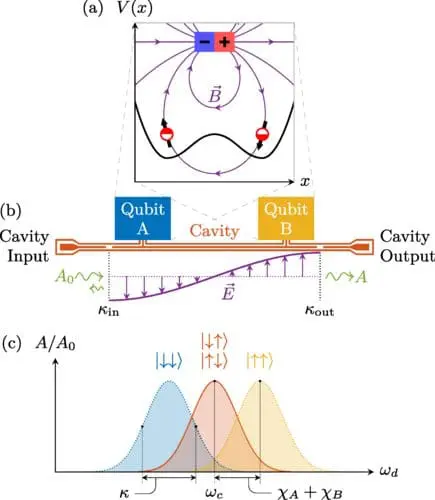
Measurement-based entanglement is a promising method for entangling quantum systems. By deriving a stochastic master equation describing the process, researchers can simulate and model the behavior of silicon double-dot flopping-mode spin qubits. The goal is to explore what modifications could enable an experimental implementation of this protocol. With device parameters corresponding to current qubit and cavity designs, simulations predict an entanglement fidelity (F) of 0.61. By increasing the cavity outcoupling rate by a factor of ten, the simulated F can reach 0.81 while maintaining a yield of 33%.
What Are Semiconductor Spin Qubits?
Semiconductor spin qubits are strong candidates for use in quantum computers due to their long spin-coherence times and reliance on proven nanofabrication technologies. Spins generally interact through the exchange interaction, which is based on electrical control of wave function overlap. Previous implementations of two-qubit gates in silicon quantum devices have used tunable exchange couplings to establish interactions between neighboring qubits. These interactions can evolve an unentangled two-qubit state into an entangled state.
However, for non-adjacent qubit pairs, this type of gate is limited by the short effective range of the exchange interaction. Circuit quantum electrodynamics (cQED) is a device architecture that has enabled strong coupling between microwave frequency photons and superconducting qubits. Long-distance coupling of superconducting qubits has also been achieved with cQED. Efforts have been made to broaden cQED by incorporating semiconductor quantum dots in microwave cavities, demonstrating strong spin-photon coupling, resonant spinspin interactions, and dispersive spinspin coupling.
The Potential for Entanglement
The potential for entanglement in semiconductor spin qubits is vast. By exploring the properties of these qubits and their interactions with microwave photons, researchers can create highly entangled spin states. This could lead to significant advancements in quantum computing and communication. The challenge lies in developing a protocol that enables measurement-based entanglement between non-adjacent qubit pairs.
Numerical Simulations
Numerical simulations play a crucial role in modeling the behavior of semiconductor spin qubits. Using stochastic master equations, researchers can simulate the process of measurement-based entanglement and explore what modifications could enable an experimental implementation of this protocol. The results of these simulations are promising, predicting high entanglement fidelities with current device parameters.
Experimental Implementation
The next step is to develop an experimental implementation of measurement-based entanglement in semiconductor spin qubits. This will require the development of a protocol that can be used to entangle non-adjacent qubit pairs. The challenge lies in creating a system that can maintain high entanglement fidelities while minimizing errors and decoherence.
Measurement-based entanglement is a promising method for entangling quantum systems, including semiconductor spin qubits. By exploring the properties of these qubits and their interactions with microwave photons, researchers can create highly entangled spin states. The challenge lies in developing a protocol that enables measurement-based entanglement between non-adjacent qubit pairs. Numerical simulations play a crucial role in modeling the behavior of semiconductor spin qubits and predicting high entanglement fidelities.
Publication details: “Measurement-based entanglement of semiconductor spin qubits”
Publication Date: 2024-07-16
Authors: Remy L. Delva, Jonas Mielke, Guido Burkard, J. R. Petta, et al.
Source: Physical review. B./Physical review. B
DOI: https://doi.org/10.1103/physrevb.110.035304