

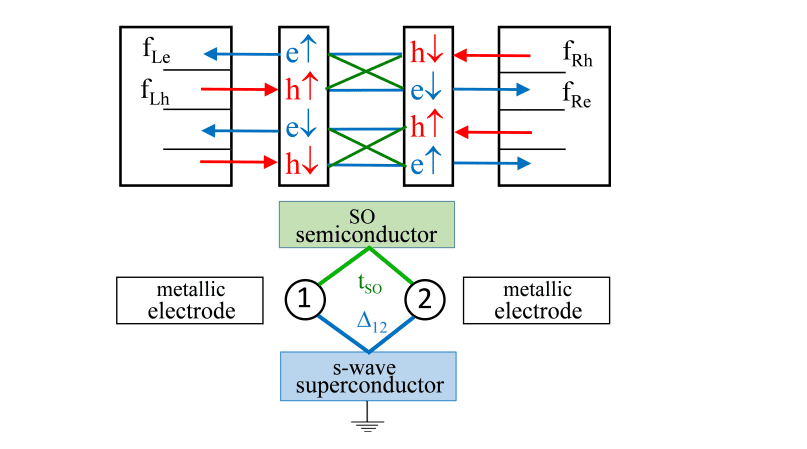
The pursuit of robust quantum states for future technologies drives exploration into novel hybrid materials, and recent work focuses on the interplay between electron spin and superconductivity within nanoscale devices. Bogdan R. Bułka, Tadeusz Domański, and Karol I. Wysokiński, from the Institute of Molecular Physics, Polish Academy of Sciences, and M. Curie-Skłodowska University, investigate a system where quantum dots are linked to a superconductor, revealing how spin-orbit interaction and a process called Andreev reflection combine to create unique quasiparticle states. Their research demonstrates that, under specific conditions, these interactions can generate fully spin-polarized quasiparticles resembling Majorana fermions, potentially offering a pathway towards building more stable and reliable quantum computers. The team’s findings highlight a ‘sweet spot’ where these effects are balanced, and they predict distinct transport characteristics that could allow scientists to experimentally verify the existence of these molecular states and assess the efficiency of energy dissipation within the system.
This research investigates a hybrid device comprising two quantum dots connected by a superconductor and linked to external electrodes. Scientists explore the interplay between spin-orbit interaction and Andreev reflection within this system, revealing how these phenomena influence electron transport through the coupled quantum dots. Calculations demonstrate a strong sensitivity of conductance to the combined effects of spin-orbit interaction and Andreev reflection, leading to novel features in the transport spectrum, including splitting of conductance peaks and the emergence of additional resonances.
Researchers demonstrate the formation of molecular Andreev bound states within the quantum dots and identify conditions under which these states evolve into fully spin-polarized quasiparticles resembling Majorana fermions. These unique states, localized on separate dots, emerge when the strength of spin-orbit interaction precisely matches the magnitude of crossed Andreev reflections, a condition the team terms the “sweet spot”. Outside this specific parameter range, these two processes compete, preventing the formation of the desired states.
Andreev Reflection and Superconducting Quantum Dots
A comprehensive review of recent research reveals a vibrant field encompassing mesoscopic physics, superconductivity, quantum dots, and related areas. Key themes include Andreev reflection, where electrons are reflected as holes in a superconductor, and its manifestations in various systems. This includes the formation and properties of Andreev bound states in quantum dots, nanowires, and Josephson junctions, as well as the tunneling of electrons as holes leading to supercurrents and non-local effects. A significant portion of the research focuses on quantum dots coupled to superconductors, leading to proximity-induced superconductivity within the dots and the formation of Josephson junctions.
Investigations explore non-local effects, revealing how electron behaviour is influenced across distances within these hybrid structures. Several studies concentrate on Majorana fermions, potential building blocks for topological quantum computation, often created in nanowires with strong spin-orbit coupling and proximity to a superconductor, and identified through non-local conductance measurements. Researchers also investigate the generation and detection of entangled electrons, utilizing Cooper pair splitting and quantum dots, with applications in quantum repeaters for long-distance quantum communication and secure quantum cryptography. Many studies address the impact of noise and correlations on these systems, crucial for understanding their behaviour and potential applications, including current correlations and shot noise analysis. Theoretical calculations and models play a vital role, employing techniques such as mean-field theory, slave-boson theory, and full counting statistics to understand the complex many-body physics at play. Research increasingly focuses on quantum information applications, and the field is characterized by a diversity of materials including nanowires, graphene, quantum dots, and Josephson junctions, alongside a high level of theoretical sophistication.
Majorana States Emerge in Quantum Dot Hybrid
This research details the successful creation and analysis of a novel hybrid device composed of two quantum dots linked to a superconductor and external electrodes. Scientists demonstrated the emergence of molecular Andreev bound states within the dots, and crucially, identified conditions under which these states evolve into fully spin-polarized quasiparticles resembling Majorana fermions. These unique states, localized on separate dots, arise when the strength of spin-orbit interaction matches the magnitude of crossed Andreev reflections, a specific parameter set the researchers term the “sweet spot”. The team’s analysis reveals a duality in charge transport, demonstrating that the device exhibits similar behaviour under symmetric bias voltage and in a Cooper pair splitter configuration.
They predict that charge transport through the zero-energy quasiparticle states at the sweet spot will be characterized by nearly perfect electron transmission. Furthermore, the researchers showed that the interplay between interdot electron pairing and spin-orbit order leads to the formation of four Dirac states, highlighting the potential for manipulating these states within the device. This research provides a promising platform for hybridizing bound states and constructing minimal versions of the Kitaev model, potentially advancing the field of topological quantum computation.
👉 More information
🗞 Interplay of spin orbit interaction and Andreev reflection in proximized quantum dots
🧠 ArXiv: https://arxiv.org/abs/2510.17379

