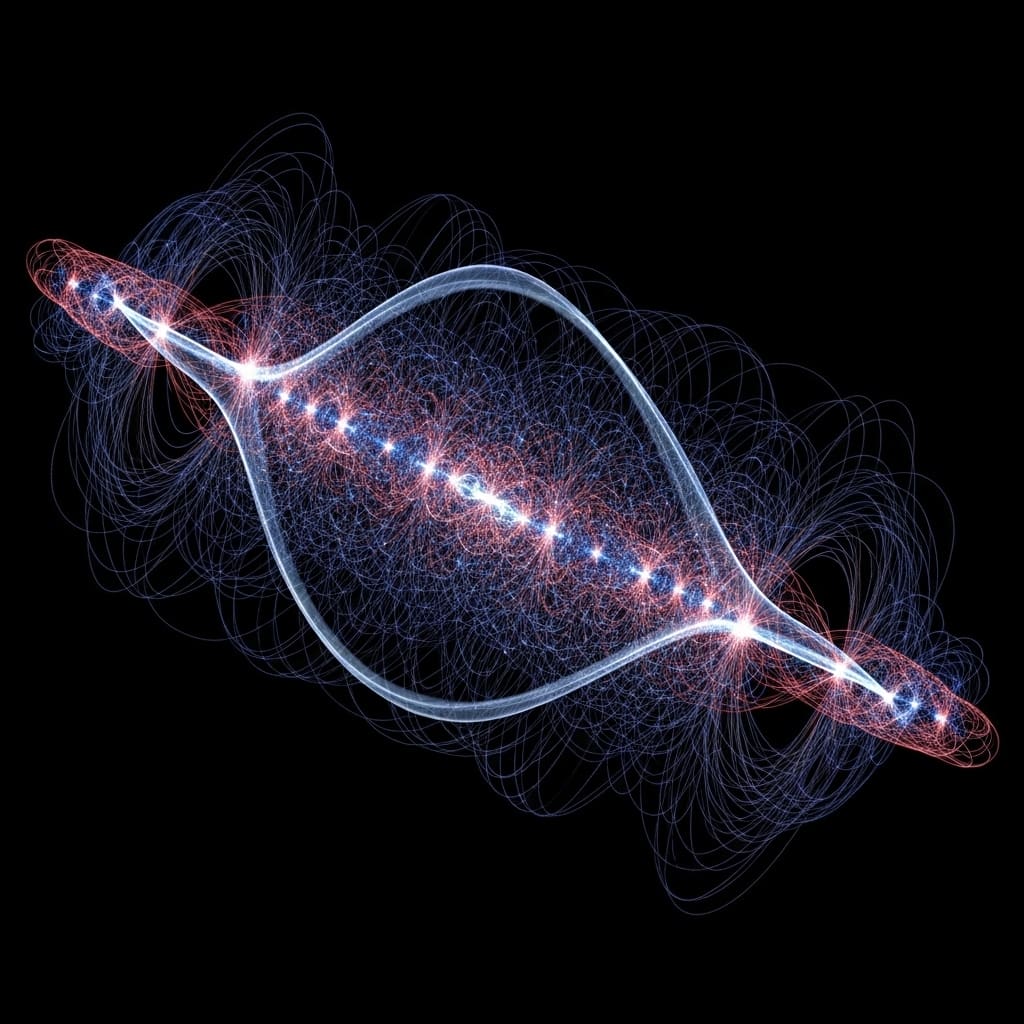
Understanding the interplay between quantum mechanics and fluid dynamics is crucial for advancing materials science and nanotechnology, particularly when considering the effects of spin-orbit coupling. Cesare Tronci of the University of Surrey, alongside colleagues, investigates the fundamental forces and correlations arising from this coupling within the framework of quantum hydrodynamics. Their research unveils previously overlooked quantum forces acting on particle trajectories, stemming from a specific current operator that significantly contributes to spin current. This work distinguishes between different mechanisms generating quantum spin correlations and clarifies spin transport phenomena like the current shift in the spin Hall effect. By leveraging the Hamiltonian structure of the system, the authors provide a new perspective on spin dynamics and propose a computational method for simulating these complex interactions.
The research focuses on orbital Madelung, Bohm trajectories, extending conventional quantum hydrodynamics to incorporate spin effects. This is achieved by supplementing established force terms with those arising from spin-orbit coupling (SOC), specifically through a current operator significantly contributing to spin current. A crucial distinction is made between quantum geometric tensor (QGT)-related spin-hydrodynamic forces and newly identified orbital forces induced by SOC, revealing two distinct mechanisms responsible for generating quantum spin-orbit correlations. By utilising the Hamiltonian structure of the hydrodynamic system, the study clarifies spin transport characteristics, including the current shift observed in the spin Hall effect.
Quantum Hydrodynamics with Spin-Orbit Coupling
The study develops a theoretical framework to describe the behavior of electrons in materials where both quantum and classical effects are important, particularly when spin-orbit coupling (SOC) is present. SOC, a relativistic effect linking an electron’s spin to its motion, leads to phenomena like the spin Hall effect. The authors employ a hydrodynamic approach to quantum mechanics, describing the electron gas as a fluid with density and velocity fields for computational efficiency in many-body problems. Bohmian mechanics, where particles have definite trajectories guided by a quantum potential, is leveraged to create a particle-based description within the hydrodynamic framework.
Geometric mechanics provides a mathematically rigorous foundation for the fluid equations, allowing for a more elegant and general treatment of the system. Semidirect product Lie groups are used as a sophisticated mathematical tool to describe the combined dynamics of the fluid and spin degrees of freedom. The central physical effect being modeled is spin-orbit coupling (SOC), crucial for spintronics and understanding materials with novel magnetic properties, with gauge invariance ensuring theoretical consistency. The system is treated as a complex fluid, drawing analogies from the study of fluids with internal structure.
The paper presents a unified framework combining quantum hydrodynamics, Bohmian mechanics, and geometric mechanics to handle spin-orbit coupled systems, representing a theoretical advance beyond a mere numerical method. The use of semidirect product Lie groups provides a mathematically sound basis for the equations, addressing issues of consistency and generality. The framework is designed to handle solutions where density can become singular, important for understanding complex fluid behavior, and allows for a seamless transition between quantum and classical descriptions. Explicitly including the geometric phase in the dynamics provides a deeper understanding of the underlying physics.
This research has potential implications for designing new spintronic devices exploiting spin currents and SOC, modeling quantum plasmas, predicting material properties with strong SOC, and gaining a better understanding of the interplay between quantum mechanics, fluid dynamics, and relativistic effects. The hydrodynamic approach could potentially lead to more efficient simulations of complex quantum systems. This work proposes treating electrons as a fluid while tracking their spin and its interaction with motion, using advanced mathematics to ensure equation correctness and handle complicated situations, potentially aiding the development of electronic devices based on electron spin.
Mead Current Drives Spin-Orbit Coupling Forces
Scientists have achieved a breakthrough in understanding spin-orbit coupling (SOC) dynamics through a novel application of quantum hydrodynamics. The research details the isolation of SOC-induced quantum forces acting on Madelung-Bohm trajectories, complementing existing force terms within spin-hydrodynamic models. Experiments revealed a crucial distinction between these SOC-induced forces and those related to the quantum geometric tensor, demonstrating that they originate from a specific current operator previously identified in theoretical chemistry, termed the Mead current operator, which plays a prominent role in spin current generation. The team measured and elucidated two fundamentally different mechanisms generating quantum spin correlations.
Leveraging the Hamiltonian structure of the hydrodynamic system, researchers detailed spin transport features, including the current shift observed in the spin Hall effect. Tests prove that the Mead current operator is entirely responsible for the quantum sources of SOC-induced geometric phase, offering a new perspective on spin dynamics. The work demonstrates how spin current influences orbital motion and unfolds the underlying mechanisms of the spin Hall effect through detailed analysis of the Hamiltonian structure. Further investigation focused on the evolution of the spin geometric phase, revealing contributions from both semiclassical and quantum SOC terms, alongside non-SOC quantum correlations.
The hydrodynamic equations, derived by applying the Madelung transform to the Pauli equation, accurately describe the behavior of electrons under SOC. A spin-vector formalism was introduced to distinguish between semiclassical and quantum torques in spin transport, providing a more nuanced understanding of these forces. The team applied their framework to the Madelung-Rashba equations for planar SOC configurations, observing a complex interplay of forces and torques characteristic of SOC dynamics. To facilitate further research, the scientists proposed a particle-based scheme for the numerical implementation of SOC hydrodynamics. This scheme, building on previous work, utilizes an ensemble of computational particles, bohmions, to sample hydrodynamic paths, each carrying a spin vector to accurately model overall spin transport dynamics. The research establishes a new variational principle expressed in terms of physically natural variables, offering a powerful tool for simulating and understanding complex quantum systems exhibiting SOC, delivering a deeper understanding of correlation forces and torques within SOC dynamics, and opening avenues for advancements in spintronics, plasmonics, and quantum plasmas.
Spin Correlations and Hydrodynamic SOC Forces
This work presents a novel hydrodynamic description of spin-orbit coupling (SOC), grounded in variational principles and Hamiltonian structures, to comprehensively understand the associated quantum forces and correlations. By applying Hamilton’s action principle to the Pauli equation, the researchers isolated SOC-induced forces acting on Madelung-Bohm trajectories, differentiating them from previously understood spin-hydrodynamic forces linked to the quantum geometric tensor. This distinction illuminates two distinct mechanisms generating quantum spin correlations, offering a more complete picture of SOC dynamics. The study elucidates key spin transport phenomena, including the current shift in the spin Hall effect and correlation-induced quantum torques, through the lens of this hydrodynamic framework.
Furthermore, the authors demonstrate the applicability of their approach using the Madelung-Rashba equations for planar SOC configurations and propose a particle-based numerical scheme for implementation. While acknowledging the limitations of excluding magnetic fields and relativistic corrections, the researchers suggest future work could extend the model to encompass these factors and explore applications in areas like electron hydrodynamics, Bose-Einstein condensates, and spintronics. This advancement provides a unified framework for understanding SOC effects and offers a new means of expressing spin current in terms of hydrodynamic variables.
🗞 Madelung hydrodynamics of spin-orbit coupling: action principles, currents, and correlations
🧠 ArXiv: https://arxiv.org/abs/2601.10698