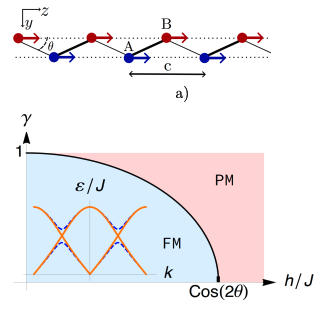
Research demonstrates the dynamical structure factor of the twisted Kitaev spin chain exhibits universal power-law divergence at its critical point, alongside non-universal high-energy features. Investigations into broken glide symmetry and incommensurate magnetic fields reveal a fermionic excitation localisation-delocalisation transition, observable via finite frequency signatures.
The behaviour of quantum systems at critical points, where phase transitions occur, exhibits universal characteristics detectable through measurements of dynamical properties. Recent research suggests that conventional descriptions of these transitions in certain magnetic materials, such as cobalt niobate (CoNb2O6), may benefit from a more nuanced theoretical framework. Specifically, the twisted Kitaev spin chain (TKSC) model, incorporating anisotropic interactions between spins, offers a potentially improved representation of the underlying physics. Uliana E. Khodaeva, from the Technical University of Munich, alongside Dmitry L. Kovrizhin of CY Cergy Paris Université, and Johannes Knolle, affiliated with the Technical University of Munich, the Munich Center for Quantum Science and Technology, and Imperial College London, present detailed calculations of the dynamical structure factor, a measure of how a material responds to external perturbations, for the TKSC model. Their work, entitled ‘Quantum critical dynamical response of the twisted Kitaev spin chain’, explores both the universal low-energy behaviour and the material-specific high-energy features of this system, extending the model to include complexities such as broken symmetry and the influence of disordered magnetic fields, revealing a transition between localised and delocalised fermionic excitations observable in the dynamical response.
Quantum materials continue to challenge established condensed matter physics, prompting ongoing refinement of theoretical models to accurately describe their emergent behaviours at phase transitions, known as critical points. Current investigation focuses on the twisted Kitaev spin chain (TKSC) model as a potential improvement over the more conventional transverse field Ising model, particularly when analysing materials such as cobalt niobate (CoNb3O8) which demonstrate notable critical behaviour.
The research presents detailed calculations of the dynamical
The research presents detailed calculations of the dynamical structure factor for the TKSC, both at and away from its critical point, establishing a comprehensive theoretical basis for interpreting experimental data. The dynamical structure factor describes how scattered particles reveal the energy and momentum of excitations within a material. Researchers extend the fundamental TKSC model by incorporating the effects of broken glide symmetry, a reduction in the material’s symmetry, and the influence of random, incommensurate magnetic fields, meaning fields that do not align with the material’s lattice. This extension reveals a transition between localised and delocalised states within the fermionic excitations, quasiparticles that behave as fundamental building blocks of matter. This transition manifests as a discernible signature at finite frequency within the dynamical response, offering a potential experimental marker to validate the model’s predictions.
To ensure the reliability of the results, the study meticulously addresses numerical limitations inherent in computational modelling. Finite-size effects, arising from the limited computational resources available, are mitigated through the use of a cut-off function, which suppresses spurious artefacts in the calculated structure factor. Furthermore, the two-fold degeneracy of the ground state, meaning the system has two equally likely lowest energy states, is accounted for by introducing a specific operator for its measurement, ensuring accurate representation of the system’s properties.
Advanced mathematical tools, including Pfaffians, determinants used in
Advanced mathematical tools, including Pfaffians, determinants used in probability and statistics, and Bogoliubov operators, which facilitate the description of quasiparticle excitations, are employed to describe the complex interactions within the TKSC. These tools provide a rigorous theoretical framework for understanding the dynamical response. The research successfully characterises both the universal, low-frequency behaviour, which is independent of material details, and the non-universal, high-energy features of the system’s response, providing a complete picture of its behaviour.
🗞 Quantum critical dynamical response of the twisted Kitaev spin chain
🧠 DOI: https://doi.org/10.48550/arXiv.2506.18766