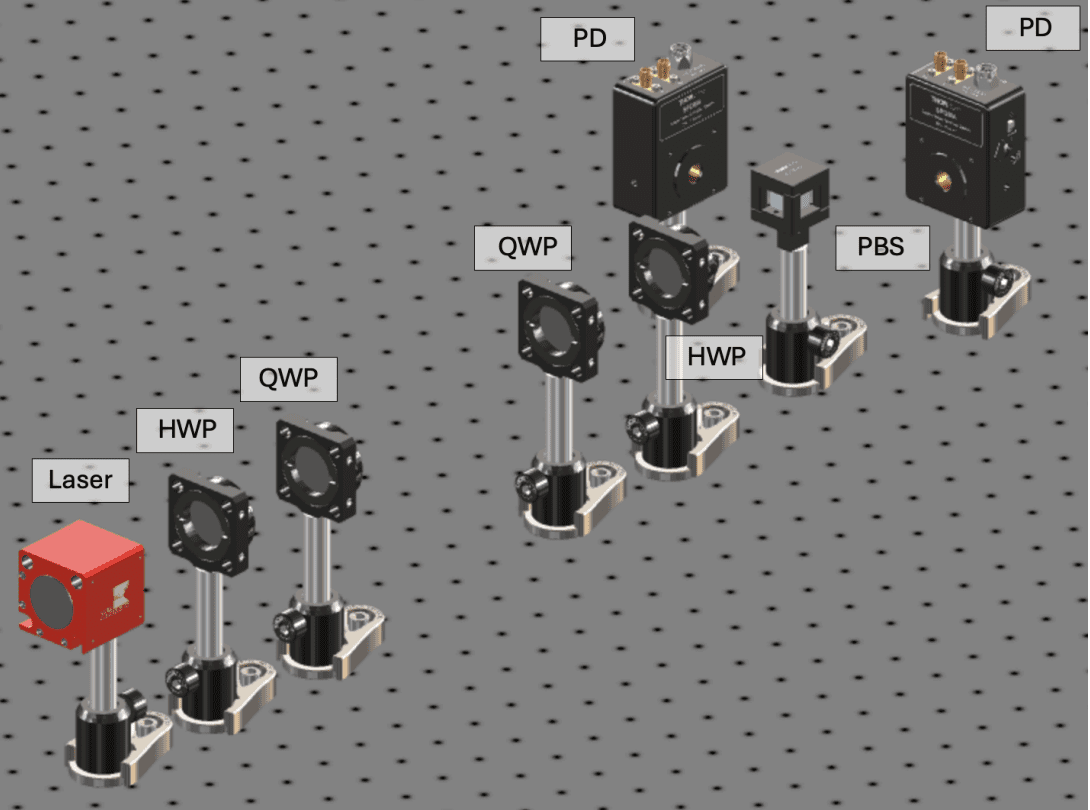
Cryptography continues to drive innovation in secure communication, and researchers are constantly seeking ways to improve existing methods. Sara P. Gandelman from Tel Aviv University and Georgi Gary Rozenman from the Massachusetts Institute of Technology present a new framework for exploring the six-state quantum key distribution protocol, a sophisticated extension of the well-known BB84 scheme. This work establishes a practical and affordable method for emulating quantum key distribution, allowing scientists to test the principles of multi-basis encoding with optical experiments and computational analysis. By bridging the gap between theory and experiment, this research provides a valuable platform for understanding and validating advanced quantum cryptography techniques in a controlled laboratory environment.
Classical Emulation of Quantum Key Distribution Protocols
Scientists achieved a significant breakthrough in quantum cryptography education and research by demonstrating that the statistical behaviour of a multi-basis quantum communication protocol, specifically the six-state protocol, can be faithfully reproduced using purely classical optical systems. This emulation mimics the results of a quantum system without actually employing quantum phenomena, offering a cost-effective and accessible alternative to complex quantum experiments. The team employed a pulsed-laser system to create and manipulate light polarization states, carefully designing the setup to mirror the key steps of the six-state QKD protocol. A simulated eavesdropper, representing a potential attack on the communication channel, was integrated into the system to assess security vulnerabilities.
The experiment measured the fractions of undisturbed bits, disturbed bits, and compromised bits, providing key metrics for evaluating the system’s performance. Experimental results closely matched theoretical predictions, with approximately 31. 3% of bits remaining undisturbed and 10. 4% compromised, aligning with the expected values. This close agreement validates the emulation approach, demonstrating that the classical optical system accurately reproduces the statistical behaviour of the quantum protocol.
This achievement confirms that classical optical systems can emulate quantum communication protocols, providing a more accessible and cost-effective way to study and understand QKD principles. The setup serves as a valuable hands-on educational tool, allowing students to learn about QKD without requiring access to expensive quantum equipment. This research emphasizes the broader applicability of emulation as a scientific paradigm, extending beyond quantum cryptography to various fields including physics, optics, and quantum computing, enabling researchers to explore complex phenomena using simpler, more manageable systems.
Optical Emulation of Six-State Key Distribution
This work pioneers a novel approach to quantum cryptography education and research through optical emulation, specifically focusing on the six-state key distribution protocol, an extension of the BB84 scheme. Scientists engineered a cost-effective, tabletop system that replicates the core principles of multi-basis encoding without requiring complex quantum hardware. The experimental setup utilizes classical optics to simulate quantum state transmission and measurement, allowing for detailed exploration of the protocol’s logical structure. This emulation technique enables researchers to directly compare theoretical predictions with experimental results in a controlled environment.
The team developed a system where polarized light represents quantum states, and optical components such as polarizers and waveplates mimic the action of quantum beam splitters and detectors. Measurements are performed using photodetectors, and the resulting data is analyzed to assess the security and performance of the protocol. This method achieves a robust platform for testing key distribution, offering a valuable alternative to expensive and technically demanding quantum key distribution experiments. The system allows for precise control over experimental parameters, facilitating detailed investigations into the effects of noise and imperfections on protocol performance.
Furthermore, the study demonstrates the universality of emulation as a powerful tool across physics, extending beyond quantum cryptography to areas like gravitational systems and quantum chaos. Scientists harnessed this technique to create physical analogs of complex quantum phenomena, providing intuitive understanding and accessible experimentation. The approach enables students and researchers to gain hands-on experience with quantum concepts without the need for specialized quantum equipment, fostering cross-disciplinary education and accelerating research progress. This innovative methodology provides a pathway to explore and validate quantum protocols in a classical setting, paving the way for advancements in secure communication technologies.
Six-State QKD Demonstrates Eavesdropping Detection
This work demonstrates a robust and cost-effective platform for exploring the principles of six-state quantum key distribution (QKD) using a purely classical optical setup. Experiments reveal that, without eavesdropping, approximately one-third of all transmitted pulses are correctly matched between Alice and Bob. Detailed analysis of the experimental correlation matrices confirms this expected performance, showing a clear diagonal pattern indicative of successful key exchange. To emulate a realistic security threat, the team introduced an intercept-resend (IR) eavesdropper, Eve, into the system. Under this attack, the correctly matched transmission rate decreased significantly, a reduction consistent with theoretical predictions.
This reduction validates the system’s ability to accurately simulate a quantum attack and assess its impact on key exchange fidelity. The experimental setup meticulously controlled polarization states using wave plates and photodiodes, recording the angular settings of both Alice’s and Bob’s equipment for each laser pulse transmitted. This detailed data logging enabled precise computation of per-basis detection probabilities and the construction of sifting matrices, allowing for a quantitative evaluation of undisturbed, disturbed, and compromised transmissions. The team’s meticulous approach delivers a reproducible framework for educational purposes and benchmarking QKD protocols, offering a valuable tool for understanding and advancing quantum cryptography.
Six-State QKD Emulation Validates Security Claims
This research successfully demonstrates a functional emulation of the six-state quantum key distribution protocol, building upon the established BB84 scheme. By combining optical components with computational analysis, the team created a cost-effective platform for exploring the principles of multi-basis encoding and verifying the connection between theoretical predictions and experimental outcomes. The system accurately reproduces the expected statistical behaviour of the protocol, showing a clear distinction between secure transmissions and those compromised by a simulated intercept-resend attack. The findings confirm the feasibility of implementing more complex quantum key distribution protocols using readily available components and demonstrate a method for quantitatively assessing their fidelity. By simulating an eavesdropper within the experimental framework, the team validated the protocol’s vulnerability to known attacks and provided a benchmark for evaluating the performance of future quantum communication systems. Future work could focus on integrating single-photon sources and detectors to achieve a more accurate representation of a practical quantum key distribution network and explore the impact of real-world noise and imperfections on protocol performance.
🗞 Emulation of the Six-State Quantum Key Distribution Protocol with Pulsed Lasers
🧠 ArXiv: https://arxiv.org/abs/2511.13413