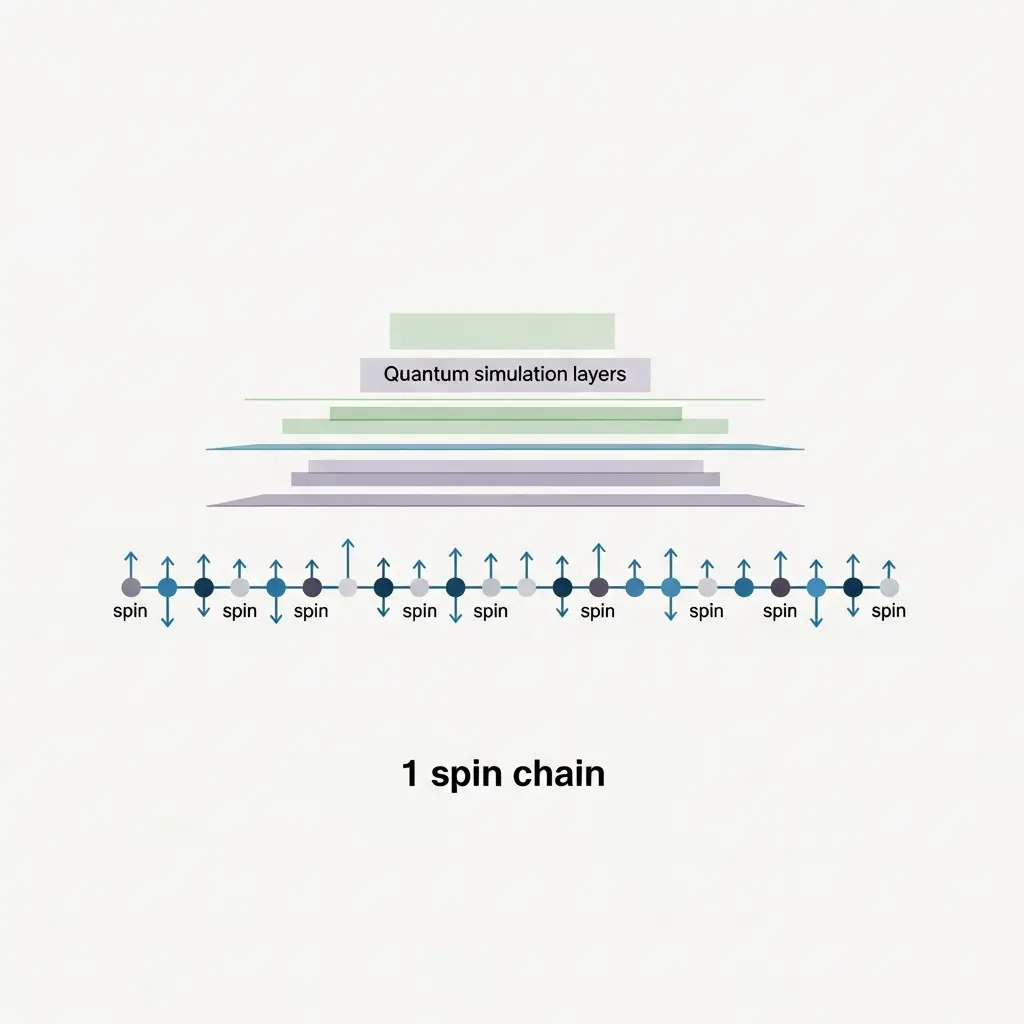
Quantum phase transitions, fundamental shifts in the behaviour of physical systems, receive fresh investigation through the lens of coherent Ising machines, devices capable of modelling complex problems. Jing-Yi-Ran Jin from Beijing Normal University, alongside Shuang-Quan Ma and Qing Ai, demonstrate a powerful connection between these machines and the well-studied one-dimensional XY spin model, using a precise mathematical mapping to a network of oscillating components. This work reveals that coherent Ising machines accurately replicate the critical behaviour of the XY model across a range of conditions, exhibiting clear signatures of quantum phase transitions through measurable changes in magnetic susceptibility. The findings establish coherent Ising machines not only as potential problem-solvers, but also as adaptable simulators for exploring universal physical phenomena and forging links between spin-based models and photonic systems.
This exact correspondence reveals that the DOPO network faithfully reproduces the quantum critical behaviour of the XY model across its anisotropic, isotropic, and transverse-field Ising regimes. The ground-state energy density and its derivatives are analysed to reveal second-order quantum phase transitions, characterised by singularities in magnetic susceptibility at critical points. These results show that coherent Ising machines (CIMs) do not only serve as powerful platforms for solving combinatorial optimisation problems, but also provide a versatile optical simulator for studying universal quantum critical phenomena, bridging quantum-spin models.
Quantum Phase Transitions and Spin Models
Research focuses on quantum phase transitions, spin models, Rydberg atoms, and integrable models, with applications in quantum computing and optimization. A key theme is the investigation of quantum phase transitions and the characterization of critical points using tools like entanglement and geometric phases. The XY spin model is a prominent area of study, used to understand magnetism and as a building block for quantum computation. Ising machines, a type of analog quantum computer, are explored for solving optimization problems, including those in graph theory, chemistry, and materials science.
Scaling and connectivity remain key challenges in developing these machines, alongside understanding their thermodynamic properties and utilizing geometric landscape annealing. Researchers are also investigating quantum correlations, such as entanglement and quantum discord, and applying techniques like Floquet dynamics and finite-temperature analysis to study quantum systems. Potential connections between quantum phase transitions and optimization, as well as the role of entanglement in optimization performance, are areas of active investigation.
DOPO Networks Mimic XY Spin Model Physics
Scientists have established a precise spectral mapping between the one-dimensional XY spin model and networks of degenerate optical parametric oscillators, or DOPOs, coherently operating as coherent Ising machines (CIMs). This correspondence demonstrates that DOPO networks accurately replicate the critical behavior of the XY model across anisotropic, isotropic, and transverse-field Ising conditions, opening new avenues for quantum simulation. The research team meticulously analyzed the ground-state energy density and its derivatives to identify second-order quantum phase transitions, revealing singularities in magnetic susceptibility at critical points. Experiments revealed that the DOPO network faithfully reproduces the quantum critical behavior, allowing for detailed investigation of quantum phase transitions, which mark fundamental changes in a quantum system’s ground state driven by quantum fluctuations. Measurements of the ground-state energy density provide a precise characterization of the system’s behavior, and the team determined critical points at fields of ±2J for the isotropic XY model, where J represents the coupling strength. This work demonstrates that CIMs are not only powerful tools for solving combinatorial optimization problems but also versatile optical simulators capable of studying universal quantum critical phenomena, effectively bridging quantum-spin models and photonic quantum systems, offering potential applications in quantum sensing and materials engineering.
Spin Chain Physics Simulated by Optical Networks
This research establishes a precise spectral mapping between the XY spin chain and a network of degenerate parametric oscillators within coherent Ising machines. The team successfully demonstrated that this optical network accurately replicates the critical behaviour observed in the spin chain across various magnetic regimes, including anisotropic, isotropic, and transverse-field Ising models. Analysis of ground-state energy and its derivatives revealed second-order quantum phase transitions, confirmed by singularities in magnetic susceptibility at critical points. These findings demonstrate that coherent Ising machines are not only effective tools for tackling complex optimisation problems, but also function as versatile simulators for investigating universal critical phenomena, effectively linking spin models with photonic systems. The ability to accurately model quantum phase transitions in a tunable optical platform opens possibilities for advancements in areas such as quantum sensing and the simulation of condensed matter physics. Future research will explore extending this approach to higher dimensions and investigating the combined effects of optical nonlinearity and quantum phase transitions.
🗞 Quantum Phase Transitions in Coherent Ising Machines: XY Model for Demonstration
🧠 ArXiv: https://arxiv.org/abs/2512.23248