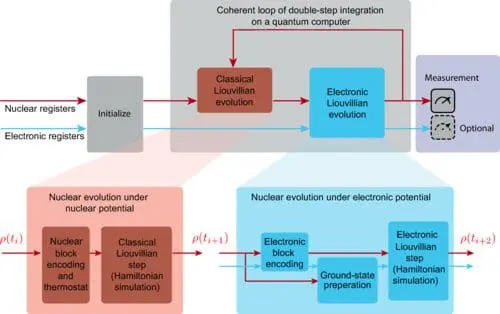
A team of researchers from the University of Toronto, Quantum Lab Boehringer Ingelheim, Pacific Northwest National Laboratory, and the Canadian Institute for Advanced Studies have made a significant breakthrough in quantum simulations. They have developed a method that improves the precision scaling of quantum simulations for coupled quantum-classical systems, commonly found in molecular dynamics simulations. The new method, based on the Koopman-von Neumann formulation of classical mechanics, allows for efficient encoding and evolution of the probability density of the classical degrees of freedom on the quantum computer. This development could have significant implications for the chemical and pharmaceutical industries.
What is the New Development in Quantum Simulations?
A team of researchers, including Sophia Simon, Raffaele Santagati, Matthias Degroote, Nikolaj Moll, Michael Streif, and Nathan Wiebe, from the University of Toronto, Quantum Lab Boehringer Ingelheim, Pacific Northwest National Laboratory, and the Canadian Institute for Advanced Studies, have made a significant breakthrough in the field of quantum simulations. They have developed a method that improves the precision scaling of quantum simulations for coupled quantum-classical systems. These systems are commonly found in molecular dynamics simulations within the Born-Oppenheimer approximation.
The researchers have employed a framework based on the Koopman-von Neumann formulation of classical mechanics. This allows them to express the Liouville equation of motion as unitary dynamics and utilize phase kickback from a dynamical quantum simulation to calculate the quantum forces acting on classical particles. This approach enables the simulation of the dynamics of these classical particles without the overheads associated with measuring gradients and solving the equations of motion on a classical computer. This results in a superpolynomial advantage at the cost of increased space complexity.
The team demonstrated that these simulations can be performed in both microcanonical and canonical ensembles. This enables the estimation of thermodynamic properties from the prepared probability density. This development is a significant step forward in the field of quantum simulations, offering a more efficient and precise method for simulating coupled quantum-classical systems.
How Does This Development Challenge Traditional Views of Dynamics?
Traditionally, dynamics are often viewed as either purely quantum or purely classical. However, many models of physical interest share features with both quantum and classical matter. For example, in molecular dynamics, the nuclei are assumed to follow Newton’s equations, but the electrons follow the Schrödinger equation. In other cases, an electromagnetic field may be treated as a time-dependent classical field, and the particles interacting with it as quantum. Neither a fully quantum model nor a fully classical model can be used to address these problems efficiently.
Quantum computers have long been known to provide exponential advantages for simulating certain quantum systems. However, when examining systems that straddle the line between quantum and classical, such as molecular dynamics, the situation is not as clear. This is because such simulation methods are comparatively underexplored. The new development by the team of researchers challenges this traditional view and offers a more efficient method for simulating these complex systems.
What is the Significance of This Development in the Chemical and Pharmaceutical Industries?
Descriptions within the Born-Oppenheimer approximation, where the wave functions of the nuclei can be considered independent of the wave functions of the electrons, play an important role in the chemical and pharmaceutical industries. These are often used to compute thermodynamic quantities of the chemical systems under study, such as the entropy or the free energy.
The new development by the team of researchers offers a more efficient method for simulating these systems. This could potentially lead to more accurate and efficient computations of thermodynamic quantities, which could have significant implications for the chemical and pharmaceutical industries. This could potentially lead to the development of more effective drugs and treatments, as well as more efficient chemical processes.
How Does This Development Improve Upon Previous Methods?
Previous methods for simulating coupled quantum-classical systems involved computing interatomic forces on quantum computers, which can be used to update the classical nuclear positions on a classical computer iteratively. However, this approach was found to be less practical for many applications, as it required the computation of the properties of the chemical systems in the canonical ensemble.
The new method developed by the team of researchers improves upon these previous methods by allowing for efficient encoding and evolution of the probability density of the classical degrees of freedom on the quantum computer. This is achieved through the use of the Koopman-von Neumann formulation of classical mechanics, which provides a natural encoding and subsequent evolution of classical probability densities into quantum states.
What is the Future of Quantum Simulations?
The development of this new method for simulating coupled quantum-classical systems represents a significant step forward in the field of quantum simulations. However, there is still much work to be done. The team of researchers plans to continue their work in this area, with the aim of further improving the efficiency and precision of these simulations.
The future of quantum simulations looks promising, with the potential for significant advancements in a variety of fields, including the chemical and pharmaceutical industries. As quantum computers become more powerful and accessible, it is likely that we will see even more innovative and efficient methods for simulating complex systems. This could potentially lead to significant advancements in our understanding of the physical world and the development of new technologies and treatments.
Publication details: “Improved Precision Scaling for Simulating Coupled Quantum-Classical Dynamics”
Publication Date: 2024-03-12
Authors: Sophia Simon, Raffaele Santagati, Matthias Degroote, Nikolaj Moll, et al.
Source: PRX Quantum 5, 010343
DOI: https://doi.org/10.1103/PRXQuantum.5.010343