

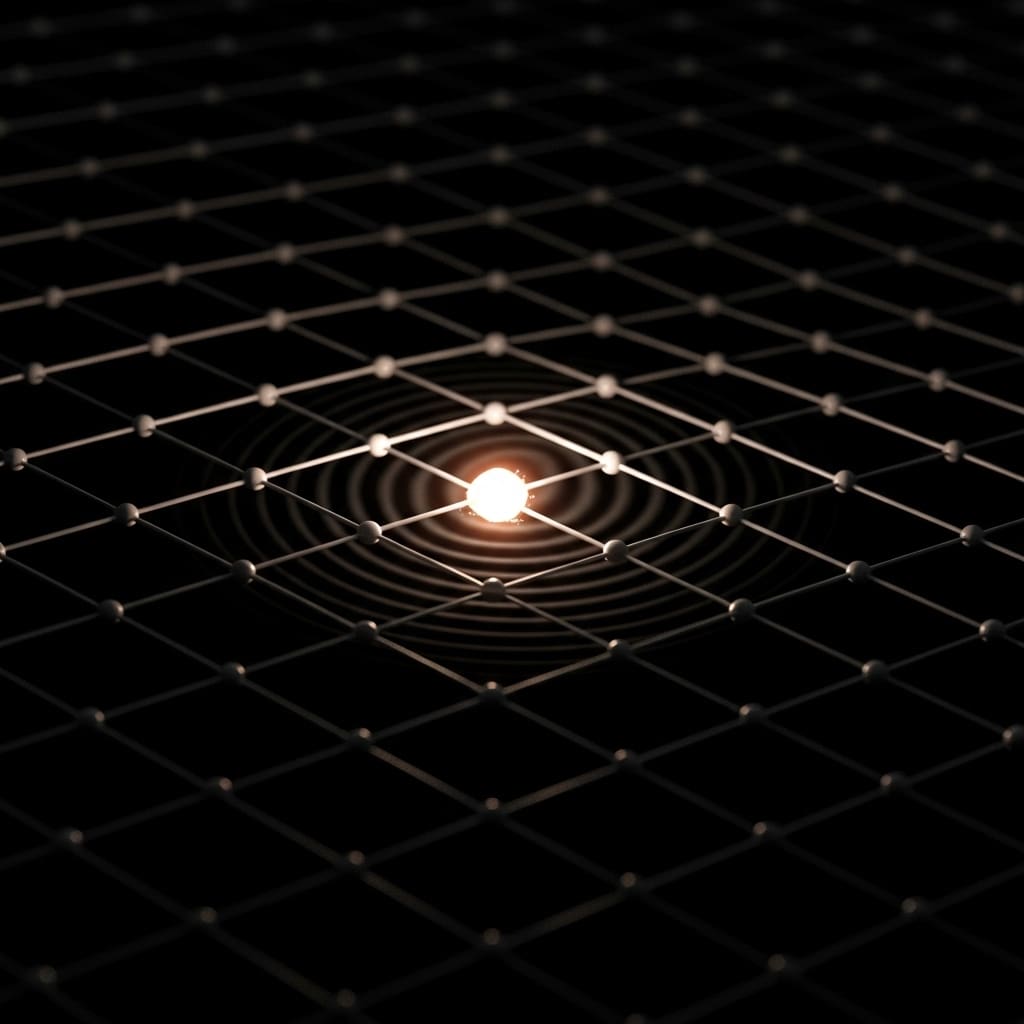
Researchers are increasingly focused on understanding magnetic flux noise, a critical limitation affecting the performance of sensitive quantum devices such as magnetometers and dark matter detectors. Keith G. Ray, Yaniv Rosen, Jonathan L Dubois, and Vincenzo Lordi, all from Lawrence Livermore National Laboratory, have developed a novel simulation that directly links materials-specific disorder to observed flux noise. Their work represents a significant advance by modelling a spin lattice of paramagnetic oxygen molecules on an aluminium oxide surface, a common source of flux noise, and calculating exchange couplings using density functional theory without relying on arbitrary parameters. This first-principles approach accurately reproduces experimental trends and, crucially, demonstrates the potential to mitigate flux noise through the application of an external electric field, offering a pathway towards improved quantum device stability and sensitivity.
Oxygen molecule spin lattices drive magnetic flux noise in superconducting circuits
Superconducting quantum devices, encompassing qubits, magnetometers, and even dark matter detectors, are critically limited by magnetic flux noise stemming from paramagnetic impurities and defects on material surfaces. Recent work presents a first-principles simulation of a spin lattice composed of paramagnetic oxygen molecules residing on an aluminium oxide surface, a prominent source of flux noise in superconducting qubits.
This research elucidates pathways to mitigate this detrimental noise, moving beyond conventional models that often rely on simplified, non-materials-specific disorder. Researchers have constructed a spin simulation without relying on pre-defined parameters or assumed disorder characteristics, instead capturing the inherent correlations within the defect landscape of real materials.
An ensemble of surface adsorbates with disordered orientations was simulated, and orientation-dependent exchange couplings were calculated using density functional theory. This approach yielded a range of exchange interactions between electron pairs, with the lowest values, 0.016 meV and -0.023 meV, falling within the range necessary to function as a two-level system and interact with GHz resonators.
Calculations of flux noise frequency, temperature dependence, and susceptibility-flux noise cross-correlation demonstrate strong agreement with experimental observations. The study confirms that surfaces containing paramagnetic adsorbates, arranged with materials-specific disorder and interactions, accurately reproduce the observed properties of magnetic flux noise in superconducting circuits. Furthermore, the research reveals that applying an external electric field can effectively tune the strength of spin-spin interactions, offering a potential method to actively reduce magnetic flux noise and improve qubit coherence.
Computational modelling of oxygen adsorbate interactions and emergent magnetic behaviour
Density functional theory calculations and Monte Carlo simulations form the basis of this work, investigating magnetic flux noise originating from paramagnetic oxygen molecules adsorbed on an aluminium oxide surface. Initial calculations determined orientation-dependent exchange couplings within an ensemble of surface adsorbates, establishing a spin lattice without relying on free parameters or assumed disorder models.
The resulting spin simulation revealed exchange interactions ranging from 0.016 meV to -0.023 meV, values appropriate for two-level systems capable of coupling to gigahertz resonators. To characterise the system’s behaviour, the researchers calculated spin-spin correlation functions at various temperatures, observing algebraic decay indicative of a Berezinskii-Kosterlitz-Thouless phase below a transition temperature of 121 mK.
This transition temperature was extracted by fitting the correlation functions to a scaling law dependent on temperature and the exchange interaction energy, yielding a value of -0.0066 meV. Fourier transformation of the total spin trajectory yielded spectra exhibiting a 1/f 0.8-1.0 scaling above 6GHz and below 30MHz, consistent with experimental observations of magnetic flux noise.
A magnetic resonance at approximately 1.60GHz, corresponding to the effective exchange parameter, was also identified. Calculated flux noise magnitudes, for a typical SQUID loop geometry, reached 6.6 × 10 -9 φ 0 /√Hz for 100% oxygen coverage, aligning with previously reported experimental values.
Exchange interactions and magnetic anisotropy in disordered oxygen molecular layers
Calculated exchange interactions between electron pairs range from -2.7 meV to +4.1 meV, with the smallest absolute value being +0.016 meV and -0.023 meV. These values fall within the range required for a two-level system capable of coupling to GHz resonators. The research details a first-principles simulation of a spin lattice comprising paramagnetic oxygen molecules on an aluminium oxide surface, identifying potential pathways for mitigating magnetic flux noise.
Simulations were performed on a 20×20 periodic lattice, considering 100%, 75%, and 50% oxygen coverage with disordered orientations at 0.01 K. The disorder in oxygen molecule orientations introduces variability in magnetic exchange couplings due to differing overlaps of electron wavefunctions. A histogram of exchange couplings reveals both ferromagnetic and antiferromagnetic interactions, with ferromagnetic couplings being more prevalent.
The study establishes that the spin anisotropy, calculated at 0.037 meV multiplied by the absolute value of the dot product of the oxygen orientation and spin direction, favours spins aligning in the plane perpendicular to the oxygen bond axis. This configuration approximates an XY model, rather than a Heisenberg model without spin anisotropy.
Monte Carlo simulations, employing Metropolis and Wolff Cluster update steps, generated typical spin arrangements exhibiting ferromagnetic domains separated by domain walls corresponding to changes in oxygen orientation. Analysis of spin-spin correlation functions revealed algebraic decay characteristic of the Berezinskii-Kosterlitz-Thouless (BKT) phase.
Fitting these correlations to a scaling law of (|r − r′|/l)−η, where r and r′ are spin positions and l is the lattice spacing, yielded a transition temperature of 121 mK and an effective exchange energy of -0.0066 meV. This transition temperature was extracted from the data using a critical scaling parameter of 1/4.
The calculated effective exchange energy is smaller than both the minimum magnitude exchange energy of 0.016 meV and the average exchange energy of -0.03 meV, likely due to the inherent disorder in the exchange interactions. Furthermore, the work demonstrates that an external electric field can tune the spin-spin interaction strength and reduce magnetic flux noise.
Paramagnetic oxygen molecules explain magnetic flux noise origins via first-principles simulation
Scientists have demonstrated a first-principles simulation of paramagnetic oxygen molecules on an aluminium oxide surface to elucidate the origins of magnetic flux noise. This simulation accurately models the disordered arrangement of these molecules and calculates the resulting exchange interactions between them without relying on empirical parameters or assumed disorder models.
The calculated range of exchange interactions, including values suitable for acting as two-level systems, aligns with the characteristics needed to couple to gigahertz resonators. Calculations of flux noise frequency, temperature dependence, and susceptibility-flux noise cross-correlation show agreement with experimental observations.
This confirms that a surface with materials-specific disorder and interactions can effectively reproduce observed magnetic flux noise phenomena in superconducting circuits. Furthermore, the research indicates that applying an external electric field can modulate the strength of spin-spin interactions and potentially reduce magnetic flux noise.
The authors acknowledge that the simulation represents a specific material system and may not directly translate to all flux noise sources. Future research could explore the impact of different surface materials and defect configurations on flux noise characteristics. These findings establish a pathway for mitigating flux noise through materials engineering and external field control, which is crucial for improving the coherence and performance of sensitive quantum devices and detectors.
👉 More information
🗞 Field-Dependent Qubit Flux Noise Simulated from Materials-Specific Disordered Exchange Interactions Between Paramagnetic Adsorbates
🧠 ArXiv: https://arxiv.org/abs/2602.09471


