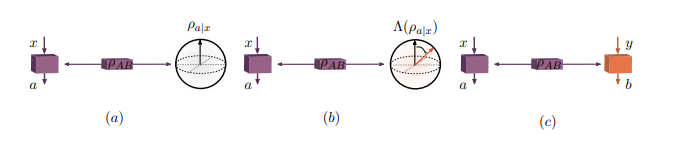
Quantum steering, a form of entanglement, promises secure communication and advanced quantum technologies, but verifying its presence in real-world devices remains a significant hurdle. Beata Zjawin from University of Gdańsk and colleagues now present a breakthrough in rigorously testing for quantum steering, even when experiments fall short of perfection. The team develops mathematical inequalities that allow scientists to confidently certify the presence of steering in quantum devices, achieving a level of analytical precision previously unattainable. This work surpasses existing numerical methods, offering the first analytical treatment of its kind and establishing a new application of operator inequalities beyond simply verifying quantum states, ultimately paving the way for more robust and reliable quantum communication systems.
Quantum Device Verification Without Assumptions
Scientists have developed a method for verifying that quantum devices are functioning correctly, without needing to make assumptions about their internal workings. This self-testing approach is crucial for building reliable quantum technologies, as the device itself provides evidence of its correctness. The research focuses on verifying that a device accurately implements a specific type of quantum state, known as a CHSH-type assemblage, which is fundamental to many quantum protocols. The method involves characterizing the device’s behavior and comparing it to a known, ideal CHSH-type assemblage. Scientists then derive mathematical inequalities to relate the device’s measurements to the ideal quantum state, establishing conditions that must be satisfied if the device is functioning correctly.
By solving these inequalities, the team obtains a lower bound on the device’s fidelity, guaranteeing a certain level of accuracy. This method provides a way to certify that a quantum device is functioning correctly, even in the presence of noise or imperfections. Verifying the correct implementation of fundamental building blocks like CHSH states is crucial for building reliable quantum computers, communication networks, and sensors.
Analytic Certification of Steering Assemblages Achieved
Scientists have pioneered a new approach to robustly certify quantum resources, specifically steering assemblages, under realistic experimental conditions. This work addresses a long-standing challenge in the field, as previous methods relied heavily on computationally intensive numerical techniques. The team successfully used operator inequalities to establish analytical lower bounds on the fidelity of steering assemblages, moving beyond purely numerical approaches. This analytical treatment represents a significant advancement in device-independent quantum certification. The study focused on the assemblage that maximally violates the Clauser-Horne-Shimony-Holt (CHSH) inequality, a crucial resource for cryptographic protocols.
Researchers rigorously proved the first analytical robust device-independent self-testing result for this assemblage, establishing a new benchmark for certification accuracy. The method centers on the concept of extractability, which quantifies how effectively a known reference resource can be recovered from an unknown one, extending this technique to assemblage self-testing. Scientists leveraged the power of operator inequalities to define a quantifiable measure of resource similarity, enabling them to establish rigorous bounds on certification fidelity. The approach mathematically demonstrates that if observed correlations closely match ideal quantum correlations, the underlying quantum resource must also be close to the reference assemblage being certified. This analytical framework provides tighter bounds than previously available numerical methods, offering a more precise and reliable means of verifying quantum resources.
Analytic Fidelity Bound for Quantum Steering Verified
Scientists have achieved a breakthrough in the field of quantum steering, developing the first analytical robust device-independent self-testing result for a specific quantum assemblage known as the CHSH-type assemblage. This assemblage, crucial for cryptographic tasks, was subjected to rigorous analysis using a novel application of operator inequalities. The work demonstrates that if observed correlations closely match ideal quantum behavior, the underlying quantum resource must also be similarly close to a reference assemblage. Experiments revealed that the team successfully derived an analytical lower bound on the fidelity between the unknown assemblage and the CHSH-type assemblage, directly linked to the degree of CHSH inequality violation observed.
This analytical approach significantly improves upon previous numerical bounds, representing a substantial advancement in the field. The method centers on the concept of extractability, quantifying how effectively a reference quantum resource can be extracted from an unknown one, and extends this framework to steering scenarios for the first time. Data shows that the team’s approach provides a quantifiable relationship between the observed CHSH violation and the fidelity of the underlying quantum assemblage. Specifically, the research establishes a direct link between the strength of observed quantum correlations and the certainty that the physical setup is indeed implementing the intended quantum resource. This advancement has implications for secure communication protocols and foundational studies of non-classicality.
Analytical Bounds for Quantum Steering Certification
Scientists have established new analytical bounds for certifying quantum resources under realistic experimental conditions, representing a significant advance in robust self-testing. Researchers developed operator inequalities that enable rigorous assessment of steering assemblages, a crucial step towards device-independent quantum technologies. Previous approaches relied heavily on numerical methods; this study delivers the first analytical treatment, offering substantial improvements over existing bounds and a deeper theoretical understanding of the process. The team’s method focuses on quantifying the similarity between unknown quantum devices and a reference resource, using observed correlations to extract information without making assumptions about the underlying quantum system. By focusing on steering scenarios, where one party is trusted and fully characterized, the researchers were able to develop a powerful technique for verifying the performance of uncharacterized devices. The researchers note that extending these analytical techniques to more complex situations remains an open challenge, representing a promising direction for future research.
🗞 Robust self-testing of quantum steering assemblages via operator inequalities
🧠 ArXiv: https://arxiv.org/abs/2509.15699