Fracture mechanics, the study of how cracks initiate and propagate in materials, often demands immense computational power, particularly when simulating crack opening. Ulysse Remond, Pierre-Emmanuel Emeriau from Quandela, Liam Lysaght from Quandela, and colleagues now present a new approach using quantum computing to tackle this challenge. Their variational quantum algorithm efficiently calculates critical properties like stress intensity factors by encoding structural displacements as quantum amplitudes and minimising elastic energy with a remarkably small number of measurements. The team demonstrates scalability through a novel remeshing technique, effectively navigating complex optimisation problems, and validates their method both on Quandela’s quantum processor Ascella and through extensive numerical simulations, paving the way for more efficient and accurate modelling of material failure.
Quantum Simulation of Crack Opening Problems
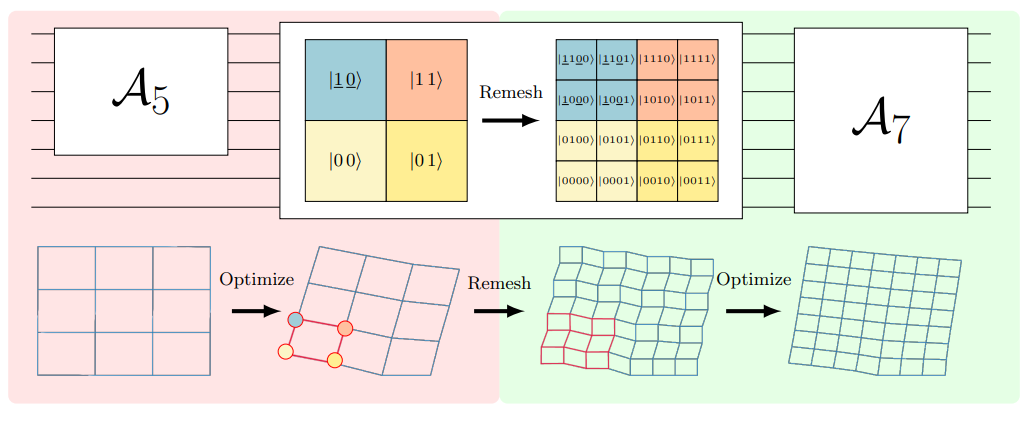
This work presents a novel variational quantum algorithm for simulating structural mechanical problems, specifically addressing crack opening scenarios that traditionally demand substantial computational resources. The team successfully implemented a parametrized quantum circuit capable of storing nodal displacements as quantum amplitudes and efficiently extracting critical observables like stress intensity factor. By minimizing elastic energy obtained from finite element methods with a polylogarithmic number of measurements, the algorithm achieves optimal nodal displacements and demonstrates a scalable approach to complex simulations. A key achievement lies in the development of a warm-start strategy based on a remeshing technique.
This method utilizes solutions from coarser meshes to circumvent barren plateaus, a common obstacle in quantum optimization, allowing for efficient optimization of increasingly refined problems. Experimental validation on Quandela’s Ascella quantum processor and comprehensive numerical simulations confirm the scalability of the approach, successfully simulating systems with up to 500,000 degrees of freedom. Results demonstrate that the remeshing technique significantly improves convergence, achieving 60% precision for stress intensity factor and 70% for crack opening displacement, while cold-start strategies failed to achieve comparable results beyond a certain level of complexity. The authors acknowledge that the cascading remeshing procedure, while effective, still requires substantial optimization time, even with the warm-start strategy. Future work will likely focus on further refining the remeshing process and exploring alternative optimization techniques to reduce computational demands and enhance the efficiency of the algorithm for even larger and more complex structural simulations.
Tensor Network Operator Decomposition for Efficiency
This research demonstrates a method to efficiently represent and calculate the matrix elements of an operator, crucial for large-scale simulations in areas like quantum chemistry and materials science. The team decomposes the operator into a sum of simpler terms that can be diagonalized using a series of controlled-NOT gates and single-qubit rotations, significantly reducing computational cost. The key lies in representing complex data as a network of interconnected tensors, allowing for efficient storage and manipulation. The authors carefully analysed how the number of independent terms required for the calculation scales with the system size, revealing a favourable scaling that makes the method practical for increasingly complex simulations. This decomposition involves breaking down the operator into terms with a specific structure, allowing for efficient diagonalization using the chosen quantum operations. The work has potential applications in condensed matter physics and the numerical solution of partial differential equations.
🗞 Quantum remeshing and efficient encoding for fracture mechanics
🧠 ArXiv: https://arxiv.org/abs/2510.14746