Quantum reinforcement learning promises to revolutionise complex decision-making, but its implementation demands substantial computational resources, particularly in terms of qubits. Thet Htar Su from Keio University, Shaswot Shresthamali from Kyushu University, and Masaaki Kondo, affiliated with both Keio University and RIKEN Center for Computational Science, address this challenge with a novel framework that dramatically reduces qubit requirements without sacrificing performance. Their work integrates a complete reinforcement learning process within a quantum system, utilising dynamic circuit operations to reuse qubits across multiple interactions and employing Grover’s algorithm to efficiently identify optimal strategies. This approach shrinks the necessary qubit count from a level impractical for many current systems to a manageable size, while simulations and experiments on real quantum hardware confirm its fidelity and feasibility, representing a significant step towards scalable quantum machine learning.
Qubit Reuse and Grover Optimisation for Learning
The team demonstrates that this combination allows the quantum agent to learn complex tasks using fewer computational resources and achieving faster convergence compared to traditional quantum reinforcement learning methods. This work represents a significant step towards implementing quantum reinforcement learning algorithms for real-world applications, particularly in situations where qubit resources are limited. A reinforcement learning framework integrates a quantum Markov decision process, dynamic circuit-based qubit reuse, and Grover’s algorithm for trajectory optimisation. The framework encodes states, actions, rewards, and transitions entirely within the quantum domain, enabling parallel exploration of state and action sequences through superposition. Dynamic circuit operations, including mid-circuit measurement and reset, allow the same physical qubits to be reused across multiple agent-environment interactions, reducing qubit requirements. Quantum arithmetic computes the returns for each trajectory.
Quantum Control, Algorithms and Hardware Foundations
This document provides a comprehensive overview of research related to Quantum Computing and Reinforcement Learning, covering core concepts, key themes, and potential applications. It explores the fundamentals of quantum computing, including algorithms like Shor’s and Grover’s, and discusses the hardware and architectures used to build quantum computers, such as superconducting qubits and quantum controllers. The document also examines the challenges of building and controlling quantum hardware and the importance of error correction. Furthermore, it provides a foundation in reinforcement learning, covering core concepts, algorithms, and applications in areas like robotics and game playing.
A strong emphasis is placed on near-term quantum computing, acknowledging the challenges and opportunities of building and programming quantum computers in the NISQ era. This includes techniques for mitigating errors, optimising circuit design, and developing algorithms that can run on limited-size quantum computers. The document highlights the importance of designing algorithms tailored to the specific characteristics of quantum hardware, considering qubit connectivity, gate fidelity, and coherence times. Significant attention is given to techniques for compiling high-level quantum algorithms into low-level quantum circuits, including qubit reuse, gate scheduling, and error mitigation. The document also emphasises the need for tools and techniques for verifying the correctness of quantum programs and debugging errors, and recognises that quantum computers will likely be used as accelerators for classical computers, requiring effective integration of these two types of computing. It references IBM Quantum, Pennylane, Qiskit, and various quantum hardware platforms, providing a valuable resource for researchers, educators, and developers working in these fields.
Quantum Reinforcement Learning with Dynamic Qubit Reuse
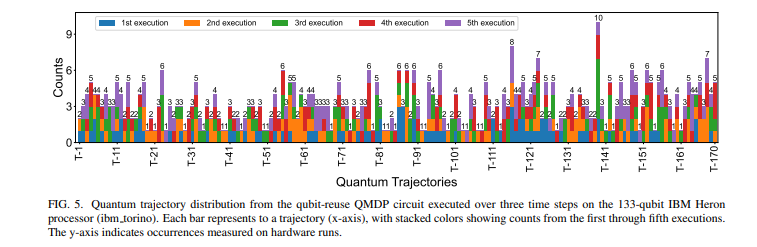
This research presents a fully quantum reinforcement learning framework that integrates dynamic circuit-based qubit reuse with a quantum Markov decision process and Grover’s search algorithm. The team successfully demonstrates multi-step agent-environment interactions within the limitations of current quantum hardware, achieving a 66 percent reduction in qubit usage compared to static designs while maintaining trajectory fidelity in both simulations and experiments on IBM Heron-class processors. By embedding Grover’s search, the framework unifies policy identification into a single quantum process, reliably amplifying the probability of measuring high-return trajectories. These findings establish a scalable foundation for quantum-native decision-making, demonstrating the feasibility of fully quantum reinforcement learning on near-term devices.
While acknowledging that hardware noise currently constrains performance, the team highlights the potential for future improvements through error-mitigation strategies tailored to dynamic-circuit architectures. Further research directions include scaling the framework to high-dimensional state-action spaces through more efficient gate decompositions and addressing limitations of the current Grover-based search in realistic, stochastic environments with approximate or adaptive oracle constructions and hybrid quantum-classical methods. As quantum hardware advances, these techniques are poised to enable increasingly sophisticated quantum reinforcement learning systems capable of tackling complex, large-scale environments.
👉 More information
🗞 Quantum Reinforcement Learning with Dynamic-Circuit Qubit Reuse and Grover-Based Trajectory Optimization
🧠 ArXiv: https://arxiv.org/abs/2509.16002