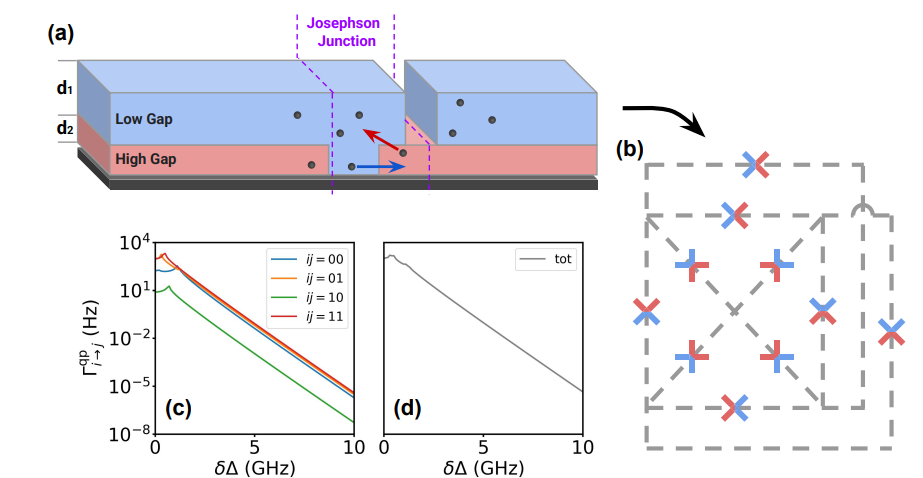
Superconducting quantum circuits represent a promising technology for building powerful quantum computers, and recent progress focuses on creating systems inherently resistant to errors. Yi Shi, Eran Ginossar from University of Surrey, Michael Stern from Technion-Israel Institute of Technology, and Marzena Szymanska from University College London, demonstrate a new approach to protecting quantum information by exploiting fundamental symmetries within a multi-qubit system. The team proposes a specific arrangement of interacting qubits, requiring at least four linked units, where the lowest energy states are naturally shielded from common sources of noise, including both energy loss and phase disruption. Simulations reveal that circuits built on this principle can maintain quantum coherence for several milliseconds, even with realistic levels of environmental disturbance, paving the way for more stable and reliable quantum computation in future devices.
Parity Symmetry Protects Superconducting Qubits
Superconducting circuits represent a leading platform for storing and manipulating quantum information. Researchers investigate symmetry-protected states of interacting qubits within these circuits, focusing on their potential for robust quantum computation. Experiments demonstrate the creation and characterisation of these symmetry-protected states, revealing their resilience to certain types of noise and decoherence. This work contributes to the development of more stable and reliable quantum computers by providing a pathway to encode quantum information in a manner that is inherently protected from environmental disturbances.
Protecting quantum information presents a significant challenge, and qubits incorporating intrinsic noise protection have recently seen considerable advancement. Researchers propose an interacting spin model requiring at least four spins with both nearest-neighbor and next-nearest-neighbor couplings. The two lowest eigenstates of this model form a symmetry-protected qubit manifold, demonstrating robustness against both relaxation and dephasing caused by local perturbations. The team maps this spin model to a superconducting circuit and demonstrates that such a circuit can achieve coherence times exceeding several milliseconds, even in the presence of noise.
Superconducting Qubit Performance and Scalability Improvements
Recent research focuses on improving the performance and scalability of superconducting qubits for quantum computing. Investigations explore different qubit types, including flux, transmon, and 0-π qubits, with a focus on minimizing decoherence and extending coherence times. A significant emphasis is placed on selecting materials with low dielectric loss, such as sapphire and titanium nitride, to reduce energy dissipation. Researchers are also developing strategies to mitigate errors caused by quasiparticles, charge noise, and environmental radiation. The team explores advanced control techniques, like Stimulated Raman Adiabatic Passage (STIRAP), to precisely manipulate qubit states and implement quantum gates.
Optimal control algorithms are employed to design pulse sequences that maximize gate fidelity. Furthermore, the research addresses the need for quantum error correction, investigating codes and methods to reduce leakage from qubit states. The research also considers scalability, exploring architectures that allow for all-to-all connectivity between qubits and investigating techniques for coupling multiple qubits together. Key takeaways highlight the critical role of materials science, the necessity of error mitigation, and the importance of advanced simulation for building practical quantum computers. Future research will likely focus on developing new materials, improving qubit designs, and exploring more efficient error correction codes.
Protected Qubit Design Tolerates Significant Disorder
This research demonstrates a practical blueprint for an intrinsically protected qubit, constructed from the lowest two energy states of a simple, four-spin interacting model. The team successfully mapped this spin model to a superconducting circuit, achieving coherence times exceeding several milliseconds even with realistic environmental noise. Remarkably, the symmetry protection inherent in this design tolerates up to fifteen percent disorder among the couplings, offering a significant advantage over traditional quantum error correction protocols. This work establishes a resource-efficient strategy for building quantum computers and provides a foundational building block for intrinsically noise-protected quantum hardware. The simplicity of the design suggests it is adaptable to a variety of physical platforms beyond superconducting circuits. While acknowledging that high-fidelity single- and two-qubit gates within this framework require further development, the researchers propose a controlling scheme utilizing STIRAP pulses as a promising next step.
🗞 Symmetry-protected states of interacting qubits in superconducting quantum circuits
🧠 ArXiv: https://arxiv.org/abs/2510.14121