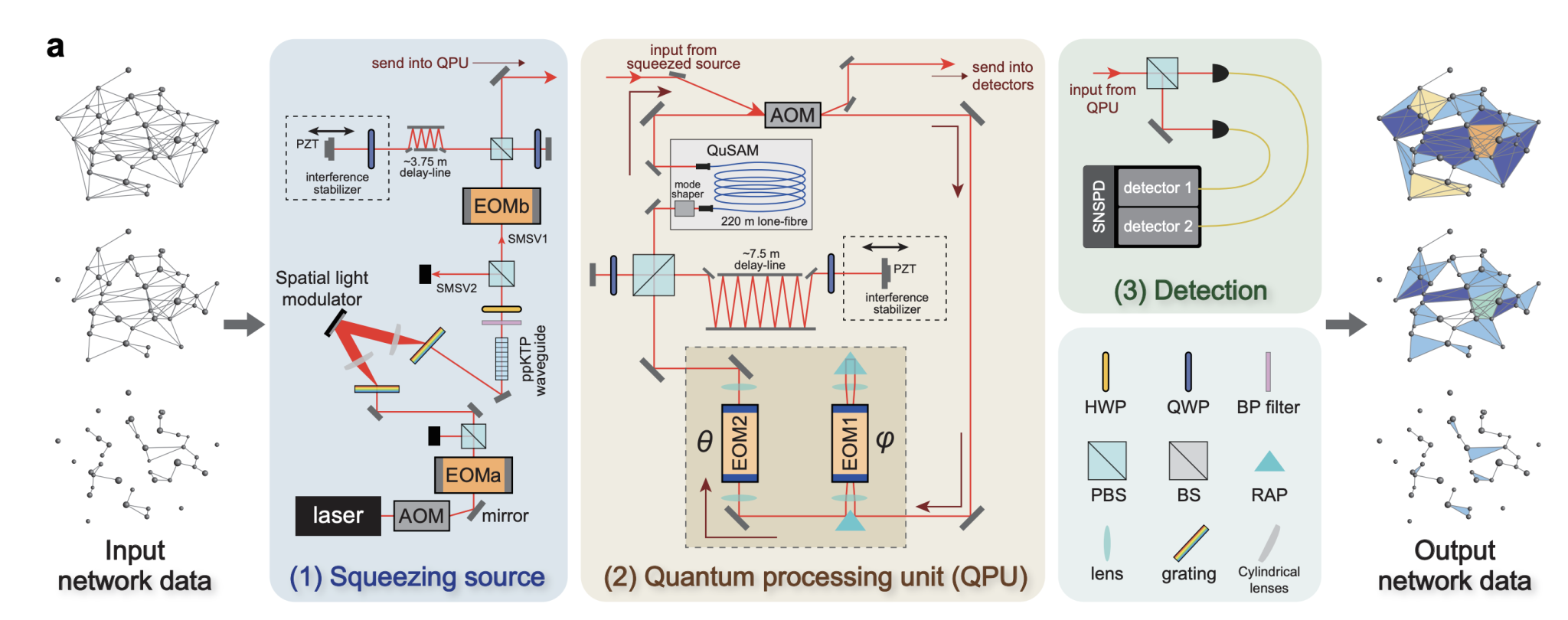
The intricate architecture of networks governs behaviour in diverse systems, from the human brain to materials science. However, pinpointing the higher-order structures within these networks – the complex connections beyond simple links – presents a formidable challenge. Now, Shang Yu, Jinzhao Sun, and colleagues, spanning institutions including Imperial College London and Queen Mary University of London, demonstrate a novel quantum processor capable of directly revealing these hidden topological features. Their programmable device encodes complex networks and utilises a quantum sampling technique to identify densely connected groups – known as cliques – and measure key network properties. This breakthrough offers a powerful new method for analysing complex systems, potentially revolutionising our understanding of network behaviour and opening doors to quantum-enhanced data analysis across multiple scientific disciplines.
Researchers have developed a new quantum processor capable of uncovering the hidden topological features within complex networks, offering a powerful tool for analysing systems ranging from the human brain to social interactions. Traditional methods struggle with the computational demands of identifying interconnected groups – known as cliques – crucial for understanding a network’s overall organisation. This new approach leverages the principles of quantum mechanics, utilising a technique called Gaussian boson sampling (GBS) to encode a network’s connections and strengths into the behaviour of photons within a reconfigurable quantum circuit.
The processor, named Babbage, employs a unique architecture combining temporal and polarization encoding to represent network data, generated by a tunable squeezed-light source and manipulated by reconfigurable optical elements. By analysing how these photons interact, the processor prioritises and identifies dense, highly-connected subgraphs – the very cliques that define a network’s topology. This allows researchers to not only identify cliques but also to estimate key topological characteristics called Betti numbers, which describe the number of connected components and ‘holes’ within a network.
Crucially, the processor can track changes in these Betti numbers, revealing topological phase transitions – points where the network’s overall structure fundamentally changes. The researchers demonstrated this capability by identifying clique percolation phenomena – the emergence of large-scale, interconnected clusters within a network – by analysing the entropy of the quantum sampling results. This sensitivity to subtle changes in network structure is a key strength of the quantum approach.
The findings reveal that the entropy of the quantum sampling results can reliably detect topological damage and identify these critical transitions, closely tracking established metrics derived from clique information. This is particularly valuable as analysing complex networks is a computationally demanding task with broad applications in fields like neuroscience and high-energy physics. While particularly effective in networks with uneven weight distributions, where the GBS bias towards high-weight connections significantly improves efficiency, the researchers suggest the approach is readily adaptable to a wider range of complex-weighted networks.
👉 More information
🗞 Topological network analysis using a programmable photonic quantum processor
🧠 DOI: https://doi.org/10.48550/arXiv.2507.08157