

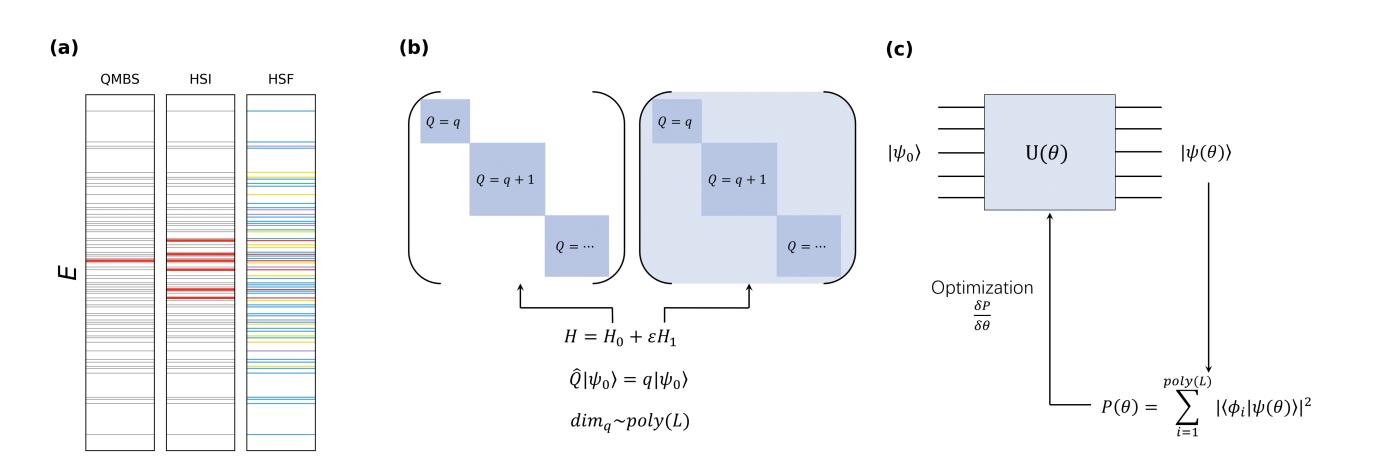
Research identifies Hilbert subspace imprint (HSI), a mechanism preventing thermalisation in quantum systems, alongside quantum many-body scars (QMBS) and Hilbert space fragmentation (HSF). HSI arises when initial states align with a limited set of energy eigenstates, demonstrated through symmetry breaking and engineered initial states, revealing a fundamental pathway to non-thermal behaviour.
The tendency of isolated quantum systems to evolve towards thermal equilibrium, a process known as thermalisation, is a cornerstone of statistical mechanics. However, recent theoretical work suggests that certain conditions can circumvent this expectation, leading to persistent non-equilibrium behaviour. Researchers are actively investigating mechanisms that enable this evasion, including quantum many-body scars (QMBS) and Hilbert space fragmentation (HSF). Now, Hui Yu, Jiangping Hu, and Shi-Xin Zhang, all affiliated with the Beijing National Laboratory for Condensed Matter Physics and the Institute of Physics, Chinese Academy of Sciences, present a novel mechanism termed ‘Hilbert subspace imprint’ (HSI), which they detail in their article, ‘Hilbert subspace imprint: a new mechanism for non-thermalization’. Their findings demonstrate that when initial quantum states strongly overlap with a limited subset of the system’s energy eigenstates, thermalisation is suppressed, offering a further pathway to understanding persistent non-equilibrium dynamics.
Quantum systems frequently deviate from the expected behaviour of thermalisation, exhibiting non-thermal dynamics that challenge conventional statistical mechanics. Recent investigations identify Hilbert subspace imprint (HSI) as a fundamental mechanism contributing to these deviations, positioning it alongside quantum many-body scars (QMBS) and Hilbert space fragmentation (HSF) as key influences on system evolution. This research demonstrates that non-thermalisation arises when initial quantum states exhibit strong overlap with a polynomially-scaled subset of the system’s eigenstates, effectively restricting the dynamics to a limited portion of the Hilbert space – the complete set of all possible quantum states – and preventing exploration of the full state space. This contrasts with ergodic systems, where states traverse the entire Hilbert space, inevitably leading to thermalisation and the loss of quantum coherence, a crucial property for quantum computation.
The study reveals two distinct pathways through which
The study reveals two distinct pathways through which HSI manifests, suggesting its robustness and versatility. Researchers observe that weak symmetry breaking, specifically a subtle perturbation of U(1) symmetry – a continuous symmetry related to phase transformations – induces non-thermal behaviour in ferromagnetic states, while simultaneously allowing antiferromagnetic states to thermalise. Conversely, the Z2-symmetric model, possessing a discrete symmetry, exhibits thermalisation for both ferromagnetic and antiferromagnetic states, demonstrating that the specific symmetry structure significantly influences the system’s evolution and dictates the emergence of non-thermal behaviour.
To directly control initial conditions, researchers engineer states using shallow quantum circuits, deliberately enhancing their overlap with the targeted, restricted Hilbert subspace. This approach confirms that a strong initial overlap with this small subspace is sufficient to induce non-thermal behaviour, establishing a clear causal link between the initial state and the observed dynamics.
Crucially, this research connects HSI to established concepts in non-equilibrium physics, positioning it within a broader framework of understanding. QMBS represent specific eigenstates that resist thermalisation, while HSF describes a situation where the Hilbert space breaks down into disconnected, non-interacting subspaces. By identifying HSI as a mechanism alongside these, the study contributes to a more complete understanding of the diverse pathways that can lead to deviations from thermal equilibrium.
The authors demonstrate that the difference between thermal and non-thermal expectation values of observables – measurable physical quantities – is proportional to the difference between the non-thermal and thermal expectation values, providing a quantifiable measure of non-thermal behaviour. This finding allows researchers to objectively assess the degree of non-thermalisation and compare the effectiveness of different mechanisms in suppressing thermalisation.
Future work will likely focus on extending this understanding to more complex systems and exploring the interplay between HSI, QMBS, and HSF. Investigating the limitations of the small leakage approximation, a simplification used in the calculations, will be essential for accurately modelling the dynamics of more complex systems. Researchers also plan to investigate the influence of stronger perturbations on the system’s dynamics, exploring the robustness of HSI in the face of external noise and interactions.
Furthermore, exploring the potential for utilizing HSI inquantum
Furthermore, exploring the potential for utilizing HSI in quantum technologies, such as protecting quantum information from decoherence – the loss of quantum coherence – represents a promising avenue for future research. Decoherence is a major obstacle to building practical quantum computers and other quantum devices.
This research establishes HSI as a fundamental mechanism driving non-thermal behaviour in quantum systems, joining the ranks of QMBS and HSF as key players in this complex landscape. By demonstrating the robustness of HSI and its potential applications in quantum technologies, this work opens up new avenues for research and development in the field of quantum information science. The continued exploration of HSI and its interplay with other non-thermal mechanisms promises to yield further insights into the fascinating world of quantum dynamics and pave the way for the development of novel quantum technologies.
🗞 Hilbert subspace imprint: a new mechanism for non-thermalization
🧠 DOI: https://doi.org/10.48550/arXiv.2506.11922


