

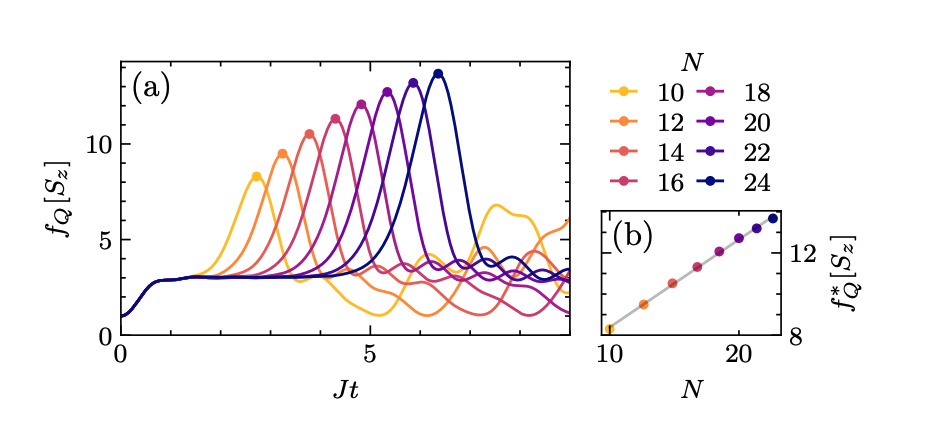
The behaviour of quantum systems following a sudden change in their environment, known as a quantum quench, reveals fascinating insights into non-equilibrium dynamics and the emergence of novel phases of matter. These transitions, distinct from those observed in systems at equilibrium, are characterised by collective behaviour arising from the intricate interplay of quantum correlations. Researchers at the Technische Universität Berlin, Jie Chen, Ricardo Costa de Almeida, and Hendrik Weimer, detail such a transition in their recent work, titled ‘Dynamical quantum phase transition with divergent multipartite entanglement’. Their investigation focuses on the one-dimensional transverse-field Ising model, a fundamental model in condensed matter physics, and demonstrates a dynamical phase transition characterised by a dramatic increase in the entanglement between multiple particles at specific moments in time following the quench. This divergence in multipartite entanglement, quantified using the Fisher information, signifies a qualitative change in the system’s behaviour and distinguishes this transition from conventional, equilibrium-based phase transitions.
Quantum systems exhibit complex behaviour when subjected to abrupt environmental changes, a process termed a quantum quench. These transitions, unlike those occurring in systems at equilibrium, reveal collective behaviours stemming from the intricate relationships between quantum states. Current research focuses on understanding the fundamental principles governing the evolution of these systems far from equilibrium, with potential implications for future technologies.
Jie Li, Christoph Kloss, and Wojciech H. Zurek, researchers at the Institute for Scientific Computing at Heidelberg University, Germany, recently published findings detailing a novel type of dynamical phase transition. This transition is characterised by a divergence in multipartite entanglement, a quantum correlation between multiple particles. They quantify this entanglement using Fisher information, a metric that assesses a system’s sensitivity to changes in its parameters, and demonstrate that the observed dynamical phase transition belongs to a distinct universality class compared to traditional phase transitions occurring in ground states. A universality class defines a set of systems exhibiting similar critical behaviour, regardless of their microscopic details.
Researchers employ spectral analysis to confirm that this dynamical phase transition represents a genuine non-equilibrium phenomenon. This arises from the constructive interference of excited states during the system’s evolution. Excited states are higher energy levels a quantum system can occupy. This interference pattern governs the system’s behaviour and drives the observed phase transition in the post-quench dynamics, highlighting the importance of considering the complete dynamical process, not just the final state.
The article also explores potential experimental realisations of
The article also explores potential experimental realisations of these dynamical phase transitions using Rydberg platforms. These platforms utilise atoms excited to very high energy levels, known as Rydberg states, allowing for precise control over atomic interactions. This control enables the simulation of the transverse-field Ising model, a theoretical model used to study magnetism and phase transitions, and facilitates the observation of the dynamical phase transition in a controlled laboratory environment. The researchers also suggest potential applications in metrology, the science of measurement, where the enhanced sensitivity offered by these transitions could lead to more precise measurements.
🗞 Dynamical quantum phase transition with divergent multipartite entanglement
🧠 DOI: https://doi.org/10.48550/arXiv.2506.13898


