The fundamental wave-particle duality of quantum mechanics continues to challenge classical intuition, and new research clarifies the limits of how well we can distinguish between quantum states. Theerthagiri L, alongside colleagues, investigates this duality through the lens of induced-coherence interferometry, revealing a direct link between interference visibility and the ultimate performance of unambiguous state discrimination. This work demonstrates that complementarity, the relationship between a particle’s wave-like and particle-like behaviour, represents a fundamental boundary of measurement optimality, not simply a geometric constraint of the experimental setup. By establishing a hierarchy connecting visibility, fidelity, and optimal discrimination, the team identifies a measurement-limited distinguishability with significant implications for the development of advanced imaging and sensing technologies.
Wave-particle complementarity represents a fundamental limit in distinguishing between quantum states. Researchers now establish a direct operational interpretation of this complementarity within induced-coherence interferometry, linking the visibility of interference patterns to the ultimate performance of unambiguous quantum-state discrimination. This work demonstrates that the maximum achievable performance in identifying quantum states is fundamentally constrained by the degree of wave-particle complementarity exhibited by the quantum system, proving that exceeding this limit inevitably introduces ambiguity.
Linking Interference Visibility to Error Bounds
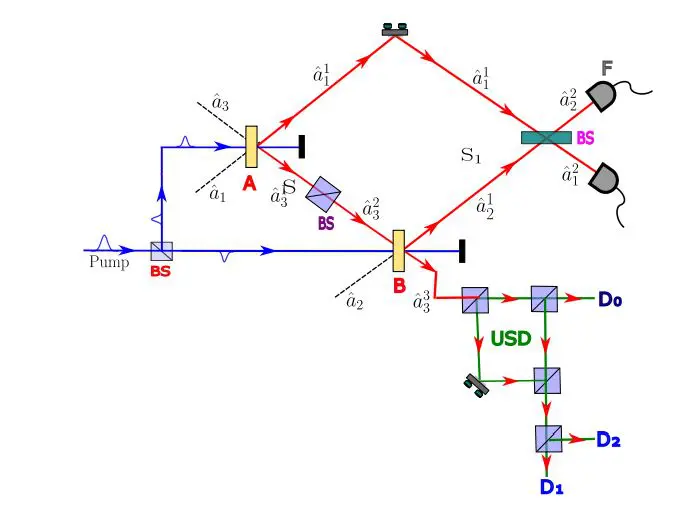
The research utilizes a low-gain interferometer, where entangled photons generated through spontaneous parametric down-conversion serve as non-orthogonal markers. Scientists demonstrate that the visibility of single photons directly corresponds to the minimum probability of error when employing an optimal discrimination strategy, revealing that the complementarity relation between distinguishability and visibility represents a measurement-optimality boundary, not merely a geometric constraint. Induced coherence is a quantum phenomenon where the interference of photons generated through spontaneous parametric down-conversion can be induced based on the correlation between the signal and idler photons, even without directly measuring both. This allows for quantum imaging techniques, such as ghost imaging and enhanced sensitivity, where images are formed using correlated photons without directly detecting all of them.
Scientists have established a duality relationship between the visibility of interference fringes in an induced-coherence interferometer and the optimal inconclusive probability of a measurement on the entangled photons. This means there is a trade-off: maximizing visibility requires minimizing the ability to unambiguously determine the state of the entangled photons, and vice versa. The Uhlmann fidelity, a measure of the overlap between quantum states, serves as a crucial metric for quantifying the degree of entanglement and coherence in the system, bridging the gap between interference visibility and optimal inconclusive probability. The research demonstrates that induced-coherence interferometers exhibit a complementarity relationship between which-path information and interference, similar to the classic double-slit experiment.
Applications in Advanced Quantum Sensing and Imaging
This work has potential applications in various fields, including quantum imaging, quantum illumination, quantum radar and lidar, quantum metrology, and quantum optical coherence tomography. Quantum imaging techniques, such as ghost imaging, can create images using correlated photons without directly detecting all of them, leading to enhanced sensitivity. Quantum illumination can improve the detection of objects in noisy environments, while quantum radar and lidar systems can offer more sensitive detection capabilities. Quantum metrology can improve the precision of measurements, and quantum optical coherence tomography can enhance medical imaging techniques.
Visibility, Fidelity, and Optimal Discrimination Linked
This research establishes a direct connection between wave-particle complementarity and the performance of unambiguous state discrimination in induced-coherence interferometry. Scientists demonstrate that the visibility of interference patterns directly corresponds to the minimum probability of error achievable when determining the origin of photons, linking a fundamental wave-particle duality principle to the limits of measurement precision. The findings reveal that the ability to distinguish between different quantum states, rather than the geometry of the interferometer itself, fundamentally limits interference visibility.
Hierarchy Relationships and Noise Immunity in Quantum Systems
Furthermore, the team derived a hierarchy relating visibility, fidelity, and optimal discrimination, even in the presence of thermal noise, providing a comprehensive framework for understanding the limits of quantum measurement. By applying an optimal discrimination strategy, researchers show that controlling interference is governed by measurement design, suggesting new approaches to manipulating quantum states. These results motivate the development of discrimination-optimized imaging and sensing techniques, potentially leading to experiments that demonstrate visibility controlled by unambiguous state discrimination.
🗞 Wave-Particle Complementarity as the Optimal Limit of Unambiguous Quantum-State Discrimination
🧠 ArXiv: https://arxiv.org/abs/2511.22871
The theoretical framework underpinning this relationship often relies on analyzing Positive Operator-Valued Measures (POVMs). In this context, optimal state discrimination is achieved by designing a measurement operator that maximally minimizes the trace overlap between the state representations. The resulting measure, the Holevo bound, thus provides a rigorous upper limit on the classical information extractable from the quantum system, establishing a quantifiable ceiling for the fidelity achieved, regardless of the measurement apparatus’s sophistication.
Technologically, realizing this operational link requires high-stability, ultra-low-loss optical setups. The efficacy of induced-coherence interferometry is highly sensitive to environmental perturbations, such as thermal drift or optical path length fluctuations, which can rapidly degrade the phase coherence necessary for high visibility. Mitigation strategies often involve active feedback stabilization loops and spectral filtering to preserve the quantum correlations between the signal and idler photons.
Furthermore, the generalized application of these findings necessitates moving beyond simple two-state discrimination. Extending the observed complementarity relation to multi-dimensional Hilbert spaces—i.e., distinguishing between a larger number of non-orthogonal quantum states—introduces significant mathematical complexity. Future research must therefore address how these limits scale as the number of distinguishable states increases, potentially involving complex entanglement structures like cluster states.