A systematic literature review of 77 primary studies reveals an increasing application of quantum and quantum-inspired algorithms to software engineering optimisation problems, particularly in areas such as operations and testing. Research concentrates on these areas; however, gaps exist across broader software engineering activities, with relevant work appearing outside traditional venues.
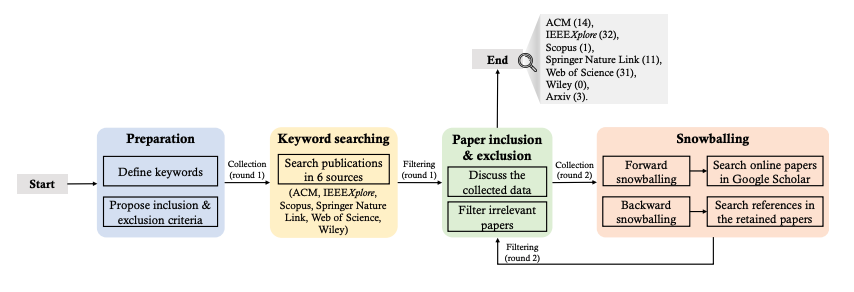
The escalating complexity of contemporary software development necessitates novel approaches to optimisation, a challenge increasingly addressed by the principles of quantum computing. Researchers are now systematically investigating the potential of quantum algorithms to enhance established techniques in software engineering, particularly in areas such as testing and operational efficiency. A comprehensive survey, published recently, examines the current state of this interdisciplinary field, synthesising findings from 77 primary studies identified through a rigorous analysis of over 2000 publications. This work, titled ‘Quantum Optimisation for Software Engineering: A Survey’, is authored by Man Zhang, Yuechen Li, Tao Yue, and Kai-Yuan Cai, all affiliated with Beihang University, and provides a valuable overview of research efforts aimed at applying quantum-inspired methods to classical software engineering problems.
Quantum and bio-inspired algorithms increasingly address complex challenges within software engineering, driving innovation and efficiency improvements. A systematic literature review, examining 77 primary studies selected from over 2000 publications, assesses their application to classical software engineering optimisation problems and reveals emerging trends. This empowers the search-based software engineering (SBSE) community, a field utilising metaheuristic optimisation techniques for software development, to leverage these advancements and address next-generation challenges.
Recent advances present opportunities to improve efficiency and effectiveness across various software engineering tasks. Researchers actively investigate quantum annealing (QA), a metaheuristic for finding the global minimum of a given objective function by exploiting quantum fluctuations, and bio-inspired techniques, including genetic algorithms (GA), which mimic the process of natural selection, and particle swarm optimisation (PSO), which simulates the social behaviour of bird flocking or fish schooling. Studies demonstrate concentrated effort in areas such as software engineering operations and software testing, revealing a pragmatic focus on established algorithms within each field.
The research reveals a trend towards hybrid approaches that combine the strengths of both quantum and bio-inspired algorithms. This integration aims to leverage the unique capabilities of each technique, potentially yielding superior results compared to single-algorithm implementations. Researchers apply these algorithms to problems ranging from scheduling and join order optimisation, crucial for database performance, to test case prioritisation and failure prediction, enhancing software reliability.
Notably, the systematic search reveals relevant publications originating outside traditional software engineering venues, emphasising the interdisciplinary nature of this research area and highlighting the importance of collaboration across disciplines. This suggests that valuable insights are emerging from fields not conventionally associated with software development.
While the review provides a broad overview of the research landscape, it also exposes gaps in certain areas of software engineering, indicating a need for further investigation and exploration. Further research needs to explore the application of these algorithms to a wider range of activities, such as requirements engineering, the process of defining and documenting software needs, and software design, the process of creating a blueprint for software implementation, and address the limitations of current approaches.
Research concentrates on optimisation problems, including join order optimisation, scheduling, and resource allocation, which naturally align with the capabilities of both quantum and bio-inspired algorithms. Software testing also receives significant attention, with studies exploring applications in test case selection, prioritisation, and minimisation, all contributing to improved software quality. The review also identifies emerging research in software security, specifically in attack identification and management, suggesting a broadening scope of application.
Addressing these gaps will require interdisciplinary collaboration and a concerted effort to translate theoretical advancements into practical solutions. Future work should prioritise the development of standardised performance metrics and datasets to facilitate more direct comparisons between different algorithms and approaches. A more rigorous evaluation of scalability, the ability of an algorithm to handle increasing problem sizes, and hardware requirements is also crucial, particularly as quantum computing technology matures. Expanding the search beyond traditional software engineering venues is essential to capture relevant research published in fields such as computer science, physics, and operations research.
The review highlights the importance of ongoing research into hybrid algorithms that effectively integrate the strengths of both quantum and bio-inspired techniques. Exploring novel quantum algorithms and bio-inspired methods explicitly tailored to software engineering problems will also be critical. Ultimately, the goal is to develop innovative solutions that address the growing complexity of modern software systems and their development processes.
👉 More information
🗞 Quantum Optimization for Software Engineering: A Survey
🧠 DOI: https://doi.org/10.48550/arXiv.2506.16878