

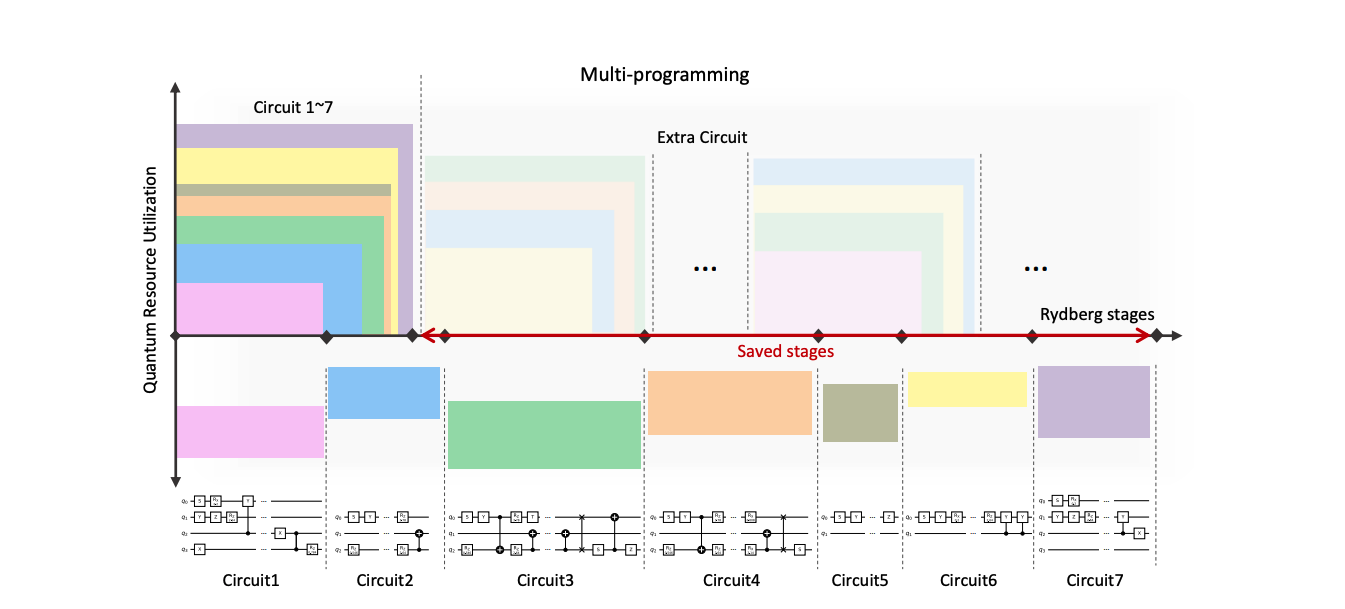
The development of quantum computing necessitates a shift from executing individual circuits to managing concurrent programmes, a functionality central to conventional operating systems. Achieving this requires overcoming significant hurdles in resource allocation and scheduling on quantum hardware. Wenjie Sun, Xiaoyu Li, and colleagues, from the University of Electronic Science and Technology of China, address these challenges in their work, entitled ‘DYNAMO: Dynamic Neutral Atom Multi-programming Optimizer Towards Quantum Operating Systems’. Their research introduces a method for realising multi-programming on neutral atom quantum processing units (QPUs), demonstrating substantial improvements in compilation speed and resource utilisation, and establishing a key step towards practical quantum operating systems. The team’s approach focuses on parallel compilation and intelligent resource allocation, enabling efficient sharing of quantum resources while maintaining the integrity of complex circuits.
Quantum computing promises substantial acceleration for specific computational problems across fields including cryptography, optimisation, and materials science. Realising this potential requires both robust quantum processing units (QPUs) and the software infrastructure to exploit their capabilities fully. As quantum hardware matures, systems capable of managing and scheduling multiple QPUs become increasingly necessary, mirroring the evolution of classical computing and demanding innovative approaches to resource allocation.
The concept of multi-programming, enabling the concurrent execution of multiple quantum programs, is central to maximising hardware utilisation and overall computational throughput. Current compilation techniques largely focus on single quantum circuits, presenting a significant bottleneck. Researchers now present DYNAMO, a Dynamic Neutral Atom Multi-programming Optimizer, which addresses this limitation by facilitating multi-programming on neutral atom quantum computers through parallel compilation and intelligent resource allocation across multiple QPUs.
A core challenge lies in partitioning the quantum chip’s resources – the physical qubits and their connectivity – amongst competing programs. DYNAMO employs a resource allocation strategy that considers both spatial and temporal sharing, allowing different programs to utilise the same physical qubits at different times, or concurrently if their operations do not conflict. This is achieved through analysis of circuit dependencies and a scheduling algorithm that minimises qubit contention and rigorously maintains circuit correctness. The method tackles scheduling conflicts that arise when multiple programs attempt to access the same resources simultaneously, prioritising critical operations and intelligently rearranging the execution order.
The effectiveness of DYNAMO stems from its ability
The effectiveness of DYNAMO stems from its ability to optimise compilation at multiple levels, leveraging techniques such as gate absorption, where multiple quantum gates are combined into a single operation, to reduce overall circuit complexity. Furthermore, the method incorporates hardware-aware compilation, taking into account the specific characteristics of the neutral atom architecture, such as qubit connectivity and gate fidelity, allowing it to generate compilation schedules tailored to the hardware.
Experimental evaluations demonstrate a substantial improvement in compilation speed, with up to a 14.39x acceleration observed across a range of circuits, from relatively small 12-gate examples to more complex circuits exceeding 1200 gates. Importantly, DYNAMO also reduces the number of execution stages required to run a quantum program by an average of 50.47%, indicating a significant improvement in resource utilisation. The method successfully distributes workloads across multiple QPUs, achieving balanced resource allocation and preventing bottlenecks.
Neutral atom quantum computing utilises neutral atoms, typically trapped using lasers, as qubits, offering a promising architecture but demanding specialised compilation strategies. Qubit connectivity, where not all qubits can directly interact, and error rates, inherent in physical qubits, represent key hardware limitations that DYNAMO actively mitigates.
The successful demonstration of multi-programming capabilities represents a critical step towards realising practical quantum operating systems. DYNAMO’s approach moves beyond single-circuit compilation to unlock the benefits of concurrent quantum computation, which is particularly important as quantum computers grow in size and complexity.
Future work will focus on extending DYNAMO to handle a wider range of quantum algorithms and hardware architectures. Investigating more sophisticated resource allocation strategies, including dynamic resource provisioning and prioritisation, will further enhance performance. Exploring the integration of DYNAMO with existing quantum programming frameworks and compilers will facilitate its adoption by the wider quantum computing community. Furthermore, research into fault tolerance and error mitigation within a multi-programmed environment is crucial for ensuring the reliability of quantum computations.
Expanding the scope to include heterogeneous QPU architectures,
Expanding the scope to include heterogeneous QPU architectures, where different QPUs possess varying capabilities and connectivity, presents another avenue for future research. Developing algorithms that can intelligently map tasks to the most suitable QPU will maximise overall system performance. Finally, investigating the potential of DYNAMO to support real-time quantum applications, such as quantum sensing and control, will unlock new possibilities for practical quantum technologies.
🗞 DYNAMO: Dynamic Neutral Atom Multi-programming Optimizer Towards Quantum Operating Systems
🧠 DOI: https://doi.org/10.48550/arXiv.2507.04874


