

Precision measurement stands to gain a powerful new tool from the emerging field of non-Hermitian physics, and a team led by Xinglei Yu, Xinzhi Zhao from Ningbo University, and Liangsheng Li now demonstrates a pathway towards unprecedented accuracy. The researchers investigate parameter estimation in quantum systems that operate beyond the usual constraints of Hermitian physics, with a specific focus on achieving what is known as Heisenberg scaling, a benchmark for optimal precision. They develop a new mathematical framework for calculating estimation precision in these systems, revealing that non-Hermitian systems possess the remarkable ability to reach this Heisenberg limit, where precision improves proportionally to measurement time. Through both theoretical analysis and experimental validation using carefully constructed non-unitary evolutions, the team confirms the realisation of Heisenberg scaling in estimation, representing a significant advance in the pursuit of ultra-precise measurements.
Quantum Precision Beyond Classical Limits
This collection of research focuses on quantum metrology and non-Hermitian physics, exploring how quantum mechanics can enhance measurement precision beyond what is possible with classical techniques. A central goal is to overcome the Standard Quantum Limit and potentially reach the Heisenberg Limit, where precision improves as the number of resources increases. Researchers are utilizing concepts from quantum information theory, such as entanglement and Fisher information, alongside tools from differential geometry to analyze and optimize quantum measurements. Investigations center on utilizing entanglement and squeezed states to surpass the Standard Quantum Limit, striving towards the ultimate goal of the Heisenberg Limit.
Adaptive measurement strategies are also being developed to optimize precision, alongside explorations of how exceptional points in non-Hermitian systems can enhance sensitivity. This research demonstrates that geometric properties, particularly those described by information geometry, can be leveraged to analyze and optimize measurements in these complex systems. Researchers are also investigating the use of weak values and post-selection techniques to enhance measurement sensitivity, alongside exploring generalized uncertainty relations to achieve tighter bounds on measurement precision. Quantum error correction and control techniques are being employed to protect quantum states from noise and further improve measurement outcomes. This comprehensive approach suggests a promising future for quantum metrology, with the potential to revolutionize fields requiring highly precise measurements.
Non-Hermitian Systems Enable Heisenberg Scaling Precision
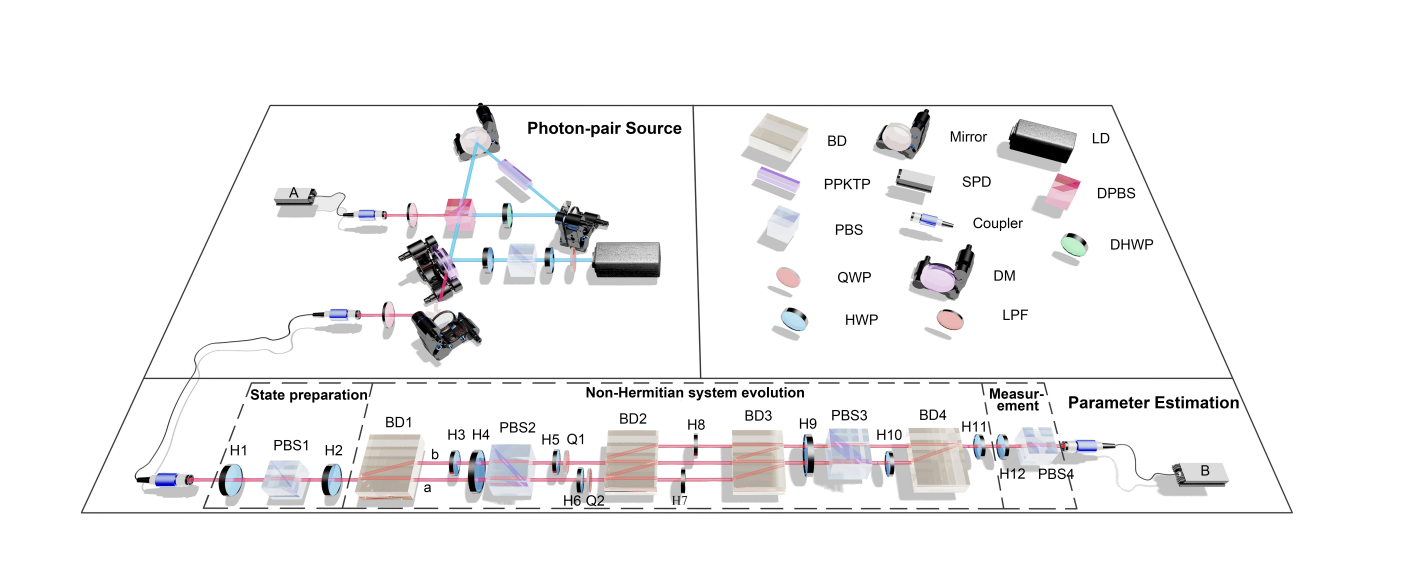
Scientists have demonstrated a novel approach to precision measurement by harnessing the unique properties of non-Hermitian systems, achieving the potential for Heisenberg scaling, a significant improvement over classical limits. The research involved characterizing the estimation precision attainable within these systems, beginning with a concise expression for the Fisher information, a key metric in quantum metrology, applicable to general non-Hermitian Hamiltonians. To validate these theoretical predictions, researchers constructed non-unitary evolutions using two distinct non-Hermitian Hamiltonians, one exhibiting parity-time symmetry and another lacking specific symmetries. The experimental setup involved preparing photons in a specific polarization state and manipulating them with optical components to create arbitrary polarization states.
Non-Hermitian system evolution was achieved by employing an ancilla qubit and a projection operation, effectively simulating the desired evolution in an open system. Measurements were then performed using additional optical components, with projective measurements optimized for the initial probe state. Statistical analysis involved numerous measurements to obtain probabilities for each evolved probe state, allowing for a direct comparison between experimental results and theoretical predictions. The study demonstrated that the estimation precision of successful detection events is characterized by the Quantum Fisher Information, and that the overall estimation precision achieves Heisenberg scaling, with the distribution of the estimator becoming more centralized as time increases. This achievement marks a significant step forward in quantum metrology, opening up new possibilities for highly precise measurements in various scientific and technological applications.
Heisenberg Scaling Achieved in Non-Hermitian Systems
This research presents a significant advancement in quantum metrology through the investigation of non-Hermitian systems, demonstrating the potential to achieve Heisenberg scaling in parameter estimation. Researchers developed a concise expression for the Quantum Fisher Information, a key metric for determining optimal estimation precision, applicable to a broad range of non-Hermitian Hamiltonians. This theoretical framework reveals that non-Hermitian systems can attain Heisenberg scaling, characterized by an inverse relationship with time, enabling increasingly precise measurements as time progresses. The team derived optimal measurement conditions based on the calculated Quantum Fisher Information, confirming that these systems can reach the fundamental limit defined by the quantum Cramér-Rao bound.
To validate these theoretical predictions, experiments were conducted using non-unitary evolutions governed by two distinct non-Hermitian Hamiltonians, one possessing parity-time symmetry and another lacking specific symmetries. These experiments successfully demonstrated the realization of Heisenberg scaling in estimation precision, marking a substantial milestone in the field. Measurements confirmed that the estimation precision follows the predicted Heisenberg scaling for both types of Hamiltonians. The developed theory is universally applicable, independent of the symmetries present in the non-Hermitian Hamiltonian, and opens exciting avenues for achieving Heisenberg-limited quantum metrology.
Heisenberg Scaling in Non-Hermitian Metrology
This research presents a significant advancement in quantum metrology through the investigation of non-Hermitian systems, demonstrating the potential to surpass classical limits in precision measurement. The team developed a general expression for the Quantum Fisher Information, a key metric for estimation precision, applicable to a wide range of non-Hermitian Hamiltonians. This formulation allows for the differentiation of systems exhibiting enhanced or reduced sensitivity near exceptional points, offering a new perspective on quantum metrology in these unique conditions. Crucially, the researchers both theoretically and experimentally confirmed the attainment of Heisenberg scaling in parameter estimation within non-Hermitian systems.
This scaling, representing a fundamental improvement over classical precision, was achieved using two distinct non-Hermitian Hamiltonians, one possessing parity-time symmetry and another lacking specific symmetries. Optimal measurement conditions were also derived, applicable to both Hermitian and non-Hermitian scenarios, and the experimental results closely aligned with the theoretical predictions. The observed oscillatory behaviour of the Quantum Fisher Information, linked to non-Markovian dynamics, suggests a pathway for identifying systems capable of achieving this enhanced precision. While a discrepancy exists between theoretical predictions and experimental data when measurement times are small, this is attributed to minor errors in the constructed evolution. Future work will likely focus on further exploring the relationship between these oscillatory behaviours, non-Markovian dynamics, and the attainment of Heisenberg scaling, potentially leading to deeper insights at the intersection of quantum metrology and non-Hermitian physics.
🗞 Toward Heisenberg Scaling in Non-Hermitian Metrology at the Quantum Regime
🧠 ArXiv: https://arxiv.org/abs/2509.12579


