

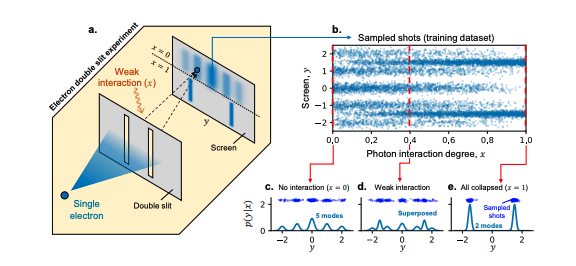
A novel quantum Mixture-Density Network, Q-MDN, efficiently models complex probability distributions with numerous modes, surpassing classical Mixture-Density Networks in both mode separation and prediction accuracy. Evaluations on the double-slit experiment and chaotic logistic bifurcation demonstrate Q-MDN’s advantage in probabilistic regression using comparable parameter counts.
The accurate representation of probability distributions containing multiple peaks, or modes, presents a significant computational challenge in both quantum and classical systems. Traditional methods, such as mixture-density networks (MDNs), struggle with scalability as the number of modes increases, requiring a rapidly expanding number of parameters to maintain precision. Researchers now demonstrate a quantum approach to this problem, utilising the principles of quantum computing to model these complex distributions more efficiently. Jaemin Seo, from Chung-Ang University, and colleagues present their work, titled ‘Quantum mixture-density network for multimodal probabilistic prediction’, detailing a quantum mixture-density network (Q-MDN) that leverages the exponential representational power of qubits to capture intricate probabilistic behaviour. Their findings, evaluated on simulations of the double-slit experiment and chaotic logistic bifurcation, suggest that Q-MDNs can achieve superior performance in separating modes and refining predictions compared to their classical counterparts, given equivalent computational resources.
Quantum Mixture-Density Networks (Q-MDNs) represent an advancement in modelling probabilistic data, offering a new approach to representing and predicting complex probability distributions with increased efficiency. Researchers have successfully implemented a Q-MDN, utilising the principles of quantum computation to overcome limitations inherent in classical methods and address challenges of scalability. This innovative model signifies a step forward in probabilistic modelling, potentially enabling more accurate and scalable solutions for applications including scientific simulation, data analysis, and control systems.
Classical Mixture-Density Networks (MDNs) traditionally represent probability distributions as a weighted sum of simpler distributions, typically Gaussian functions, but struggle with scalability when modelling distributions with many distinct peaks, or ‘modes’. A probability distribution’s ‘modes’ represent the most likely values within the distribution. The Q-MDN directly addresses this limitation by harnessing the exponential representational power of qubits – the fundamental units of quantum information – to encode a significantly larger number of modes using a comparable number of parameters, allowing it to capture intricate probabilistic landscapes with greater precision and detail.
The core innovation lies in the quantum circuit’s
The core innovation lies in the quantum circuit’s ability to efficiently represent the parameters defining each Gaussian component of the mixture. This enables a high-resolution prediction of Gaussian mixture components crucial for accurately capturing complex probabilistic landscapes. This is achieved through a parameterised quantum circuit where the circuit’s parameters directly correspond to the means and variances of the Gaussian distributions, allowing precise control over their shape and position. By manipulating these parameters, the Q-MDN effectively learns the underlying probability distribution from data, adapting its representation to match observed patterns.
Researchers evaluated the model’s performance using the double-slit experiment, a foundational demonstration of quantum mechanics, and the chaotic logistic bifurcation task, a benchmark for assessing a model’s ability to capture complex, non-linear dynamics. These rigorous tests demonstrated the Q-MDN’s versatility and robustness in handling diverse probabilistic scenarios.
Results indicate the Q-MDN surpasses classical MDNs in both mode separability – the ability to distinguish between closely spaced peaks in the distribution – and prediction sharpness, a measure of the confidence in the predicted values. Crucially, these improvements are achieved while maintaining a comparable parameter budget, demonstrating the efficiency gains offered by the quantum approach.
This enhanced performance translates to advantages in probabilistic regression tasks, where accurately modelling multimodal distributions is essential for reliable predictions, enabling more accurate forecasting and decision-making in various applications. The Q-MDN’s ability to capture complex probabilistic landscapes with greater precision and efficiency opens new possibilities for modelling phenomena in fields such as finance, weather forecasting, and medical diagnosis, potentially improving outcomes in these critical areas.
The successful application of quantum circuits to probabilistic modelling establishes a foundation for further exploration of quantum machine learning techniques, paving the way for the development of more powerful and efficient algorithms. This research demonstrates the potential of quantum computing to address limitations in classical machine learning, opening new avenues for innovation.
Future research will focus on extending the Q-MDN
Future research will focus on extending the Q-MDN to higher-dimensional datasets and investigating its robustness to noise inherent in current quantum hardware, addressing practical challenges in implementing quantum algorithms. Researchers will explore techniques for mitigating the effects of noise and improving the reliability of quantum computations, enabling the deployment of quantum algorithms on real-world quantum devices.
Applying this model to practical problems in fields such as financial modelling and weather forecasting will further validate its potential impact and demonstrate its utility beyond theoretical benchmarks, solidifying its position as a valuable tool for data analysis and prediction. Researchers will collaborate with experts in these fields to identify relevant applications and evaluate the performance of the Q-MDN on real-world datasets, developing customized algorithms and data preprocessing techniques to optimize its performance.
🗞 Quantum mixture-density network for multimodal probabilistic prediction
🧠 DOI: https://doi.org/10.48550/arXiv.2506.09497


