

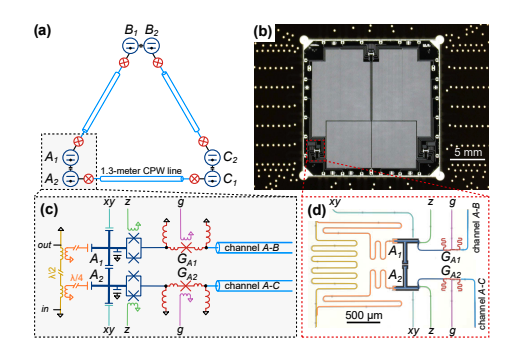
A three node communication network, utilising 1.3 metre transmission lines, successfully demonstrates quantum state transfer and generates entanglement between nodes. Genuine multipartite entangled GHZ states are created and a quantum secret sharing protocol is implemented, effectively detecting eavesdropping and enabling secure communication.
The secure transmission of information remains a fundamental challenge, particularly as quantum technologies advance and the threat of increasingly sophisticated eavesdropping increases. Researchers are now exploring methods beyond conventional cryptography, utilising the principles of quantum mechanics to guarantee security. A team led by scientists from the University of Chicago and the University of Illinois at Urbana-Champaign demonstrate a functional quantum network capable of distributing a secret amongst multiple parties, ensuring its confidentiality even if one party is compromised. Haoxiong Yan, Allen Zang, Joel Grebel, Xuntao Wu, Ming-Han Chou, Gustav Andersson, Christopher R. Conner, Yash J. Joshi, Shiheng Li, Jacob M. Miller, Rhys G. Povey, Hong Qiao, Eric Chitambar, and Andrew N. Cleland detail their work in “Quantum secret sharing in a triangular superconducting quantum network”, presenting a three-node communication system where quantum entanglement facilitates the secure distribution of classical information. The device, constructed with superconducting transmission lines, allows for the generation of complex quantum states and the implementation of a quantum secret sharing (QSS) protocol, effectively detecting any attempt at illicit interception.
A functional three-node quantum communication network, utilising superconducting qubits, establishes a platform for secure communication and further protocol development, representing a step towards a quantum internet. Experiments successfully achieve quantum state transfer and entanglement generation between all node pairings within a triangular topology defined by 1.3-meter transmission lines, validating the theoretical framework underpinning quantum key distribution and associated protocols. This physical realisation demonstrates the potential for creating secure communication channels impervious to eavesdropping, a critical advancement in data security and privacy. Quantum key distribution (QKD) uses the principles of quantum mechanics to generate and distribute cryptographic keys, ensuring secure communication.
The system generates genuine multipartite entangled Greenberger-Horne-Zeilinger (GHZ) states, a critical resource for advanced quantum communication tasks and quantum computation, exceeding the capabilities of classical communication. GHZ states are a specific type of quantum entanglement involving three or more particles, where the state of one particle is instantaneously correlated with the states of the others, regardless of the distance separating them. Researchers meticulously control and manipulate qubits – the quantum equivalent of bits – to create these entangled states, confirming the fidelity of the qubit control and entanglement generation processes with high precision. These GHZ states enable protocols offering enhanced security and efficiency, paving the way for novel applications in secure data transmission and distributed computing.
Crucially, researchers implement a quantum secret sharing (QSS)
Crucially, researchers implement a quantum secret sharing (QSS) protocol, enabling the secure distribution of classical information across the network, bolstering data protection. The QSS protocol actively detects potential eavesdropping attempts, ensuring the confidentiality of shared secrets and safeguarding sensitive data from unauthorized access. Experimental results confirm the protocol’s effectiveness in identifying and mitigating security breaches, demonstrating a practical application of quantum security principles. In QSS, a secret is divided into multiple parts, distributed among different parties, and can only be reconstructed when all parts are combined.
The demonstrated network operates as a robust testbed for evaluating and refining more complex quantum communication protocols, providing a platform for innovation and development. Researchers systematically investigate the performance of the network, measuring key parameters such as entanglement fidelity – a measure of the quality of entanglement – coherence time, and error rates, and employ sophisticated measurement techniques and data analysis methods to extract meaningful insights. This thorough evaluation process provides valuable insights into the challenges of building a practical quantum communication system.
Future research will focus on extending the network’s capabilities, exploring new protocols and applications, and addressing the challenges of scaling up the system. Researchers plan to investigate quantum repeaters to overcome the limitations of signal loss over long distances, enabling the creation of a global quantum network. Quantum repeaters amplify and regenerate quantum signals, extending the range of quantum communication. They also aim to develop more efficient error correction techniques and explore the integration of quantum and classical communication technologies.
The network’s modular architecture allows for easy expansion and integration of new components, facilitating the development of more complex quantum systems. Researchers can readily add new nodes, qubits, and control systems to the network, enabling the exploration of advanced quantum protocols and applications. This modularity ensures the network’s adaptability and scalability.
Researchers are developing advanced error correction codes and protocols to mitigate the effects of noise and decoherence, improving the reliability and stability of quantum communication. Decoherence refers to the loss of quantum information due to interactions with the environment. They are exploring novel error correction techniques that can effectively protect quantum information from environmental disturbances, enabling the transmission of secure and reliable quantum signals over long distances.
Researchers are actively investigating new materials and fabrication
Researchers are actively investigating new materials and fabrication techniques to improve the performance and scalability of superconducting qubits. They are exploring alternative qubit designs and materials that offer enhanced coherence times, reduced error rates, and improved scalability.
Future research will explore the integration of quantum communication technologies with existing classical networks, creating a hybrid infrastructure that leverages the strengths of both approaches. Researchers plan to develop protocols and interfaces that enable seamless communication between quantum and classical devices, facilitating the widespread adoption of quantum communication technologies.
The successful demonstration of secure communication and entanglement distribution across multiple nodes represents a significant milestone in the development of quantum communication technologies. Researchers validated the theoretical principles underpinning quantum key distribution and demonstrated the feasibility of building a practical quantum network. This achievement paves the way for the creation of a secure and reliable quantum internet, transforming the way we communicate and process information. This ongoing research will pave the way for a quantum future, revolutionising the way we communicate, process information, and secure our data.
🗞 Quantum secret sharing in a triangular superconducting quantum network
🧠 DOI: https://doi.org/10.48550/arXiv.2506.10878


