

Quantum network tomography presents a significant challenge in verifying and optimising emerging quantum communication networks, and recent work by Athira Kalavampara Raghunadhan, Matheus Guedes De Andrade, Don Towsley, and colleagues addresses this by rigorously comparing different methods for estimating the properties of quantum links. The researchers investigate three distinct measurement strategies, local measurements, joint measurements, and pre-shared assisted measurements, to determine how accurately the characteristics of quantum channels can be identified. Their analysis demonstrates that the pre-shared assisted measurement scheme offers the highest estimation accuracy, while joint measurements strike a balance between precision and practical implementation, and local measurements perform best in very noisy conditions. These findings establish a crucial foundation for selecting optimal measurement strategies in real-world quantum networks, ultimately enabling more reliable and scalable quantum communication technologies.
Quantum Network Tomography, Three Measurement Strategies
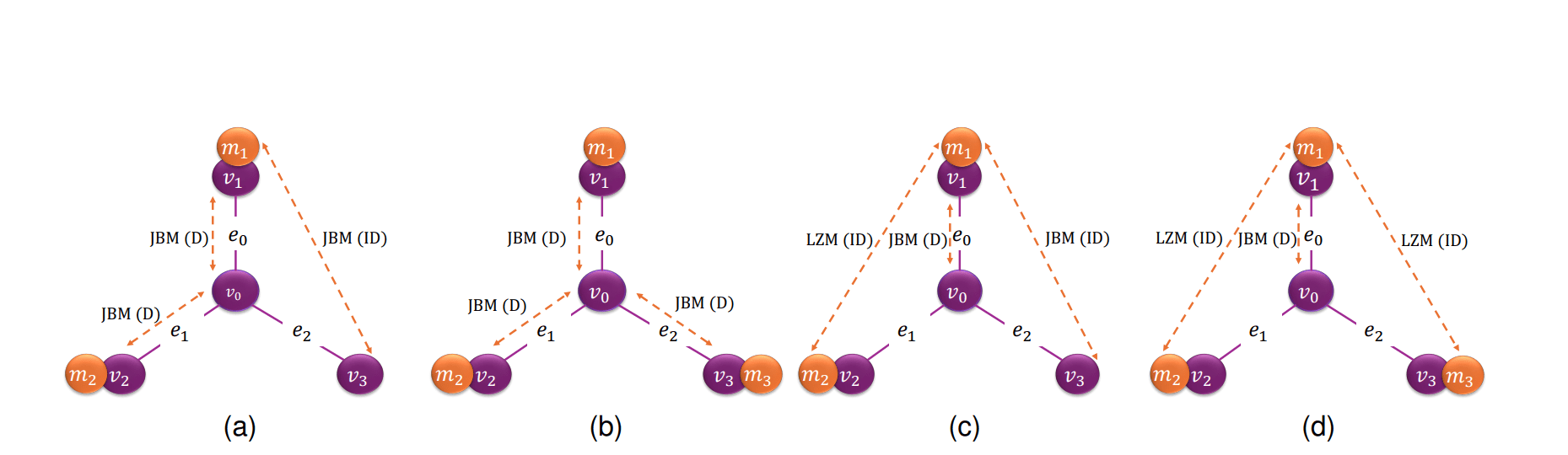
Scientists developed a comprehensive methodology for quantum network tomography, a process for characterizing the properties of quantum networks. The research focuses on accurately estimating the parameters of individual links within complex network topologies, modeling links as depolarizing channels and generating Werner states to simulate noise. Researchers compared three distinct measurement schemes, local Z-basis measurements (LZM), joint Bell-state measurements (JBM), and pre-shared entanglement-assisted measurements (PEM), to identify optimal strategies for characterizing quantum links and assessing how noise impacts estimation precision. For each measurement scheme, the team derived mathematical expressions for the Quantum Fisher Information Matrix (QFIM), a crucial tool for quantifying information content.
Evaluating estimation precision using the Quantum Cramér-Rao Bound (QCRB) revealed that PEM consistently achieves the lowest QCRB, indicating the highest estimation accuracy. JBM offers a favorable balance between precision and implementation complexity, while LZM, though experimentally simpler, exhibits higher estimation error. However, LZM outperforms JBM in high-noise regimes when estimating parameters for a single link. Further evaluation on a four-node star network compared a JBM-only configuration with a hybrid approach combining JBM and LZM. When employing two monitors, the JBM-only strategy consistently outperforms the hybrid approach across all noise levels. With three monitors, JBM achieves a lower QCRB only in low-noise regimes with heterogeneous links. This work establishes a practical basis for selecting measurement strategies in experimental quantum networks, enabling more accurate and scalable link parameter estimation under realistic noise conditions and paving the way for robust and reliable quantum communication networks.
Entanglement-Assisted Measurements Enhance Network Tomography Precision
Scientists investigated measurement strategies for quantum network tomography, focusing on estimating link parameters within networks modeled as depolarizing channels distributing Werner states. The research team analyzed three distinct schemes, local Z-basis measurements (LZM), joint Bell-state measurements (JBM), and pre-shared entanglement-assisted measurements (PEM), deriving the probability distributions of measurement outcomes for each. Closed-form expressions for the Quantum Fisher Information Matrix (QFIM) were obtained, allowing evaluation of estimation precision through the Quantum Cramér-Rao Bound (QCRB). Numerical analysis demonstrates that the PEM scheme consistently achieves the lowest QCRB, indicating the highest estimation accuracy across all noise regimes.
JBM provides a favorable balance between precision and implementation complexity, while LZM, though experimentally simpler, exhibits higher estimation error relative to the other schemes. However, LZM outperforms JBM in high-noise regimes for single-link estimation. Further evaluation on a four-node star network compared a JBM-only configuration with a hybrid approach combining JBM and LZM. When two monitors are used, the JBM-only strategy outperforms the hybrid approach across all noise regimes. With three monitors, JBM achieves a lower QCRB only in low-noise regimes with heterogeneous links. These results establish a practical basis for selecting measurement strategies in experimental quantum networks, enabling more accurate and scalable link parameter estimation under realistic noise conditions.
Link Estimation Accuracy in Quantum Networks
This research investigates methods for accurately estimating the properties of links within quantum networks, a crucial step towards building a functional quantum internet. Scientists analyzed three distinct measurement strategies, local Z-basis measurements, joint Bell-state measurements, and pre-shared assisted measurements, to determine their effectiveness in characterizing network links modeled as depolarizing channels. The team derived mathematical expressions that quantify how well each method performs, revealing the precision with which link parameters can be estimated. Results demonstrate that the pre-shared assisted measurement scheme achieves the highest estimation accuracy, while joint Bell-state measurements offer a good balance between precision and practical implementation.
Although simpler to implement, local Z-basis measurements generally exhibit lower precision, but surprisingly outperform joint Bell-state measurements in conditions with high noise levels for single link estimation. Further analysis on a simulated network showed that combining local and joint measurements can improve performance in specific high-noise scenarios with varying link characteristics. This research establishes a solid foundation for selecting appropriate measurement techniques, ultimately enabling more accurate and efficient quantum network tomography.
👉 More information
🗞 Measurement Strategies and Estimation Precision in Quantum Network Tomography
🧠 ArXiv: https://arxiv.org/abs/2511.01657

