


Quantum machine learning offers potential computational benefits through the exploitation of quantum phenomena, but realising complex models within current hardware limitations remains a significant challenge. Researchers are now exploring architectural innovations to enhance both the scalability and expressive power of quantum neural networks. Hoang-Quan Nguyen, Xuan-Bac Nguyen, et al., from the University of Arkansas and collaborating institutions, address this need in their paper, “QMoE: A Quantum Mixture of Experts Framework for Scalable Quantum Neural Networks”. They present a novel framework integrating the mixture of experts paradigm, commonly used in classical machine learning, into a quantum setting, demonstrating improved performance on classification tasks compared to standard neural networks. The proposed architecture utilises multiple quantum circuits, termed ‘experts’, and a routing mechanism to selectively apply these experts to specific inputs, offering a pathway towards more efficient and interpretable quantum learning.
Quantum machine learning explores potential computational advantages offered by emerging quantum computers, attracting considerable attention as a prospective application for near-term devices. Classical machine learning algorithms frequently demand substantial computational resources, particularly when processing large datasets and complex models, creating a natural domain where quantum computation may offer benefits. Leveraging quantum phenomena such as superposition and entanglement promises to accelerate specific machine learning algorithms and potentially improve their performance, although realising this potential necessitates overcoming limitations imposed by current quantum hardware.
The development of scalable machine learning models presents a significant challenge, as the complexity of these models often increases rapidly with the size of the dataset. Deep learning, a prominent branch of machine learning, employs artificial neural networks with multiple layers to extract intricate patterns from data, but these networks can become computationally expensive and require substantial memory, hindering their application to large-scale problems. Consequently, researchers explore methods to enhance the scalability and efficiency of deep learning architectures, seeking innovative approaches to manage computational demands.
The mixture of experts (MoE) paradigm offers a
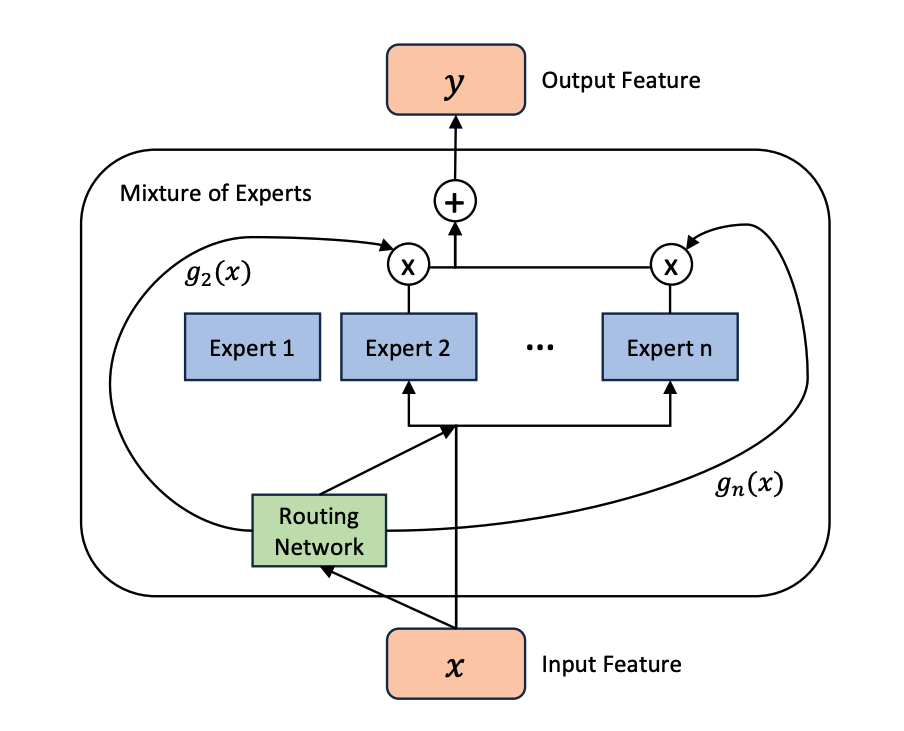
The mixture of experts (MoE) paradigm offers a strategy for improving the scalability of deep learning models, dividing a complex task among multiple specialised ‘expert’ networks, each responsible for processing a specific subset of the input data. A routing mechanism dynamically selects which experts to activate for each input, enabling the model to maintain computational efficiency while increasing its capacity. This modular approach allows MoE models to handle larger and more complex datasets than traditional monolithic networks.
Recent advances in quantum computing have spurred the exploration of quantum analogues to classical machine learning algorithms, adapting quantum K-nearest neighbour, support vector machines, and clustering algorithms for quantum computers, demonstrating the potential for quantum speedups. Quantum neural networks (QNNs) represent a particularly promising area, offering the possibility of creating more expressive and efficient models, but QNNs still face challenges in terms of scalability and resource requirements.
Integrating the MoE paradigm into quantum machine learning offers a potential solution to these challenges, distributing the learning process across multiple quantum experts. This research presents a novel quantum machine learning (QML) architecture, a Mixture of Quantum Experts (QMoE), which integrates the established Mixture of Experts (MoE) paradigm into a quantum computing framework.
The QMoE architecture fundamentally reimagines how a quantum machine learning model is constructed, moving away from relying on a single, large, and increasingly difficult to train quantum circuit. Instead, it employs a modular design consisting of multiple smaller, specialised quantum circuits, termed ‘experts’, each designed to focus on learning specific aspects of the input data. Crucially, a learnable ‘routing mechanism’ directs each input to a selection of these experts, effectively creating a distributed processing system that aggregates their outputs to produce the final prediction.
The benefit of this approach lies in its potential for scalability, as training numerous smaller quantum circuits is demonstrably less computationally demanding than training a single, massive one. Furthermore, the specialisation of each expert allows the model to learn more complex data patterns, as each circuit can focus on extracting specific features, and the routing mechanism introduces a form of dynamic sparsity, activating only the most relevant experts for each input, which further enhances efficiency.
Experimental validation of the QMoE architecture, utilising benchmark
Experimental validation of the QMoE architecture, utilising benchmark datasets such as MNIST and Fashion-MNIST for image classification, demonstrates its effectiveness, consistently outperforming standard neural networks. This suggests that the combination of modularity, specialisation, and dynamic routing yields a powerful learning framework, and while the current implementation relies on relatively simple routing mechanisms, such as a softmax function for assigning inputs to experts, future research will likely explore more sophisticated methods to optimise this process. Investigating the performance of QMoE on larger, more complex datasets, like ImageNet, and exploring different quantum circuit architectures for the individual experts, represent promising avenues for further development.
The model achieves superior performance by effectively learning complex data patterns through the specialisation of its quantum expert circuits, establishing a pathway towards scalable and interpretable learning frameworks within the quantum domain. By distributing the computational load and enabling specialisation, QMoE offers a promising solution to the challenges currently hindering the advancement of QML, underscoring the importance of exploring hybrid quantum-classical approaches. Combining the strengths of both computational paradigms unlocks new capabilities in machine learning.
The core innovation lies in the combination of quantum circuits with the MoE approach, a technique commonly used in classical machine learning to improve model capacity and performance. Rather than relying on a single, complex quantum circuit, QMoE distributes the computational burden across multiple, simpler circuits, each trained to handle specific features or patterns within the data, enhancing both the expressibility and trainability of the model. This overcomes limitations inherent in single parameterized quantum circuits (PQCs).
🗞 QMoE: A Quantum Mixture of Experts Framework for Scalable Quantum Neural Networks
🧠 DOI: https://doi.org/10.48550/arXiv.2507.05190


