Quantum metrology aims to enhance the precision of measurements, and researchers continually seek ways to overcome the limitations imposed by environmental noise. Arpan Das, from Universitat Autònoma de Barcelona and the Faculty of Physics at the University of Warsaw, along with Rafał Demkowicz-Dobrzański from the University of Warsaw, now present a new approach to tackling this challenge. Their work introduces a method that effectively models complex, correlated noise using a simplified framework, allowing scientists to design optimal measurement strategies and establish fundamental limits on precision. This advancement promises to improve the accuracy of a wide range of quantum technologies, from atomic clocks to gravitational wave detectors, by providing a powerful tool for mitigating the effects of environmental disturbances.
Correlated Noise Mitigation via Pseudomodes
This research details significant advances in quantum metrology, particularly addressing the impact of correlated noise on precision measurements and developing methods to overcome it. The work focuses on improving the accuracy of parameter estimation in quantum systems when faced with realistic noise, which often exhibits correlations rather than being purely random. A key technique employed is the pseudomode approach, which accurately models the environment’s influence on the system and captures the effects of non-Markovian dynamics, where the environment possesses memory effects. Scientists created a Python package, QMET, to simulate and analyze quantum metrology protocols in noisy environments, demonstrating enhanced precision compared to standard approaches, especially in scenarios with strong correlations.
The study investigates systems where the environment’s past influences its present state, departing from simpler models that assume a “fresh” environment for each measurement. The comprehensive approach combines theoretical analysis, numerical simulations, and a practical software tool, representing a significant advancement in the field. The rigorous validation of the QMET package ensures its reliability and accuracy, and the developed strategies could have a significant impact on quantum sensing, imaging, and communication. Results demonstrate significant improvements in precision with the developed strategies, particularly when correlations are strong, and establish universal bounds on achievable precision, providing a benchmark for evaluating different metrology protocols.
Bosonic Environments and Quantum Sensing Protocols
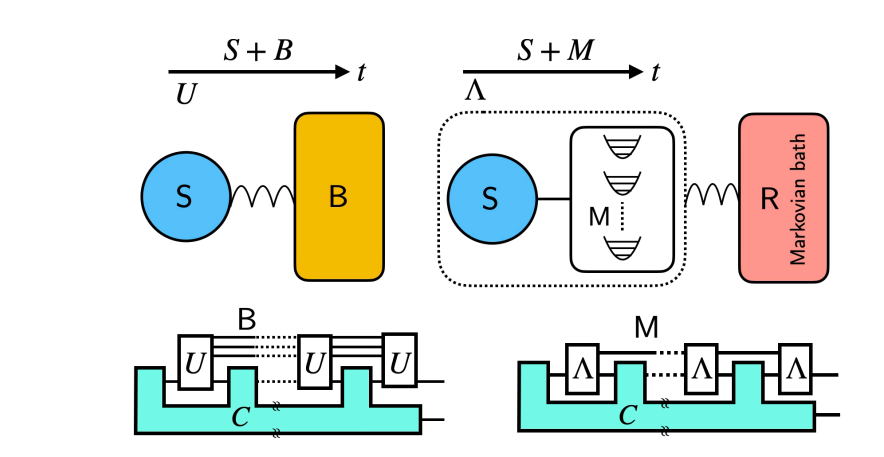
Scientists developed a novel methodology for analyzing quantum metrological protocols operating within bosonic environments, employing a Markovian embedding technique based on pseudomode formalism. This approach effectively reduces the complexity of the problem by modeling the environment in a low-dimensional space, enabling the application of recently developed tools to determine optimal sensing protocols and fundamental metrological bounds for scenarios with correlated noise. The study pioneers a method to circumvent the challenges posed by environmental noise, a significant obstacle in the development of current quantum technologies, by precisely quantifying how noise impacts the potential of quantum sensing. Researchers engineered a system where the sensing probe is linearly coupled to a bosonic environment, allowing them to accurately investigate frequency estimation protocols under the influence of noise modeled as damped Jaynes-Cummings dynamics.
This setup facilitates a detailed examination of environmental correlations, moving beyond simplified models that assume a “fresh environment” at each sensing step, a common limitation in previous studies. The team’s technique addresses the complexities of correlated noise by considering the full history of interactions between the probe and the environment, accurately capturing the buildup of correlations over time. The study further advances the field by reconciling the quantum comb mathematical framework with the Iterative see-saw Quantum Fisher Information (QFI) optimization algorithm and a tensor-network framework. This integration allows for the construction of efficient numerical optimization protocols capable of handling a large number of quantum controls and extended sensing times, significantly improving the scalability of the analysis. Scientists harnessed this combined approach to move beyond illustrative examples and analyze physically-relevant noise models, representing a crucial step towards practical applications of quantum metrology.
Markovian Embedding Models Correlated Quantum Noise
Scientists have developed a novel method for analyzing quantum metrology protocols in the presence of complex, correlated noise, achieving a breakthrough in modeling realistic quantum systems. The work centers on a technique called Markovian embedding, which allows researchers to effectively translate non-Markovian dynamics into a Markovian framework suitable for analysis. This approach begins with a system linearly coupled to a bosonic bath, where the parameter to be estimated is encoded within the system’s Hamiltonian. The team demonstrated that the complete system dynamics are fully determined by the bath correlation function, enabling an effective description through the Markovian dynamics of an enlarged system.
This allows for the analysis of metrological tasks involving the reduced system dynamics without relying on standard approximations that simplify the environment. Researchers effectively represent the original environment with a finite number of discrete pseudomodes, creating a Markovian master equation that accurately reproduces the original system’s behavior. This technique circumvents the challenges of dealing with infinite degrees of freedom, enabling the analysis of complex quantum systems previously inaccessible to standard methods. The method’s power lies in its ability to accurately model physically-relevant, inherently quantum correlated noise, opening new avenues for designing robust quantum sensors and improving the precision of quantum measurements.
Correlated Environments Enhance Quantum Precision
This research presents a new framework for analyzing quantum metrological protocols when a system interacts with a complex, quantum environment exhibiting correlations. The team overcame a significant challenge in modeling such systems by employing a technique called Markovian embedding, effectively mapping the complex, non-Markovian dynamics onto a more manageable, Markovian system with added degrees of freedom. This allowed them to investigate how correlations within the environment impact the precision of parameter estimation, demonstrating an improvement in estimation precision when environmental correlations are present. The researchers validated their approach using a specific model, a two-level system interacting with a bosonic environment, for which an exact solution exists, enabling a direct comparison between correlated and uncorrelated scenarios. Numerical calculations confirmed the enhanced performance achievable with correlated environments and demonstrated that the derived results align with established, universal bounds on estimation precision. The team anticipates that this formalism can be extended to analyze a wider range of complex quantum dynamics, potentially leading to a unified understanding of quantum metrology in the presence of inherently quantum, correlated noise.
👉 More information
🗞 Quantum metrology in presence of correlated noise via Markovian embedding
🧠 ArXiv: https://arxiv.org/abs/2509.19685