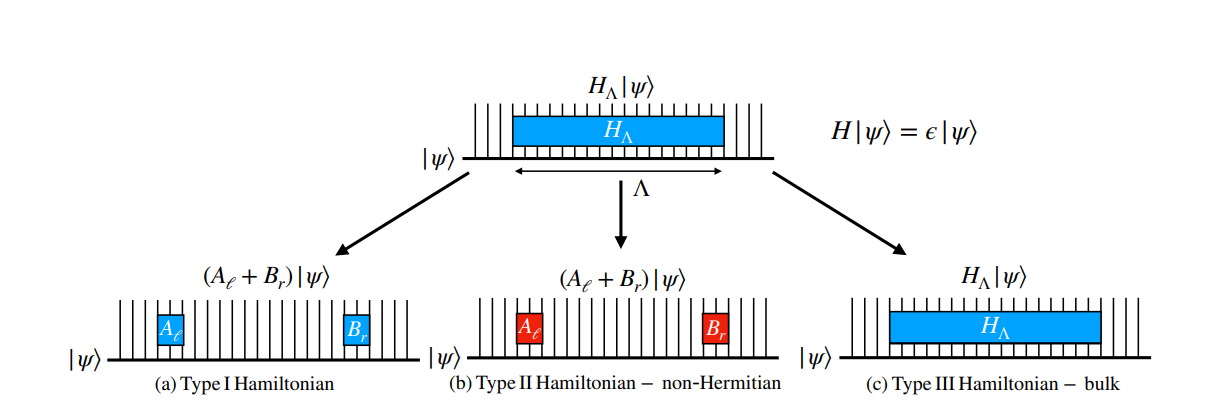
Understanding how quantum states relate to the Hamiltonians that govern their behaviour represents a fundamental challenge in physics, and recent research focuses on identifying ‘parent Hamiltonians’ which possess specific states as their ground states. Lei Gioia from Caltech and Sanjay Moudgalya from Technische Universität München, along with Olexei I. Motrunich, investigate this problem by classifying different types of parent Hamiltonians and exploring their connection to quantum many-body scars, special states that resist thermalisation. The team rigorously demonstrates how these Hamiltonians can be distinguished by their local structure, using a specific quantum state as a key example, and establishes that distinct dynamical behaviours arise from each type. This work not only clarifies the relationship between locality and quantum many-body scars, but also provides a framework for understanding a wider range of quantum systems and predicting their behaviour.
Parent Hamiltonians and Quantum Many-Body Scars
Scientists have achieved a comprehensive classification of parent Hamiltonians, mathematical constructs used to model quantum systems and their energy states. This work formalizes distinctions between three distinct types of these Hamiltonians, differing in how they decompose into strictly local terms while maintaining the same set of quantum states as their eigenstates. The research utilizes the W state as a primary example, rigorously deriving the complete set of local parent Hamiltonians associated with it. These parent Hamiltonians exhibit asymptotic Quantum Many-Body Scars (QMBS), special, non-thermal eigenstates embedded within the energy spectrum of a system, demonstrating distinct dynamical signatures dependent on the Hamiltonian type.
Investigations into short-range entangled states reveal constraints on admissible Hamiltonian types, further refining the classification scheme. Researchers demonstrated that for simple quantum states, such as product states, only a single type of parent Hamiltonian exists. This work provides a foundation for understanding the interplay between locality and QMBS, opening avenues for classifying the rich structures and dynamical properties of these systems.
Ground State Classification via Tensor Networks
Scientists have developed a powerful method for classifying parent Hamiltonians, mathematical models describing the energy of quantum systems, focusing on their relationship to ground states. The team utilizes tensor networks, a mathematical tool for representing complex quantum states, to distinguish between different Hamiltonian types defined by how they break down into interactions between localized parts of the system. The core of this work lies in demonstrating that if a Hamiltonian’s ground state can be accurately represented using a highly injective tensor network, it must belong to a specific category, termed type II. This classification hinges on the properties of the transfer matrix, a key component of the tensor network, which reveals information about entanglement and correlations within the system.
A full-rank transfer matrix, indicating strong entanglement, prevents the Hamiltonian from being constructed solely from local interactions, classifying it as type II. This establishes a clear connection between the Hamiltonian’s mathematical structure, the entanglement properties of its ground state, and its overall behaviour. The research demonstrates that type I Hamiltonians, those built from local interactions, allow for a specific mathematical relationship between symmetry operators and local unitary operators. However, a full-rank transfer matrix prevents this relationship from holding, definitively classifying the Hamiltonian as type II. This rigorous mathematical framework provides a new tool for understanding and classifying quantum systems, with implications for the development of new quantum technologies and materials.
🗞 Distinct Types of Parent Hamiltonians for Quantum States: Insights from the State as a Quantum Many-Body Scar
🧠 ArXiv: https://arxiv.org/abs/2510.24713