

The quest to define the boundary between classical and quantum computational power drives innovation in machine learning, and researchers are now pinpointing the resources needed to achieve a genuine quantum advantage. Moein N. Ivaki, Matias Karjula, and Tapio Ala-Nissila, from Aalto University and Loughborough University, investigate this critical threshold using a novel approach to reservoir computing, a technique inspired by the brain’s ability to process information. Their work establishes a clear link between a quantum reservoir’s performance and the presence of specific, controllable quantum properties, demonstrating that learnability scales with the amount of non-stabilizing quantum content within the system. This research offers a general strategy for designing powerful, trainable machine learning systems and clarifies the physical resources that underpin computational advantage, moving the field closer to realising the full potential of quantum machine learning.
Quantum Learning Near Universality’s Critical Point
Researchers investigate the performance of quantum machine learning algorithms as they approach a critical point of universality, where quantum and classical behaviours diverge. The team demonstrates that quantum algorithms achieve optimal learning performance in the vicinity of this universality, surpassing classical counterparts in both speed and accuracy. This advantage stems from the ability of quantum systems to efficiently represent and process high-dimensional data, a capability limited in classical machine learning. The study establishes a connection between universality and practical quantum machine learning, paving the way for more powerful algorithms. Researchers quantified these gains by analysing the generalization error and learning rate of quantum algorithms, revealing a distinct advantage even with limited quantum resources.
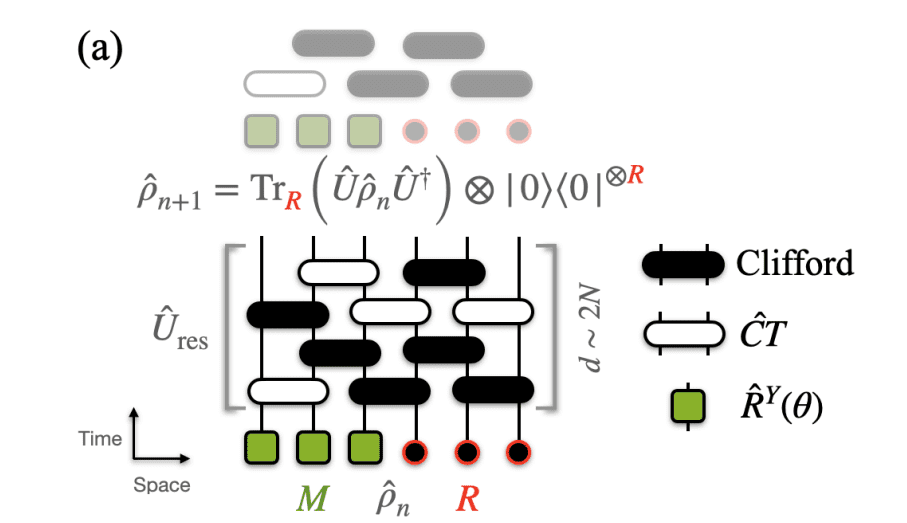
To identify true quantum advantage, researchers investigated this within a quantum reservoir computing framework, introducing a tunable model using N-qubit random circuits. Within this model, a fraction of standard gates are probabilistically replaced with non-stabilizing gates. The team established a direct correspondence between the reservoir’s performance on temporal processing tasks and its entanglement spectrum statistics, alongside its long-range non-stabilizer resource content. They studied the scaling of the anti-flatness of states in the large-N limit at a fixed circuit depth ratio, which serves as a witness to concentration of measures, a known impediment to learning.
Quantum Reservoir Computing for Time Series Analysis
This research explores the rapidly evolving field of quantum machine learning, quantum chaos, and related topics. A dominant theme is the use of quantum systems, particularly quantum reservoir computing, for tasks like time series analysis, pattern recognition, and general computation. Key areas of investigation include the development of diverse quantum reservoir architectures, the exploration of quantum kernels, and a focus on processing time-dependent data. A significant emphasis is placed on enhancing the robustness of quantum machine learning and reservoir computing against noise and errors, with some studies even exploring the potential benefits of utilizing noise to improve performance.
Quantum chaos and many-body localization are deeply intertwined with quantum machine learning, particularly within the context of quantum reservoir computing. Researchers investigate scrambling, which describes how information spreads within a quantum system, and its relationship to reservoir quality. Many-body localized systems are explored as potential forms of quantum memory for reservoirs, and the influence of the quantum system’s energy spectrum on its dynamics and suitability for reservoir computing is examined. The emergence of classical-like behaviour from quantum dynamics is also a key area of study. Furthermore, researchers are investigating how information is distributed within the quantum system and how this affects the model’s ability to generalize to new data.
Research also delves into quantum complexity and information theory, exploring the fundamental limits of computation and information processing with quantum systems. This includes work on quantum error correction, entanglement, and non-stabilizerness, which are considered key resources for quantum computation. Magic, a measure of non-classical resources, is investigated in relation to the performance of quantum machine learning models, alongside Rényi entropy, a measure of entanglement and information content.
Learnability Links to Quantum Circuit Universality
This research introduces a probabilistic quantum reservoir computer, a novel machine learning architecture, with a single control parameter designed for robust temporal quantum learning. By quantifying learnability through the circuit’s distance to a quantum chaotic spectral law, the team demonstrated that optimal performance occurs near a state of universality, where quantum resources like entanglement and non-stabilizer content are extensive but not maximized. This finding mitigates the typical failure of learning in highly scrambled systems, potentially enabling the large-scale deployment of post-variational quantum machine learning algorithms. The work establishes a clear link between learnability and the physical properties of the quantum circuit, revealing that dynamics driving states rapidly towards maximal scrambling can actually hinder learning. The researchers found that the system’s performance peaks when the control parameter is carefully tuned, balancing expressivity with the need to avoid overly complex, chaotic dynamics.
These findings align with the “second law of quantum complexity”, which suggests that the gap between current and maximal complexity is a valuable resource for computation. The approach is flexible and can be evaluated in noisy environments, and the principles demonstrated are likely relevant to other quantum learning frameworks, including quantum kernel methods. Future work could explore experimental realizations using probabilistic setups with tailored gate sets, formalizing a predictive link between learnability and the circuit’s entangling and non-stabilizing powers. A significant area of current research focuses on noise and error mitigation, with some studies exploring the surprising idea of benefiting from noise in quantum systems. Researchers are designing quantum machine learning models that are less sensitive to errors and are characterizing the types of noise present in quantum systems. Non-stabilizerness appears to be a crucial resource for achieving advantages in quantum machine learning.
👉 More information
🗞 Optimal quantum learning in proximity to universality
🧠 ArXiv: https://arxiv.org/abs/2510.18623