

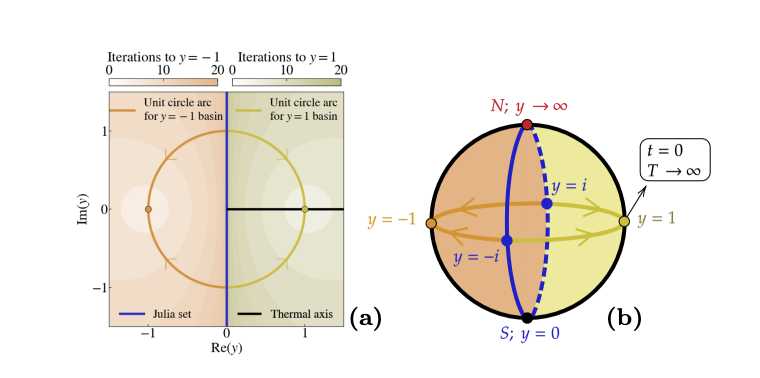
Dynamical phase transitions, shifts in a system’s behaviour as it evolves over time, represent a fascinating challenge to conventional understandings of how materials change state. Manmeet Kaur and Somendra M. Bhattacharjee, from Ashoka University, now demonstrate a powerful new way to analyse these transitions by connecting them to the mathematics of complex dynamics and a technique called the real-space renormalization group. Their work reveals a surprising link between dynamical phase transitions and the Julia set, a beautiful and intricate fractal that defines the boundaries between different stable states, offering a new framework for predicting and understanding these complex phenomena. This approach, applied to a model of magnetic materials, demonstrates how the physical constraints of a system, such as its shape and edges, profoundly influence the occurrence of these transitions and provides a compelling explanation for why certain changes can suppress them.
Quantum Dynamics, Fractals, and Topological Transitions
This research establishes a novel connection between dynamical quantum phase transitions and complex dynamics, achieved through a real-space renormalization group analysis of the one-dimensional transverse-field Ising model. Scientists discovered that these transitions, appearing as abrupt changes in system behaviour, occur precisely when the system’s evolution intersects the Julia set of its corresponding renormalization group transformation, revealing a deep mathematical link between quantum dynamics and fractal geometry. The renormalization group transformation effectively simplifies the system, allowing researchers to focus on its essential features and long-term behaviour, while the Julia set defines a boundary in complex dynamics, separating regions with different evolutionary paths. This study confirms that these phenomena are inherently quantum mechanical, occurring on a timescale dictated by the strength of interactions within the system.
Researchers further demonstrated the significant influence of topology and boundary conditions on these dynamical transitions. Specifically, the team found that an open chain, with defined ends, completely suppresses dynamical phase transitions, causing distinct transitions to merge into a single event. This result is explained by considering quantum speed limits, which impose fundamental constraints on how quickly a quantum system can evolve, and how these limits affect the system’s behaviour. The authors acknowledge that their analysis focuses on a specific model and that extending these findings to more complex systems remains an open question, suggesting that future work could explore the broader implications of this connection between quantum dynamics and complex dynamics in diverse physical systems.
👉 More information
🗞 Julia Set in Quantum Evolution: The case of Dynamical Quantum Phase Transitions
🧠 ArXiv: https://arxiv.org/abs/2509.14923


