Researchers from various institutions, including the South China University of Technology and Huawei Technologies, have developed a quantum-inspired machine-learning method for molecular docking, a key tool in drug design. The team combined quantum-inspired algorithms with deep learning to improve the efficiency and accuracy of molecular docking. Their method outperformed traditional docking algorithms and deep learning-based algorithms by over 10%. Compared to the current state-of-the-art deep learning-based docking algorithm, DiffDock, their method improved the success rate from 33% to 35%. This research could significantly enhance the drug development process.
Quantum-Inspired Machine Learning for Molecular Docking
Introduction and Background
A team of researchers from the School of Automation Science and Engineering at South China University of Technology, Central Research Institute 2012 Labs Huawei Technologies, Laboratory of AI for Science Huawei Cloud Computing Technologies Co Ltd, State Key Laboratory of Surface Physics and Department of Physics Fudan University, and Shenzhen Institute for Quantum Science and Engineering have developed a quantum-inspired machine learning method for molecular docking. Molecular docking is a crucial tool in structure-based drug design, enhancing the efficiency of drug development. Traditional docking methods, which involve searching for possible binding sites and conformations, are computationally complex and often yield poor results in blind docking.
Quantum-Inspired Algorithms and Deep Learning
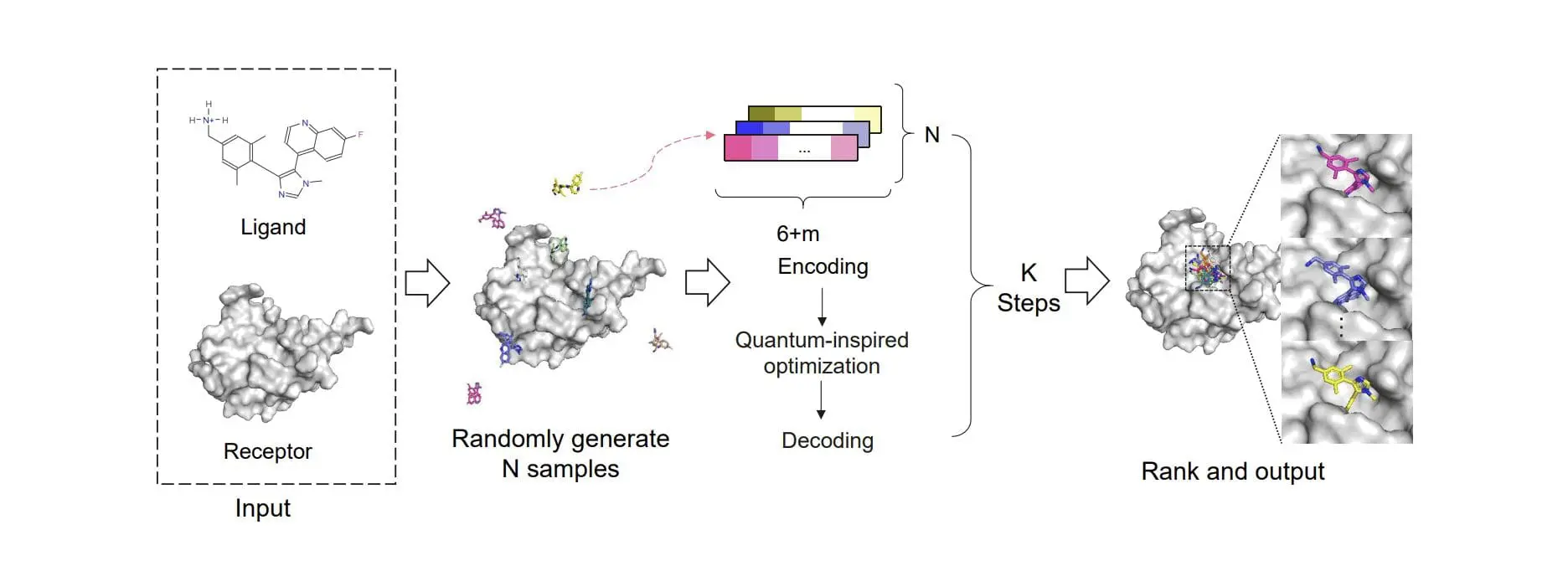
The researchers have combined quantum-inspired algorithms with gradients learned by deep learning in the encoded molecular space. Quantum-inspired algorithms, which combine quantum properties and annealing, have shown significant advantages in solving combinatorial optimization problems. The team’s numerical simulation shows that their method outperforms traditional docking algorithms and deep learning-based algorithms by over 10%. Compared to the current state-of-the-art deep learning-based docking algorithm, DiffDock, the success rate of Top1 RMSD2 achieves an improvement from 33% to 35% in the same setup.
Drug Development and Molecular Docking
Drug development is a complex and costly process that involves extensive research and development efforts. Among various structure-based drug design methods, molecular docking stands out as one of the most commonly utilized techniques for predicting essential parameters such as binding mode and affinity between drug molecules and target proteins. By providing valuable insights into the binding interactions between drug molecules and target proteins, molecular docking plays a crucial role in guiding the design of potent and selective drug candidates, thereby contributing to an improved success rate in drug development.
Quantum Annealing and Drug Design
Recent studies have explored the use of quantum computing or quantum-inspired algorithms in drug design, demonstrating their ability to enhance computational speed and achieve comparable or even greater accuracy compared to classical algorithms. Quantum annealing is an advantageous method for solving combinatorial optimization problems and expediting the drug development process. Quantum annealing stands out from conventional methods by employing the principle of quantum adiabatic evolution.
Quantum-Inspired Algorithms with a Gradient Field
In this paper, the researchers propose Quantum-inspired algorithms with a gradient field generated by the Diffusion model in Molecular Docking (QDMD) to tackle blind molecular docking tasks. The theoretical framework establishes a connection between the evolution of the quantum-inspired algorithm, specifically the simulated bifurcation algorithm (SB algorithm), and the score-based generative model. The gradient information in the optimization process is derived from the scoring function sθx generated by the deep learning model.
Conclusion
Overall, the combination of quantum-inspired algorithms and deep learning-based scoring functions shows great promise in molecular docking tasks. The researchers’ method surpasses previous methods under the same settings and improves accuracy from 33.24% to 35.26% compared to DiffDock. In the recently released ligand data where the model training has not encountered the ligands before, the percentage of RMSD ≤ 1 Å is nearly 6 percentage points higher than that of DiffDock.
“Quantum-Inspired Machine Learning for Molecular Docking” by Riyang Shu, Bowen Liu, Zhitao Xiong, Xiaoxian Cui, Yunting Li, Wei Cui, Man‐Hong Yung, Nan Qiao, published on January 22, 2024.