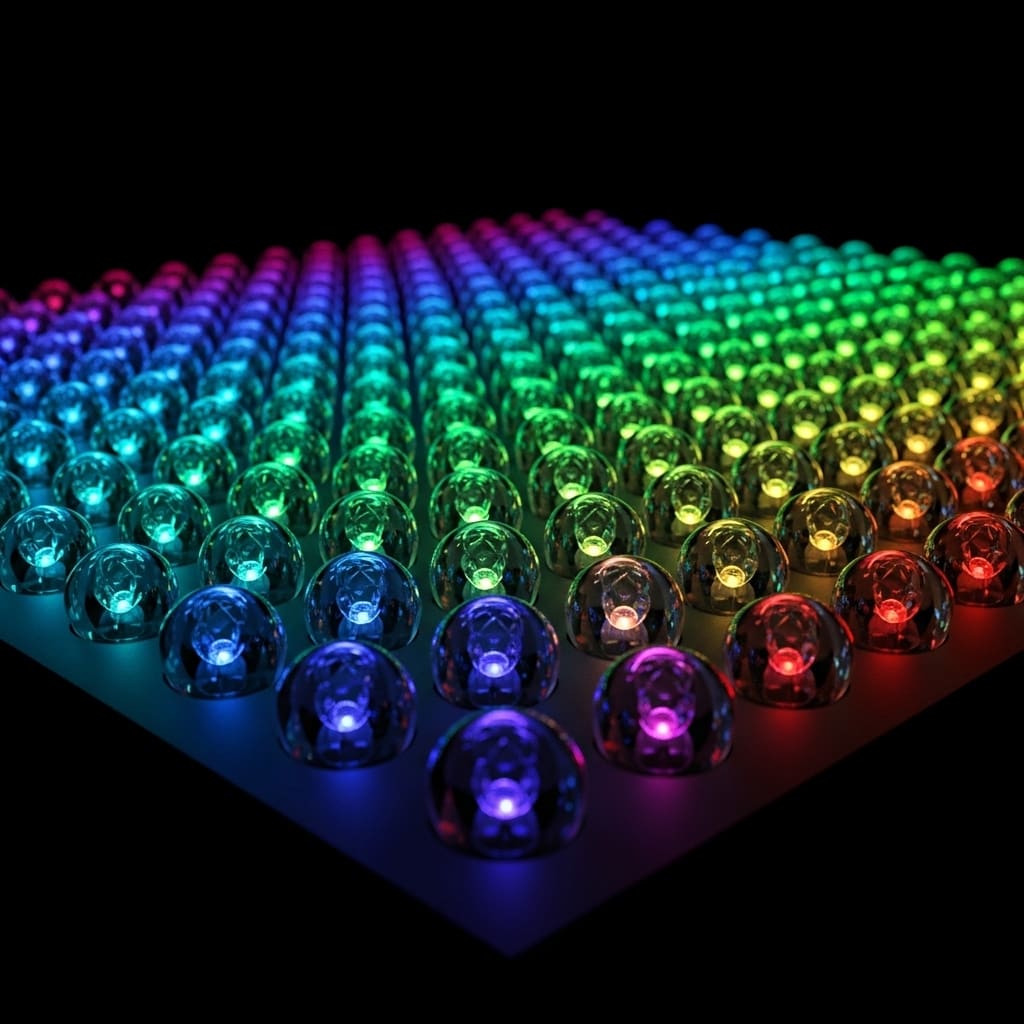
Researchers are pushing the boundaries of light-matter interaction by developing scalable cavity array microscopes, and a new study details significant advances in this technology. Anna Soper, Danial Shadmany, and Adam L. Shaw, from Stanford University, alongside Lukas Palm, David I. Schuster, and Jonathan Simon, et al., demonstrate a 600-site cavity array microscope with improved stability, degeneracy, and potential for further scaling. This work represents a crucial step forward because it addresses key technical challenges, such as optical aberrations and field of view limitations, that previously hindered the creation of large, uniform cavity arrays suitable for interfacing with individual atoms. By identifying sensitivities and establishing control techniques, the team outlines a clear pathway towards systems containing tens of thousands of cavities, promising applications in parallel quantum operations, rapid readout of quantum systems, and the exploration of complex atom-photon interactions.
High finesse two-dimensional cavity arrays for enhanced light-atom interaction
Scientists have developed a cavity array microscope achieving over 600 individually controlled optical cavities, representing a significant advance in the field of light-matter interactions. This next-generation architecture builds upon previous work, overcoming limitations in scalability and performance to create a platform for exploring many-cavity quantum electrodynamics.
The research demonstrates an average cavity finesse of 114(17) across 603 cavities, a substantial improvement over earlier designs, and achieves an array-averaged single atom peak cooperativity exceeding 10. A key innovation lies in the system’s ability to engineer a two-dimensional array of tightly spaced cavity modes with wavelength-scale waists, ideally suited for interfacing with large atomic arrays.
The study meticulously examines imperfections within the system, including optical aberrations, field of view constraints, and cavity non-degeneracies, identifying the factors limiting performance. Researchers exposit control mechanisms and techniques to align and operate the system with stability, paving the way for future expansion.
Specifically, the team addressed challenges related to coating losses and surface roughness of optical components, achieving a field of view radius of 140μm and demonstrating 537 mutually degenerate cavities within the readout-optimized cavity linewidth. This advancement unlocks possibilities for highly parallelized remote entanglement generation, fast and non-destructive mid-circuit readout, and the implementation of hybrid atom-photon Hamiltonians.
The work lays out a clear pathway towards scaling the system to tens of thousands of independent cavities, maintaining compatibility with existing atom arrays. By doubling the density of the microlens array and leveraging a wider field of view microscope objective, the researchers project a substantial increase in the number of achievable cavities. This new design offers a compelling advantage over other resonator geometries, balancing bandwidth, atom-surface distance, and cooperativity for neutral atom array applications.
Characterisation of cavity stability via aspheric lens displacement and array finesse mapping
A cavity array microscope, employing free space intra-cavity optics, was constructed to engineer a two-dimensional array of tightly spaced cavity TEM modes with wavelength-scale waists. Hundreds of degenerate cavity modes were realised with improved, uniform finesse, and the technical features of the system were explored to assess scalability.
The performance of each cavity was characterised by meticulously mapping stability regions across the array, achieved through precise longitudinal displacement of aspheric lenses within the optical setup. This involved systematically varying the lens position over a range of 18μm and recording the resulting stability of each cavity, revealing a distinct pattern where central cavities stabilised before those at larger radial indices.
Radial slices of the collected data explicitly demonstrated these shifted stability regions, while simultaneous measurement of the array-averaged finesse and number of stable cavities identified an optimal operating point. Numerical ray-tracing simulations, incorporating realistic aspheric lens properties, corroborated the experimentally observed stability shifts, attributing them to field curvature.
The simulations showed that ideal lenses exhibited no shift, but realistic aspheres induced a shift consistent with the experimental data, with minor discrepancies explained by quadratic misalignment aberrations like defocus. Cavity finesse, a key figure of merit, was determined by quantifying cavity losses from various sources including surface roughness, anti-reflective coating reflection and absorption, and clipping on lens apertures.
An average round-trip loss of 5.3% was measured, corresponding to an array-averaged finesse of 114. Detailed analysis, summarised in a loss budget, identified anti-reflective coating and scattering losses as dominant contributors, with individual cavity performance variations attributed to dust, local imperfections on the micro-lens array and mirrors, and radially dependent clipping loss. The study lays out a pathway towards operation with tens of thousands of independent cavities, compatible with existing atom arrays, by suggesting replacement of the aspheres with high numerical aperture, wide field of view microscope objectives.
High-finesse cavity array performance and limitations to cavity degeneracy
An average finesse of 114(17) was obtained across 603 cavities, limited by coating losses and surface roughness of the optical elements used in the system. This finesse, paired with a nominal waist of 1.15μm, corresponds to an array-averaged single atom peak cooperativity exceeding 10. The field of view of the cavity array microscope is 140μm in radius, constrained by the numerical aperture required to achieve the expected waist and primarily limited by field curvature from the intra-cavity aspheric lens.
Furthermore, 537 cavities were demonstrated to be mutually degenerate within the readout-optimized cavity linewidth, representing a finesse of 26. Residual non-degeneracy stems from nanometer-scale optical path length variations caused by surface irregularity and stress on the optics, which were identified using novel optical characterization techniques.
The research indicates that the number of achievable cavities can be increased through modifications to the intra-cavity optics, potentially supporting tens of thousands of cavities at high cooperativity. Specifically, doubling the density of the microlens array and utilizing a wider field of view microscope objective could enable operation with tens of thousands of independent cavities while maintaining compatibility with existing atom arrays.
The system achieves a 5.7mm atom-surface separation, minimizing susceptibility to surface charges and decoherence during Rydberg atom operations. This long working distance, combined with the high cavity count, is projected to provide a viable path towards GHz-scale entangling rates for neutral atom quantum processors.
High finesse cavity arrays for scalable quantum information processing
Scientists have developed a cavity array microscope capable of generating hundreds of independent, resonant optical cavities with wavelength-scale mode waists. This system facilitates strong light-matter interactions and is particularly well-suited for interfacing with large atomic arrays. The achieved prototype features 603 cavities with an average finesse of 114, corresponding to a peak cooperativity exceeding 10 for single atoms.
Detailed characterisation revealed limitations stemming from optical aberrations, field of view constraints, and surface irregularities, but also identified control mechanisms to mitigate these effects and enhance stability. The research demonstrates a pathway towards scaling the system to tens of thousands of cavities while maintaining compatibility with existing atom arrays.
This advancement is significant because it enables highly parallelised remote generation of quantum states, fast and non-destructive mid-circuit readout, and the implementation of complex hybrid atom-photon Hamiltonians. The system’s performance, assessed by bandwidth, atom-surface distance, and cooperativity, positions it favourably compared to other resonator geometries commonly used with neutral atom arrays.
Limitations acknowledged by the researchers include coating losses and surface roughness of optical components, which currently limit finesse, and field curvature that constrains the field of view. Future work will focus on optimising intra-cavity optics, including increasing the density of microlens arrays and utilising wider field-of-view microscope objectives, to achieve the projected scalability and further enhance performance for quantum networking applications.
🗞 Stability, degeneracy, and scalability of a 600-site cavity array microscope
🧠 ArXiv: https://arxiv.org/abs/2602.06587