

The complex behaviour of certain materials often arises from subtle disruptions in their inherent symmetry, and researchers are continually seeking ways to understand and predict these effects. D. Rivera, Fernando P. Sabino from Universidade de São Paulo, H. Raebiger, and colleagues demonstrate how symmetry breaking, induced by interactions between electron spins, profoundly influences the properties of quantum hexaborides. Their work focuses on europium and samarium hexaboride, materials exhibiting unusual magnetic and electronic characteristics, and reveals that variations in the exchange field, the interaction between electron spins, create distinct atomic environments within these compounds. This research offers a new explanation for experimental observations, previously interpreted as evidence of mixed chemical states, and provides a powerful framework for understanding the intricate relationship between symmetry, magnetism, and electronic structure in complex materials.
Symmetry breaking proves to be a powerful approach for describing quantum materials, capturing phenomena such as strong correlation, mass renormalization, and complex phase transitions, even when considered alongside established theories. This work explores spin symmetry breaking in EuB6 and SmB6 and how its relation to the exchange field determines onsite properties, depending on the type of symmetry breaking. The method involves spin-polarized Density Functional Theory calculations to investigate these relationships and characterise the resulting material properties.
Rare-Earth Materials, Density Functional Theory Calculations
This document details a comprehensive computational study using Density Functional Theory to investigate the electronic structure and properties of materials, with a particular focus on understanding complex behavior in materials containing rare-earth elements. The research relies on DFT calculations to model electronic structure, allowing prediction of properties like bonding, magnetism, and optical behavior. The study addresses limitations of standard DFT functionals in accurately describing strongly correlated electron systems and excited states, employing hybrid functionals and beyond-DFT methods to improve accuracy. Extensive computational details are provided, ensuring reproducibility and transparency.
A significant focus lies on understanding the electronic and magnetic properties of materials containing rare-earth elements, which often exhibit complex behavior due to their partially filled 4f orbitals. The research addresses the challenges of modeling strongly correlated electron systems, crucial for accurately predicting the properties of many materials, including those with magnetism or superconductivity. Calculations predict various spectroscopic properties, such as X-ray absorption spectra, which can be compared with experimental data to validate the theoretical models. The paper also explores the role of defects in influencing material properties, using DFT calculations to determine their formation energies and electronic structures.
The research investigates the electronic structure and reactivity of surfaces and interfaces, crucial for applications in catalysis and nanotechnology. This research contributes to a deeper understanding of the electronic structure and properties of materials, particularly those with complex behavior. The computational methods and results presented can be used to predict material properties, design new materials, interpret experimental data, and advance fundamental understanding of the relationship between electronic structure and material properties.
Symmetry Breaking Alters Rare-Earth Electronic Properties
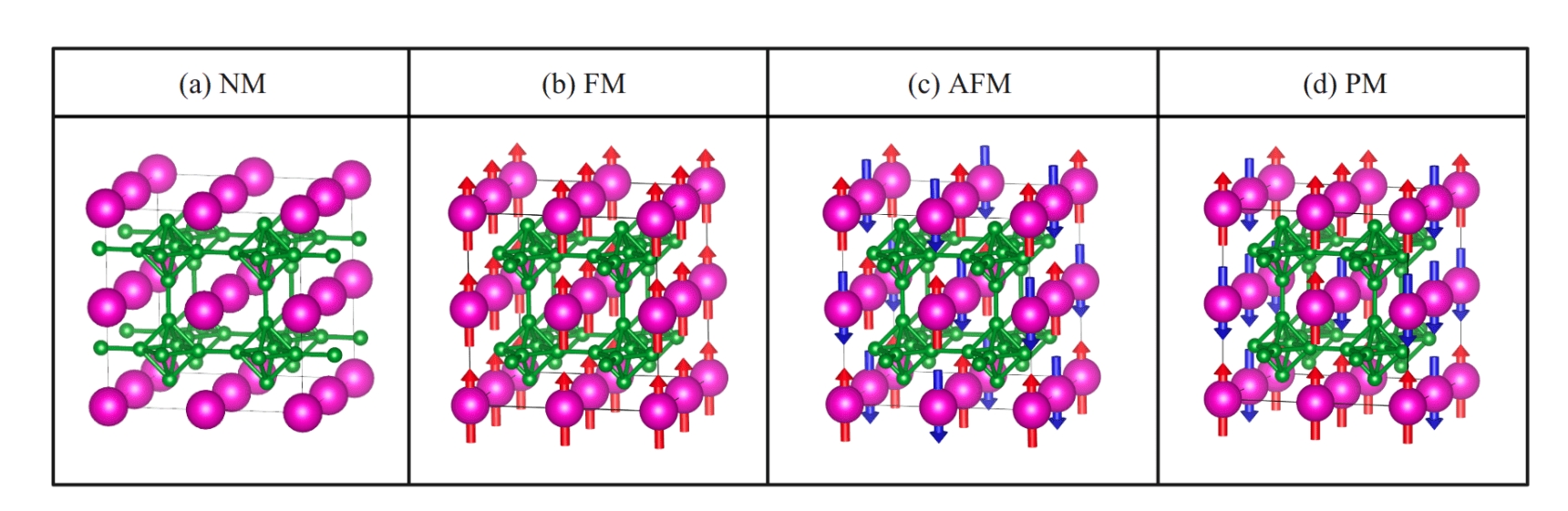
Scientists investigated symmetry breaking in EuB6 and SmB6, revealing how alterations to the arrangement of atomic magnetic moments influence electronic properties. The research team employed spin-polarized Density Functional Theory calculations, systematically comparing magnetic configurations to understand the impact of symmetry breaking on the materials’ behavior. Results demonstrate that a paramagnetic configuration generates distinct magnetic environments around the rare-earth atoms, leading to variations in the exchange field. These variations induce symmetry breaking in the electronic and magnetic properties of both europium and samarium.
The team’s calculations provide an alternative explanation for experimental observations from X-ray Absorption Spectroscopy measurements, which previously suggested the presence of multiple atomic environments within EuB6 and SmB6. This work proposes that the observed multiple environments arise from the symmetry-broken exchange field. Further analysis reveals that breaking the symmetry of the atomic magnetic moments lowers the total energy of the system, making the symmetry-broken state energetically favorable. This symmetry breaking leads to substantial variations in magnetization and charge density, highlighting the fundamental role of local spin symmetry breaking in defining material properties. The research confirms that the exchange field is crucial in magnetic environments and significantly impacts atomic-scale properties. The team’s findings are consistent with experimental observations of coexisting atomic environments in EuB6 and SmB6, supporting the proposed link between symmetry-broken exchange fields and local electronic and magnetic behavior.
Magnetic Symmetry Breaking Explains Rare-Earth Properties
This research demonstrates that symmetry breaking, arising from differing magnetic environments, can explain the electronic properties of materials like EuB6 and SmB6 without invoking a mixed-valence configuration. Through spin-polarized Density Functional Theory calculations, scientists systematically compared magnetic configurations, revealing that a paramagnetic state generates distinct exchange fields for rare-earth atoms. These varying fields induce symmetry breaking in the electronic and magnetic properties, leading to non-equivalent atomic environments despite a symmetric crystal structure. The team showed that this subtle distinction in magnetic environments directly impacts the electronic structure and can account for observed structures in X-ray Absorption Spectroscopy measurements.
The findings offer an alternative explanation for experimental results previously attributed to a mixed-valence state, suggesting that local magnetic environments, rather than charge distribution, are key to understanding the behaviour of these materials. To confirm the robustness of their conclusions, the researchers performed additional calculations, including those incorporating on-site interactions and spin-orbit coupling, consistently reinforcing the role of symmetry breaking driven by magnetic environments. While the study successfully explains existing data, the authors acknowledge that further investigation is needed to fully explore the interplay between magnetic symmetry breaking and electronic properties in a wider range of quantum materials.
👉 More information
🗞 Exchange field induced symmetry breaking in quantum hexaborides
🧠 ArXiv: https://arxiv.org/abs/2511.05738

