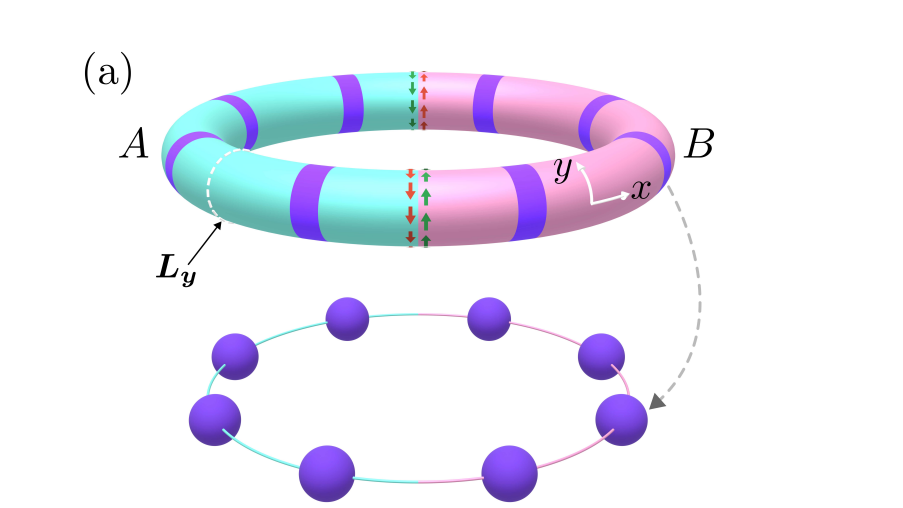
The pursuit of exotic states of matter has led scientists to investigate fractional quantum Hall (FQH) effects, typically observed in two-dimensional electron systems, within simplified, one-dimensional models. Hrushikesh Sable, Subrata Das, and Vito W. Scarola, all from Virginia Tech, now demonstrate characteristics of a bosonic FQH state within a tilted, extended Bose-Hubbard model. The team reveals that introducing a static tilt and reducing kinetic energy leads to the conservation of dipole moment, effectively creating conditions for emergent FQH correlations. This achievement establishes a pathway for exploring complex quantum phenomena using simpler, time-reversal invariant models and opens new avenues for understanding and potentially harnessing the properties of these intriguing states of matter.
Applying a strong tilt induces conservation of dipole moment, enabling the emergence of FQH-like behaviour. Employing analytical calculations, exact diagonalization, and density matrix renormalization group techniques, researchers analyse the energy and entanglement properties to reveal these FQH correlations. These findings establish the presence of fractional quantum Hall behaviour within this tailored system, offering insights into correlated quantum phenomena.
Bose-Hubbard models (BHMs) were initially developed to study the quantum liquid phases of helium and have since proven versatile in modelling diverse systems, including helium supersolids, disordered superconductors, and ultracold atoms. This research investigates the use of quenched kinetics in simple, time-reversal invariant eBHMs to explore emergent phenomena.
Lattice Bosons Mimic Fractional Quantum Hall States
This research demonstrates that a lattice system of interacting bosons can exhibit behaviour reminiscent of the fractional quantum Hall effect. The team designed a model that captures key features of FQH states, such as fractionalization of excitations and topological order, but realized within a lattice structure. They employed a combination of analytical calculations and numerical techniques to explore the ground state properties of this model.
Tilted Bose-Hubbard Model Hosts Fractional Hall Correlations
This research demonstrates the emergence of bosonic fractional Hall (FQH) correlations within a one-dimensional extended Bose-Hubbard model subjected to a strong tilt. By applying analytical, exact diagonalization, and density matrix renormalization group techniques, scientists revealed that the tilted system exhibits properties characteristic of FQH states, specifically through the conservation of dipole moment. These findings establish a pathway for exploring emergent phenomena using quenched kinetics within relatively simple, time-reversal invariant models. The team’s work builds on previous investigations of extended Bose-Hubbard Hamiltonians and their potential to host supersolid phases.
By introducing a static tilt, they discovered a means to induce FQH-like behaviour, offering new insights into the interplay between interactions and topology in condensed matter systems. While the current study focuses on one-dimensional models, the authors suggest that similar FQH correlations may be observable in higher-dimensional systems and could connect to existing four-dimensional FQH models. Future research will explore the potential for vortex attachment and the possibility of realizing a bosonic Moore-Read state at specific fillings, as well as determining the minimal interaction range needed to observe topologically robust scaling parameters.
👉 More information
🗞 Quantum Hall correlations in tilted extended Bose-Hubbard chains
🧠 ArXiv: https://arxiv.org/abs/2510.27685