

The quest to reconcile quantum mechanics and general relativity drives physicists to explore the boundaries of what’s possible, and a key step involves testing fundamental principles with increasingly massive objects. Omer Feldman, from [Institution name], and colleagues, are pioneering work towards building a matter-wave interferometer capable of achieving this, using nanodiamonds as test particles. Their recent work details a crucial advancement in this field, successfully trapping and cooling these nanodiamonds within a vacuum at extremely low temperatures, a feat necessary for observing their quantum behaviour. This achievement represents a significant step towards probing the interface between quantum mechanics and gravity, potentially opening new avenues for testing theories about the very nature of spacetime and the quantization of gravity itself.
This innovative approach seeks to explore how gravity and quantum phenomena interact, potentially revealing deviations from established quantum theory and offering insights into the nature of gravity itself. The research focuses on testing objective collapse models, which propose that quantum superpositions are not indefinite but spontaneously collapse, and investigating whether gravity is fundamentally quantized. Nanodiamonds are uniquely suited to this task because they are massive enough to be sensitive to gravitational effects, yet small enough to exhibit quantum behavior.
Levitating these tiny crystals in ultra-high vacuum isolates them from external disturbances that would otherwise destroy their delicate quantum state, allowing for precise control and measurement of the nanodiamond’s position, motion, and internal quantum state, utilizing the nanodiamond’s internal nitrogen-vacancy (NV) centers as highly sensitive quantum sensors. The experimental setup employs either optical levitation, using focused laser beams to suspend the nanodiamond, or Paul traps, which utilize electric fields for trapping. Maintaining an ultra-high vacuum environment is critical, minimizing collisions with gas molecules and preserving quantum coherence. Sophisticated cooling techniques, including laser cooling, feedback cooling, and autocatalytic cooling using the NV center, reduce the nanodiamond’s motion to near its lowest energy state.
Precise control and measurement of the nanodiamond’s position and velocity are achieved through optical interferometry and NV center readout. Researchers are actively searching for spontaneous localization, evidence of the nanodiamond collapsing from a superposition of positions, and meticulously testing decoherence rates to compare observed values with theoretical predictions. They are also attempting to observe how gravity affects the phase and coherence of quantum superpositions, pushing the boundaries of our understanding of fundamental physics. Despite significant progress, challenges remain in maintaining quantum coherence and achieving sufficient isolation from environmental noise.
Improving measurement precision and scaling up experiments to utilize multiple levitated nanodiamonds are key areas of ongoing research. Combining this technology with other quantum systems, such as superconducting circuits, could lead to the development of hybrid quantum devices with unprecedented capabilities. This research program represents a cutting-edge effort to bridge the gap between quantum mechanics and gravity, utilizing levitated nanodiamonds as a unique and promising platform for exploring the fundamental laws of nature.
Nanodiamonds Levitated for Quantum Gravity Tests
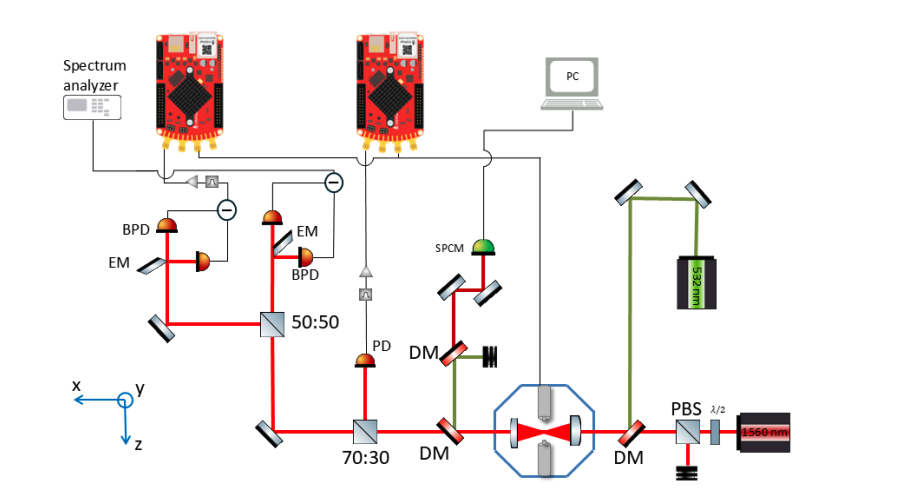
Researchers are developing a novel matter-wave interferometer using nanodiamonds as test particles, aiming to explore the intersection of quantum mechanics and general relativity. This project requires precise control over the nanodiamonds, and the team has focused on innovative techniques for trapping, cooling, and manipulating these particles in a vacuum environment. The approach centers on levitating the nanodiamonds using electric fields, allowing them to be isolated from external disturbances and observed with high precision. A key step has been accurately determining the mass and position of the nanodiamonds, achieved by carefully measuring the particle’s motion within the trap as a function of applied voltages and background gas pressure.
By analyzing the frequencies of these motions, they were able to deduce the particle’s mass with increasing accuracy, ultimately determining a radius of 91 nanometers and a mass of 9. 6 × 10⁻¹⁸ kilograms for one nanodiamond. This precise characterization is crucial for interpreting the results of the interferometer experiments. To further refine control, researchers implemented an active feedback cooling system to reduce the nanodiamond’s motion, effectively lowering its temperature to 570 millikelvin. This level of cooling represents a significant advancement in the field.
The cooling process relies on optimizing the signal-to-noise ratio and carefully calibrating the optical detection system. Addressing potential instability, the team investigated and mitigated the effects of stray electric fields. They discovered that the electrospray process used to introduce the nanodiamonds into the vacuum chamber leaves residual charge on nearby surfaces, which can distort the trapping potential over time. By carefully monitoring the trap’s performance and understanding the source of these disturbances, they were able to stabilize the system and ensure long-term precision. This attention to detail is essential for conducting sensitive measurements and achieving the goals of the experiment.
Nanodiamond Trapping Reaches Record Vacuum Levels
Researchers are making significant progress towards realizing a novel matter-wave interferometer using nanodiamonds, a crucial step in bridging the gap between quantum mechanics and general relativity. This ambitious project aims to test fundamental principles of physics in previously unexplored regimes and potentially probe the nature of gravity at the quantum level. A key achievement has been the successful trapping of a nanodiamond within an ultra-high vacuum environment, reaching a pressure of 1 × 10⁻⁸ mbar, the deepest vacuum yet achieved for a nanodiamond in a Paul trap. This level of vacuum is essential because it minimizes disturbances from gas molecules, allowing for longer and more precise measurements within the interferometer.
The team has also demonstrated effective cooling of the trapped nanodiamond to 570 millikelvin, bringing the experiment closer to the temperature requirements for a short-duration interferometer. Surprisingly, the nanodiamond remained stably trapped even when illuminated with a high-intensity laser, up to 165 Watts per millimeter squared, defying expectations that such intense light would cause the particle to degrade or be lost from the trap. This resilience opens up possibilities for using high-intensity light for detection and control within the interferometer. These advancements address a major obstacle in the field, as maintaining stable trapping under ultra-high vacuum conditions was previously considered a significant challenge.
Theoretical calculations indicate that the achieved vacuum level is sufficient for the targeted short-duration interferometer, with a duration of 100 microseconds. Furthermore, the researchers observed a wide range of charge-to-mass ratios in the nanodiamonds, demonstrating control over the particle’s initial trapping conditions. While frequency drift remains a challenge, requiring several days for system relaxation after each trapping event, these results collectively represent a substantial step forward in the development of a groundbreaking instrument for exploring the fundamental laws of physics.
🗞 Trapping and cooling of nanodiamonds in a Paul trap under ultra-high vacuum: Towards matter-wave interferometry with massive objects
🧠 ArXiv: https://arxiv.org/abs/2508.14687


