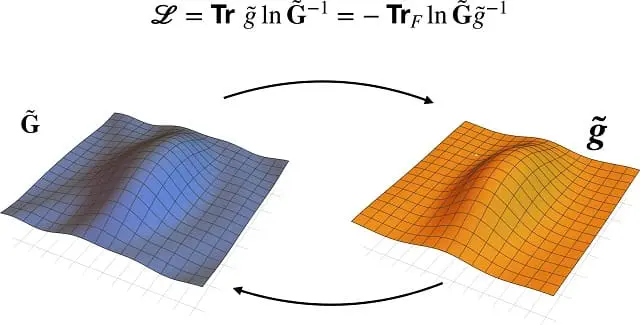
Professor Bianconi’s study, titled “Gravity from Entropy,” presents a novel approach deriving gravity from quantum relative entropy, bridging quantum mechanics and Einstein’s general relativity. By treating spacetime metrics as quantum operators and employing quantum relative entropy, the research introduces an entropic action that quantifies metric differences, leading to modified Einstein equations.
These equations align with classical general relativity under low-energy conditions and predict a small positive cosmological constant consistent with observed cosmic expansion. The study also introduces the G-field, which may offer new insights into dark matter’s nature.
Introduction to Gravity from Entropy
The study titled Gravity from Entropy introduces a novel approach to deriving gravity from quantum relative entropy, offering a potential bridge between quantum mechanics and Einstein’s general relativity. This work addresses the long-standing challenge of unifying these two fundamental theories, which have historically been difficult to reconcile due to their differing frameworks for describing physical phenomena at vastly different scales.
Professor Bianconi’s research treats the metric of spacetime—a central concept in general relativity—as a quantum operator. By leveraging quantum relative entropy, a concept from quantum information theory, the study quantifies the difference between the spacetime metric and the metric induced by matter fields. This approach leads to modified Einstein equations that reduce to classical general relativity under low-energy conditions but also predict the emergence of a small, positive cosmological constant.
A key innovation in this work is the introduction of the G-field, an auxiliary field acting as a Lagrangian multiplier. The G-field plays a crucial role in the modified gravitational equations and suggests new interpretations for dark matter, a mysterious component of the universe’s mass that remains undetected. This theory not only advances our understanding of gravity but also opens avenues for exploring other cosmological puzzles.
The implications of this research are far-reaching. Linking gravity to quantum information theory provides a potential pathway toward a unified theory of quantum gravity. Additionally, the predicted emergent cosmological constant aligns well with observations of the universe’s accelerated expansion, addressing a significant discrepancy in theoretical predictions. While further investigation is required to fully explore these implications, this work represents a meaningful step forward in understanding the fundamental nature of spacetime and gravity.
The Challenge of Quantum Gravity
The challenge of unifying quantum mechanics with general relativity has long been a central problem in theoretical physics. While quantum mechanics successfully describes the behavior of particles at microscopic scales, general relativity governs the dynamics of spacetime on macroscopic scales. The incompatibility between these two frameworks arises from their fundamentally different descriptions of reality: quantum mechanics relies on probabilistic outcomes and discrete units of energy, while general relativity is rooted in a smooth, continuous geometry of spacetime.
Professor Bianconi’s work addresses this challenge by treating the metric of spacetime as a quantum operator. This approach draws upon quantum relative entropy, a concept from quantum information theory, to quantify the difference between the spacetime metric and the metric induced by matter fields. By doing so, the study derives modified Einstein equations that reduce to classical general relativity in low-energy regimes but also predict the emergence of a small, positive cosmological constant.
The introduction of the G-field as an auxiliary field further extends this framework. Acting as a Lagrangian multiplier, the G-field plays a critical role in the modified gravitational equations and suggests new interpretations for dark matter. This innovation not only advances our understanding of gravity but also opens avenues for exploring other unresolved questions in cosmology.
The implications of this research are significant. By linking gravity to quantum information theory, it offers a potential pathway toward a unified theory of quantum gravity. Additionally, the predicted emergent cosmological constant aligns well with observations of the universe’s accelerated expansion, addressing a key discrepancy in theoretical predictions. While further investigation is required to fully explore these implications, this work represents a meaningful step forward in understanding the fundamental nature of spacetime and gravity.
The Role of Entropy and the G-Field
The role of entropy in Bianconi’s model is central to deriving gravitational dynamics. By applying quantum relative entropy, the framework quantifies the difference between the spacetime metric and matter-induced metrics, leading to a novel expression for gravitational interactions. This approach replaces traditional geometric descriptions with an information-theoretic foundation, where entropy gradients drive the evolution of spacetime.
The G-field emerges as a critical component in this formulation, acting as a Lagrange multiplier that enforces consistency between the entropic description and dynamical equations. Mathematically, it modifies the Einstein-Hilbert action by introducing terms proportional to the divergence of the metric tensor. This modification ensures that gravitational dynamics remain consistent with quantum information principles while preserving general covariance.
The implications for dark matter are particularly intriguing. The G-field’s behavior suggests that apparent missing mass in galaxies could arise from entropic effects rather than unseen particles. By treating dark matter as a manifestation of spacetime geometry, this framework offers an alternative explanation to particle-based theories, potentially resolving long-standing discrepancies in galactic rotation curves.
In cosmology, the model predicts a small positive cosmological constant emerging naturally from entropic considerations. This aligns with observations of cosmic acceleration without requiring fine-tuning or exotic matter. The theory thus provides a unified description of gravitational phenomena across scales, from local dynamics to large-scale structure formation.
By linking gravity to quantum information theory, Bianconi’s work bridges two fundamental aspects of physics previously treated as separate domains. This synthesis not only advances our understanding of spacetime but also opens new avenues for addressing unresolved questions in cosmology and quantum gravity.
Wider Implications of the Research
Bianconi’s integration of entropy into gravitational dynamics offers fresh insights into quantum gravity by redefining spacetime’s behavior at quantum levels. By treating entropy gradients as drivers of spacetime evolution, the model predicts novel phenomena in extreme conditions such as black holes or the early universe. This approach suggests that traditional geometric descriptions may be insufficient, necessitating a shift towards information-theoretic foundations for understanding gravitational interactions.
The framework also introduces potential observable effects that could be tested empirically. Modifications in gravitational wave patterns and anomalies in the cosmic microwave background are proposed as signatures of Bianconi’s model. These predictions open avenues for future research, enabling empirical validation through current and upcoming astronomical observations, thereby bridging theoretical advancements with observational data.
More information
External Link: Click Here For More