

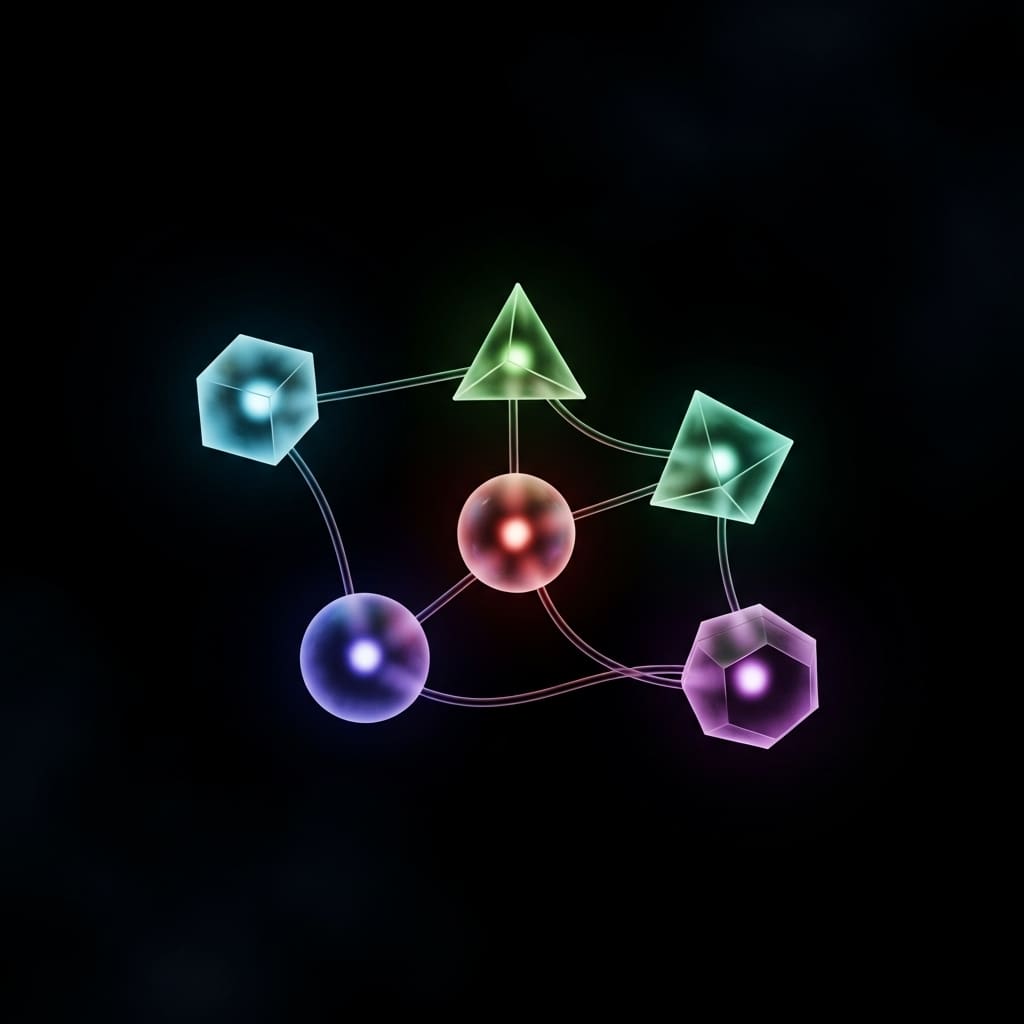
Graph theory provides powerful tools for understanding complex systems, and researchers are increasingly applying these methods to the realm of quantum mechanics. Rohit Kumar and Satyabrata Adhikari, both from Delhi Technological University, are pioneering a new approach to quantum correlations by introducing a novel class of quantum states, termed -graph states, constructed from the underlying structure of graphs. This work establishes a direct link between the properties of a graph, its connections and arrangement, and the resulting quantum state, differing from conventional methods and offering a tunable parameter to control quantum behaviour. Importantly, the team derives a clear condition for identifying these states and develops a practical detection criterion based on readily measurable quantities, potentially enabling experimental verification of structured quantum correlations and opening new avenues for quantum information processing.
Combinatorial structures in quantum correlation: A new perspective Graph-theoretic structures play a central role in describing and analysing quantum systems. This work introduces a new class of quantum states, called Aα-graph states, constructed from either unweighted or weighted graphs by combining the degree matrix and the adjacency matrix. These states represent a novel approach to defining quantum correlations based on the underlying graph structure, potentially offering new insights into entanglement and quantum information processing. The construction incorporates a parameter α, allowing researchers to tune the relative weighting of the degree and adjacency contributions, creating a family of states with varying properties. This methodology establishes a connection between graph theory and quantum mechanics, opening avenues for exploring quantum phenomena through combinatorial structures and vice versa.
Initially, the researchers established conditions under which the resulting quantum operator represents a valid quantum state. Subsequently, they derived a positive partial transposition (PPT) condition for Aα-graph states, expressed in terms of graph parameters. This PPT condition involves only the Frobenius norm of the adjacency matrix, the degrees of the vertices and the total number of vertices. These results were obtained for simple graphs.
Graph States and Quantum Entanglement Generation
Researchers have introduced a new class of quantum states, termed Aα-graph states, which are constructed directly from the adjacency and degree matrices of graphs. These states incorporate a tunable mixing parameter, α, allowing for control over their properties and establishing a direct link between graph structure and quantum correlations. The team demonstrated that identifying the appropriate range for α is crucial for ensuring the physical validity of these states, paving the way for generating entangled states using graph theory. The work establishes a novel connection between graph theory and moments-based quantum entanglement detection, offering a new framework for characterizing quantum correlations in structured states.
Specifically, the researchers derived expressions for key entanglement indicators, such as the second and third moments of the partial transpose, in terms of graph-theoretic parameters like vertex degrees and edge weights. This formulation allows for the potential detection of entanglement through experimentally accessible measurements on randomised quantum systems. The authors acknowledge that further research is needed to fully classify the entanglement properties of Aα-graph states for different graph families and to extend the formalism to more complex, multipartite systems. They suggest that these states may be particularly relevant for applications in noisy intermediate-scale quantum devices, where graph-structured interactions are common. The team’s findings open several avenues for future investigation, including exploring the potential of these states for quantum information processing and communication.
Graph States and Tunable Quantum Entanglement
Researchers have introduced a new class of quantum states, termed Aα-graph states, which are constructed directly from the adjacency and degree matrices of graphs. These states incorporate a tunable mixing parameter, α, allowing for control over their properties and establishing a direct link between graph structure and quantum correlations. The team demonstrated that identifying the appropriate range for α is crucial for ensuring the physical validity of these states, paving the way for generating entangled states using graph theory. The work establishes a novel connection between graph theory and moments-based quantum entanglement detection, offering a new framework for characterizing quantum correlations in structured states.
Specifically, the researchers derived expressions for key entanglement indicators, such as the second and third moments of the partial transpose, in terms of graph-theoretic parameters like vertex degrees and edge weights. This formulation allows for the potential detection of entanglement through experimentally accessible measurements on randomised quantum systems. The authors acknowledge that further research is needed to fully classify the entanglement properties of Aα-graph states for different graph families and to extend the formalism to more complex, multipartite systems. They suggest that these states may be particularly relevant for applications in noisy intermediate-scale quantum devices, where graph-structured interactions are common. The team’s findings open several avenues for future investigation, including exploring the potential of these states for quantum information processing and communication.
👉 More information
🗞 Combinatorial structures in quantum correlation: A new perspective
🧠 ArXiv: https://arxiv.org/abs/2512.15686

