On April 14, 2025, researchers published Accelerating large-scale linear algebra using variational quantum imaginary time evolution, detailing the integration of a novel quantum approach into Ansys’s LS-DYNA software. This method enhances computational efficiency for complex simulations by reducing processing time through advanced graph partitioning techniques.
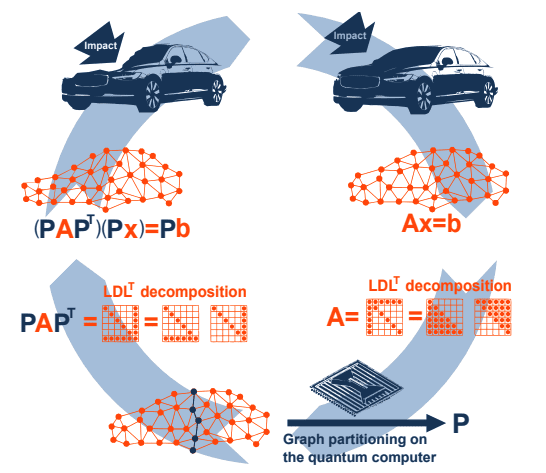
The research introduces a quantum approach using variational quantum imaginary time evolution (VarQITE) to optimize graph partitioning for large sparse linear systems in finite element analysis (FEA). Integrated into Ansys’s LS-DYNA software, this hybrid quantum-classical method accelerates FEA simulations across diverse applications, including blood pump dynamics and automotive crash testing. Results demonstrate up to 12% reduction in wall-clock time for certain problems. Additionally, a classical heuristic inspired by Fiduccia-Mattheyses enhances VarQITE solutions from hardware runs, showcasing quantum computing’s potential for large-scale FEA in the NISQ era.
In engineering simulations, solving large-scale problems often requires efficiently partitioning graphs into smaller components—a process known as graph partitioning. This task is critical for optimizing computational workflows across distributed systems. However, traditional methods for graph partitioning can be computationally intensive and may not always yield optimal results, particularly for complex real-world applications such as crash simulations or stress analysis in large structures.
IonQ, a leader in quantum computing, has developed a novel approach to address these challenges by leveraging quantum algorithms to solve graph partitioning problems (GPPs) with greater efficiency. Their research demonstrates the potential of quantum computing to revolutionize computational workflows, offering faster and more accurate solutions compared to classical methods.
A Hybrid Framework for Enhanced Efficiency
IonQ’s method combines quantum and classical computing resources in a hybrid framework designed to tackle GPPs. By utilizing quantum algorithms, they have developed a technique that significantly outperforms traditional heuristics commonly employed in engineering simulations. This innovation is particularly relevant for industries where computational efficiency can translate into substantial cost savings and improved design outcomes.
The research focuses on coarsening graphs—reducing their complexity while preserving essential features—to make them more manageable for quantum processing. IonQ’s method ensures that the partitions remain balanced, maintaining a nodal weight balance within a 5% tolerance. This precision is crucial for applications where even minor imbalances can lead to significant computational inefficiencies.
Key Findings: Improved Efficiency and Scalability
IonQ’s experiments demonstrate that their quantum-based approach achieves faster convergence rates compared to classical methods. The results show a marked improvement in computational efficiency, with reductions in wall-clock time (WCT) for linear system solves across various problem sizes. This enhanced performance is particularly evident when scaling up the number of nodes in coarsened graphs, where IonQ’s solutions consistently outperform traditional partitioning techniques.
The implications of these findings are profound for industries reliant on large-scale simulations. By reducing computational overhead, IonQ’s method enables engineers and researchers to perform complex analyses more quickly, facilitating faster design iterations and better decision-making processes.
A Quantum Leap in Engineering Workflows
IonQ’s research underscores the growing potential of quantum computing to transform engineering workflows. The ability to solve GPPs more efficiently not only accelerates simulations but also opens new possibilities for tackling previously intractable problems. This advancement could lead to more accurate and timely results in fields ranging from automotive design to aerospace engineering.
Moreover, IonQ’s hybrid approach demonstrates the practicality of integrating quantum resources with existing classical infrastructure. By building on established workflows, their method provides a pathway for industries to adopt quantum computing without overhauling their current systems.
Looking ahead, IonQ plans to further refine their methodology by exploring larger-scale implementations and more complex graph structures. The goal is to continue improving the scalability of their approach while addressing any limitations encountered in real-world applications. This ongoing research will be crucial for ensuring that quantum computing remains a viable and effective tool for solving increasingly intricate engineering challenges.
Paving the Way for Quantum-Driven Innovation
IonQ’s advancements in graph partitioning represent a significant milestone in the application of quantum computing to real-world problems. By enhancing computational efficiency and scalability, their research offers a promising avenue for industries seeking to optimize their simulation workflows. As quantum technologies continue to evolve, IonQ’s work serves as a testament to the transformative potential of quantum-driven innovation in engineering and beyond.
👉 More information
🗞 Accelerating large-scale linear algebra using variational quantum imaginary time evolution
🧠 DOI: https://doi.org/10.48550/arXiv.2503.13128