

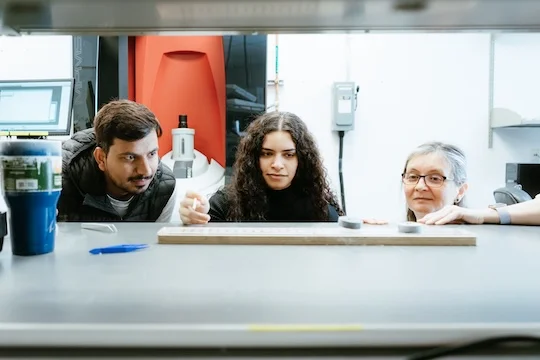
The pursuit of room-temperature superconductors has garnered significant attention in recent years, as these materials can revolutionize energy efficiency by enabling the transmission of electrical energy without resistance.
A team of international researchers, led by Päivi Törmä of Aalto University in Finland and including Emilia Morosan of Rice University, has been awarded a multimillion-dollar grant from The Kavli Foundation to explore the development of next-generation superconductors through the application of artificial intelligence and quantum geometry.
By harnessing the power of quantum geometry in 3D materials, the researchers aim to create superconductors that can function at unprecedentedly high temperatures, thereby overcoming the limitations of current superconductors, which require extreme cooling. This innovative approach has far-reaching implications for advancing our understanding of material design. It could potentially lead to transformative breakthroughs in energy efficiency, particularly in computing and other fields where energy demands are continually escalating.
Introduction to Quantum Geometry-Enabled Superconductivity
The Kavli Foundation has awarded a multimillion-dollar grant to an international research collaboration led by Päivi Törmä of Aalto University in Finland to develop and test next-generation superconductors through artificial intelligence and quantum geometry. This initiative aims to push the boundaries of quantum materials science and superconductivity to achieve room-temperature superconductivity by 2033. The research team, which includes Emilia Morosan from Rice University, will focus on synthesizing and characterizing new materials that can function at unprecedentedly high temperatures.
The potential benefits of room-temperature superconductors are significant, as they could revolutionize energy efficiency by transmitting electrical energy without resistance, minimizing energy loss. Current superconductors require extreme cooling to temperatures between minus 150 C and minus 270 C, which offsets their energy efficiency benefits. Room-temperature superconductors could eliminate this hurdle, enhancing energy efficiency in computing and beyond. Superconductors form Cooper pairs of electrons, enabling resistance-free current flow that contrasts with traditional conductors, where electrical resistance generates heat.
The research collaboration will employ two groundbreaking approaches to advance superconductivity: flat band superconductivity and AI-driven material discovery. Flat band superconductivity involves investigating materials in which the electronic bands are flat, leading to high-temperature superconductivity. AI-driven material discovery uses machine learning algorithms to identify new materials with potential superconducting properties. The team will also explore the interplay between crystal structure, magnetism, and superconductivity, as well as the role of quantum geometry in 3D materials.
Materials Design and Synthesis
Emilia Morosan’s research at Rice University focuses on materials design, synthesis, and characterization. Her lab employs advanced materials synthesis techniques such as crystal growth from molten fluxes, vapor transport, and solid-state reactions coupled with detailed structural and physical property measurements. The goal is to create materials with high critical parameters (temperature, field, current) and can be fashioned into wires or devices to enable applications.
Morosan notes that the design of high-temperature superconductors has been slow due to the extreme conditions required to stabilize some candidate materials. Using quantum geometry in 3D materials is a paradigm shift in the search for practical superconductors. Magnetism and superconductivity were traditionally thought to be mutually exclusive, but evidence suggests that magnetic interactions could promote superconductivity, particularly in certain high-temperature superconductors.
Quantum Geometry and Its Potential Implications
Quantum geometry refers to the study of geometric properties of materials at the quantum level. The concept has the potential to lead to significant advancements in superconductivity and other quantum effects. Jeff Miller, nanoscience program officer at The Kavli Foundation, emphasizes that more theoretical work is needed to guide quantum geometry research, as well as continued experiments in 2D materials like graphene and the discovery and synthesis of 3D materials exhibiting quantum geometry effects.
Amy Bernard, vice president of science at The Kavli Foundation, highlights the potential practical implications of this research. “The concept of quantum geometry could lead to significant advancements in superconductivity and other quantum effects,” she says. “This research could uncover materials that dramatically reduce energy consumption in computationally intensive processes, which have far-reaching implications for addressing sustainability in the long term.”
Collaborative Research Team
The collaborative research team includes experts from various institutions around the world, including Milan Allan at Ludwig-Maximilians-Universität, Dmitri Efetov at Ludwig-Maximilians-Universität, Claudia Felser at Max Planck Institute for Chemical Physics of Solids, Harold Hwang at Stanford University, Miguel Marques at Ruhr University, Priscila Rosa at Los Alamos National Lab, and Päivi Törmä at Aalto University.
The Kavli Foundation, the Klaus Tschira Foundation, and Kevin Wells, a committed environmental leader and science philanthropist support the team. The research can potentially make significant breakthroughs in superconductivity and quantum materials science, with far-reaching implications for energy efficiency, sustainability, and technological innovation.
Foundations and Funding
The Kavli Foundation was established in 2000 by Fred Kavli to stimulate fundamental research in astrophysics, nanoscience, neuroscience, and theoretical physics. The foundation also honors scientific discoveries with The Kavli Prize. The Klaus Tschira Foundation supports natural sciences, mathematics, and computer science, as well as the appreciation of these subjects, through research, education, and science communication.
Kevin Wells is a science philanthropist who provides seed funding to incubate new directions in scientific research, including fundamental physics, quantum science, and condensed matter physics. His recent philanthropy includes support for research projects in these areas, with a focus on addressing sustainability and environmental challenges. The collaborative research team is grateful for the support of these foundations and individuals, which enables them to pursue groundbreaking research in quantum geometry-enabled superconductivity.
External Link: Click Here For More


