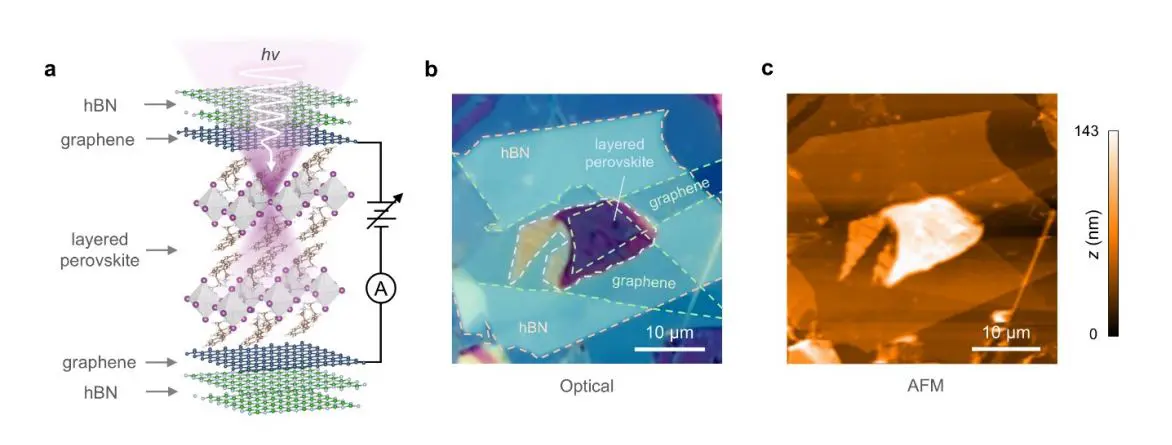
Layered hybrid perovskites represent a promising new frontier in optoelectronics, and researchers are now uncovering the fundamental mechanisms driving their unusual behaviour. Zihan Zhang, Sihan Chen, and Mingfeng Chen, alongside colleagues at Florida State University, the University of Chicago, Washington University, and Yale University, demonstrate a geometric origin for spontaneous photocurrent in these materials. The team’s work reveals that subtle ionic displacements within the crystal structure, combined with the material’s unique band structure, generate a shift current, a flow of charge arising not from an applied voltage, but from the material’s inherent asymmetry. This discovery challenges previous assumptions about charge transport in layered perovskites and opens up exciting possibilities for designing novel optoelectronic devices based on these geometrically-driven effects.
Perovskite Heterostructure Exhibits Strong Optical Nonreciprocity
This research details the investigation of a two-dimensional perovskite heterostructure, (PEA)PbI4, encapsulated within hexagonal boron nitride and contacted with graphene electrodes. The study reveals strong nonreciprocal and nonlinear optical responses stemming from the non-centrosymmetric crystal structure of the perovskite. Scientists observed a significant photocurrent generated under optical excitation, dependent on both excitation power and polarization, demonstrating non-reciprocity, meaning the current doesn’t reverse with the applied field. The perovskite flake also exhibited strong second harmonic generation, confirming its non-centrosymmetric nature, with the intensity of this effect increasing quadratically with excitation power.
Researchers attribute these effects to slight displacements of ions within the perovskite crystal structure, breaking its symmetry. They developed a theoretical model to explain the observed phenomena, highlighting the importance of interlayer interactions and the resulting shift currents. This model demonstrates that the non-centrosymmetric structure generates shift currents responsible for the observed photocurrent, and accurately predicts its dependence on excitation power and polarization. Calculations confirm that the photocurrent is primarily driven by shift currents, rather than direct electron transitions.
The study also reveals a unique temperature dependence of the photocurrent, with excitonic transitions exhibiting an opposite trend compared to transitions above the bandgap and the second harmonic generation response. The team fabricated a high-quality heterostructure by stacking hexagonal boron nitride, perovskite, and graphene flakes using a dry-transfer technique. They then performed detailed optoelectronic measurements, including current-voltage characteristics, photocurrent measurements, and second harmonic generation spectroscopy. This research demonstrates the potential of non-centrosymmetric 2D perovskites for developing novel optoelectronic devices based on shift currents and nonlinear optical effects, providing a comprehensive understanding of the underlying mechanisms and laying the foundation for future research in this exciting field.
Perovskite Flake Devices for Charge Transport Studies
Scientists engineered a novel device architecture to investigate charge transport in layered (PEA)2PbI4 perovskite crystals, focusing on the geometric origin of observed photocurrents. They fabricated two-terminal devices by sandwiching thin flakes, approximately 100nm thick and 10μm across, between few-layer graphene electrodes. These flakes were exfoliated from monolithic crystals, naturally cleaving along the 2D planes to ensure optimal crystalline orientation for measurements. To prevent degradation, the devices were encapsulated using thin flakes of hexagonal boron nitride, maintaining the perovskite’s integrity during characterization.
Characterizing cross-plane charge transport with a 355-nm laser revealed a pronounced photoresponse in the layered perovskite. Resistance measurements demonstrated a significant drop from greater than 100 TΩ in the dark to 23 GΩ under an optical power of 50 μW, indicating high crystallinity and a low density of trap states. Crucially, the study observed a nonreciprocal photocurrent, consistently registering an open-circuit voltage of 50mV and a short-circuit current that scaled linearly with the fourth power of illumination. To understand this response, scientists employed optical second harmonic generation as a sensitive probe of noncentrosymmetric crystals.
Exciting (PEA)2PbI4 flakes with a 784-nm pulsed laser, they detected pronounced second harmonic generation signals, confirming the absence of inversion symmetry. The intensity of second harmonic generation scaled quadratically with excitation power, consistent with theoretical predictions, and exhibited an anisotropic polar pattern mirroring that of the spontaneous photocurrent. This correlation strongly suggested that in-plane crystal polarization was responsible for both the nonreciprocal charge transport and the nonlinear optical response. To uncover the microscopic origin of these effects, the team developed a theoretical model of the layered perovskite, incorporating ionic displacements from centrosymmetric coordinates, specifically shifting lead ions and shearing iodine ions to break inversion symmetry, mirroring reported distortions of the [PbI6]4- octahedra. Validating the model, calculations accurately reproduced the experimental observations, confirming that these structural deformations are crucial for enabling the observed nonreciprocal transport and nonlinear optical responses.
Shift Current Drives Unexpected Photocurrent in Hybrid Crystals
This study uncovers a geometric origin of spontaneous photocurrent in the layered material (PEA)₂PbI₄, revealing an unconventional mechanism for charge carrier motion. Despite the expectation that charge transport would be constrained within the two-dimensional planes, researchers observed a robust photocurrent flowing along a specific crystallographic direction. Using a tight-binding theoretical framework, they identified shift current as the microscopic origin of this effect, arising from ionic displacements away from centrosymmetric positions and amplified by the high density of electronic bands in the layered hybrid structure. These structural distortions break out-of-plane mirror symmetry, effectively doubling the unit cell along the z-axis.
Comparison of the tight-binding results with density functional theory calculations validated the model’s accuracy, particularly for the valence and conduction bands dominated by hybridized lead and iodine orbitals. The negligible contribution from the organic components enabled a simplified description focused on the inorganic layers, coupled through an effective interaction of −2.11 eV. Both experimental measurements and theoretical analysis confirmed that the photocurrent originates from shift current rather than conventional diffusive transport. Calculations of the shift vector revealed strong asymmetry in momentum space, especially near the Γ point, where broken inversion symmetry has the greatest impact.
Finite shift vectors appear near the optical bandgap and increase with photon energy, indicating that the strongest photocurrent occurs at higher energies. Notably, the calculated shift conductivity closely matches the experimentally measured photocurrent spectrum. Optimal agreement between theory and experiment was achieved using ionic displacements of δx = 0.01a, δy = 0.02a, and δs = 0.03a, with a = 8.74 Å. Overall, these findings demonstrate how symmetry breaking and geometric effects in low-dimensional materials can be harnessed to engineer new optoelectronic functionalities.
Geometric Origin of Perovskite Photocurrent Revealed
This research demonstrates a geometric origin for spontaneous photocurrent in the layered hybrid perovskite (PEA)2PbI4, challenging conventional understanding of charge transport in these materials. Contrary to expectations that charge movement across the 2D planes is limited, the team observed a significant photocurrent flowing along a specific crystalline orientation. Through a tight-binding model, they identified shift current as the underlying microscopic process, enabled by ionic displacements from centrosymmetric coordinates and enhanced by the high density of bands within the layered hybrid crystal structure.
🗞 Nonreciprocal Transport with Quantum Geometric Origin in Layered Hybrid Perovskite
🧠 ArXiv: https://arxiv.org/abs/2512.13663