Understanding the properties of Gaussian states is fundamental to many areas of science, from information processing to quantum computation, and now, Alice P. G. Hall, Carlos H. S. Vieira, and Jonas F. G. Santos, from various Brazilian Federal Universities, demonstrate a new approach to precisely estimating parameters within these states. Their work centres on a novel method of preparing these states using noncommutative Gaussian measurements, introducing parameters that can be carefully tuned to enhance precision. The team reveals that adjusting these uncertainty parameters significantly boosts the Fisher information, a key measure of estimation accuracy, and that preparing the probe state can even generate coherence, further improving performance. This research not only advances the use of coherence in precision measurement, but also offers a pathway to experimentally feasible improvements in Gaussian-based technologies using standard optical devices.
Quantum Precision Beyond Classical Limits
This extensive compilation of research papers and concepts explores the frontiers of quantum information, quantum estimation, and related fields. Central to this work is quantum estimation and metrology, focusing on how accurately we can determine parameters like phase, frequency, or other physical quantities using quantum states and measurements. Researchers consistently strive to surpass classical limits to achieve higher precision, investigating methods for establishing the tightest possible bounds on estimation precision. A significant portion of the research centers on Gaussian quantum states and channels, which are relatively easy to generate and control experimentally, forming the foundation of continuous-variable quantum information processing.
Researchers investigate how quantum coherence and entanglement, fundamental quantum resources, can be harnessed to enhance estimation precision, and explore the connection between quantum measurements, thermodynamics, and the possibility of building quantum engines. A growing area explores weak measurements, which minimally disturb the system, offering potential for revealing information without destroying coherence. Specific research areas include continuous-variable quantum information, utilizing continuous degrees of freedom like the amplitude and phase of light to encode and process quantum information. Squeezed states, reducing uncertainty in one variable at the expense of another, improve measurement precision. The potential uses of this research are far-reaching, including high-precision sensors for measuring magnetic fields, gravitational waves, time, and temperature, improved quantum imaging techniques, secure quantum communication protocols, and enhanced quantum algorithms. This work also contributes to fundamental physics by enabling more precise tests of theoretical predictions and advancing the development of a wide range of quantum technologies.
Uncertainty Parameters Enhance Gaussian State Estimation
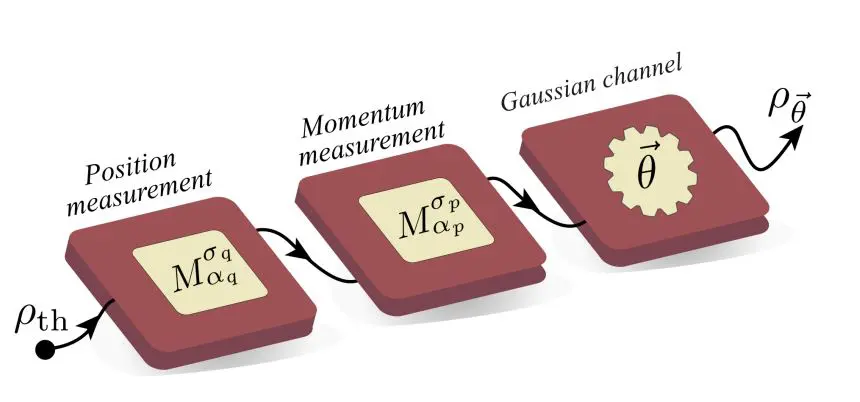
Scientists have developed a novel method for parameter estimation using Gaussian states, crucial for advancements in information processing and quantum computation. The study focuses on preparing probe states using two noncommutative Gaussian measurements performed on position and momentum observables, introducing adjustable parameters that influence estimation precision. Results demonstrate that the Fisher information, and therefore the precision of characterizing Gaussian channels, can be significantly increased by carefully adjusting these uncertainty parameters. Importantly, the research shows that both the amount of coherence generated during probe-state preparation and its rate of change with respect to the estimated parameter directly affect improvements in the Fisher information. This discovery highlights the potential of harnessing coherence to enhance precision in parameter estimation. Experiments employed techniques feasible within existing optical devices, demonstrating the practical applicability of the research, and establishing a pathway for leveraging coherence to improve metrological techniques.
Coherence Optimisation Boosts Parameter Estimation Precision
Scientists have achieved a breakthrough in quantum metrology by demonstrating how to enhance parameter estimation in Gaussian quantum systems. The work focuses on improving the precision with which physical parameters can be determined by carefully preparing the initial quantum state of a probe, specifically using noncommutative Gaussian measurements. Researchers discovered that adjusting the uncertainty parameters during probe-state preparation can directly increase the quantum Fisher information, a key metric for estimation precision. Experiments demonstrate that this coherence, induced by the noncommutative Gaussian measurements, is crucial for enhancing estimation precision. The team applied this protocol to two fundamental Gaussian channels, the attenuator and the amplifier, which serve as building blocks for Gaussian quantum information processing. This work establishes a pathway for leveraging coherence in quantum metrology and paves the way for more sensitive and accurate quantum sensors.
Coherence Optimizes Gaussian Channel Parameter Estimation
This work investigates how carefully preparing a quantum probe state can enhance the precision of estimating parameters related to Gaussian channels, which are fundamental to many quantum technologies. Researchers demonstrated that employing specific noncommutative Gaussian measurements during probe state preparation increases the amount of information obtainable about the channel, as quantified by the Fisher information. Notably, introducing coherence into the probe state further improves estimation precision, with the rate of change of this coherence being particularly important. The team applied this protocol to two common Gaussian channels, attenuators and amplifiers, showing that adjusting the uncertainty parameters during probe preparation directly relates to squeezing within the probe state, and consequently, to improved parameter estimation. These findings contribute to the growing field of quantum metrology, demonstrating a pathway to enhance the sensitivity of measurements using coherence.
🗞 Probing parameters estimation with Gaussian non-commutative measurements
🧠 ArXiv: https://arxiv.org/abs/2511.13451