

Quantum computers promise revolutionary computational power, but realising this potential requires efficiently translating complex algorithms into instructions that physical hardware can execute. Marouane Benbetka, Merwan Bekkar, and Riyadh Baghdadi, from Ecole nationale Supérieure d’Informatique, alongside Martin Kong from The Ohio State University, address a key challenge in this process, known as qubit mapping. Their research introduces a new algorithm that optimises how quantum information flows across a quantum processor, minimising the number of operations needed to connect distant qubits. By modelling circuits with a novel approach that considers the relationships between operations, the team achieves significant improvements in circuit efficiency and scalability, demonstrably outperforming existing methods on standard quantum computing benchmarks and paving the way for more complex and reliable quantum computations.
Polyhedral Model Optimizes Quantum Circuit Mapping
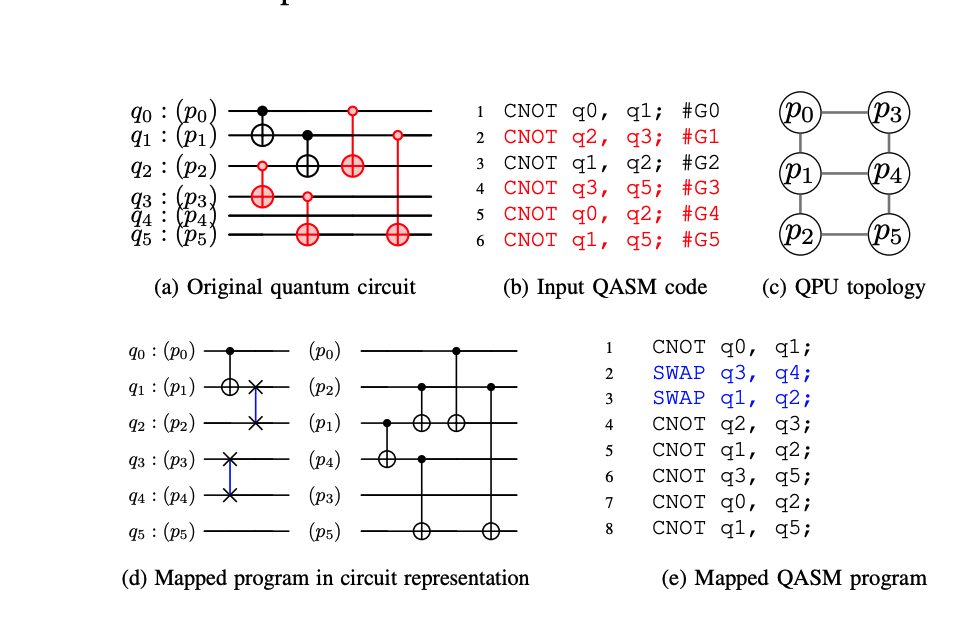
Scientists are tackling a fundamental challenge in quantum computing: efficiently translating complex quantum algorithms into instructions that can be executed on real hardware. Connecting logical qubits to the physical qubits within a quantum processor requires careful planning, often necessitating ‘SWAP’ gates which move qubit states and introduce potential errors. This research introduces a new approach leveraging concepts from traditional compiler optimization, specifically the polyhedral model, to improve qubit mapping and routing. The team’s method focuses on understanding dependencies within a quantum circuit, allowing for more informed decisions about qubit arrangement and minimizing the need for error-prone SWAP gates. By formally analyzing these dependencies, scientists aim to create a more efficient and reliable pathway for quantum computations.
Qubit Mapping via Transitive Dependence Analysis
Researchers have developed a novel qubit mapping algorithm, named Qlosure, to address the critical challenge of connecting logical and physical qubits in quantum circuits. Recognizing that current quantum programs often require qubit interactions not directly supported by the underlying hardware, the team engineered a method to insert ‘SWAP’ gates, effectively moving qubit states to enable necessary interactions. Unlike previous approaches, Qlosure harnesses transitive dependences to optimize qubit placement across the entire circuit. The study pioneered a technique to model quantum circuits using mathematical abstractions, allowing researchers to compute these transitive dependences, revealing relationships between operations across multiple layers.
This computation provides a comprehensive understanding of all possible qubit paths affected by mapping decisions. By analyzing these dependences, the algorithm partitions circuits based on dependence distances and computes distinct weights for each layer, guiding qubit placement to minimize circuit complexity. Experiments employed large datasets from established benchmark suites, alongside evaluation on quantum processors from IBM and Rigetti, to demonstrate the algorithm’s effectiveness. Results show that Qlosure consistently outperforms four existing tools, delivering improvements in circuit depth and SWAP count while maintaining competitive scalability. This advancement is crucial because minimizing circuit depth directly reduces the impact of qubit decoherence, a major obstacle in building practical quantum computers.
Qlosure Minimizes SWAP Gates and Circuit Depth
The research team developed a novel qubit mapping algorithm, named Qlosure, that significantly improves the efficiency of quantum circuits on current hardware. This work addresses the challenge of adapting circuits to Quantum Processing Units (QPUs) which are limited to nearest-neighbor connectivity, requiring the insertion of SWAP gates to move qubit states. Qlosure leverages a unique approach by modeling quantum circuits with mathematical abstractions, allowing the computation of transitive dependences, essentially predicting how SWAP gate insertions impact later stages of the circuit. Experiments demonstrate that Qlosure effectively minimizes the number of SWAP gates needed while also reducing the overall circuit depth, a key metric for quantum program performance.
Using benchmark circuits, the team evaluated Qlosure on quantum processors from IBM and Rigetti, achieving substantial improvements compared against established mapping tools. Specifically, a complex 54-qubit circuit was successfully mapped, demonstrating the algorithm’s scalability. The team achieved this by focusing on the impact of SWAP gates on future circuit regions, a capability enabled by counting transitive dependences, allowing informed decisions about qubit movement and minimizing disruptions later in the quantum computation.
Transitive Dependence Optimizes Quantum Circuit Compilation
This research presents a novel qubit mapping algorithm that significantly improves the efficiency of quantum circuit compilation. The team developed a method to harness mathematical relationships, specifically transitive dependences, to make informed decisions when inserting SWAP gates, operations necessary to adapt quantum circuits to the physical constraints of quantum processors. By considering how candidate SWAP gates impact future operations, the algorithm minimizes the number of gates along the circuit’s critical path, thereby reducing error accumulation. Evaluations conducted on multiple quantum devices and benchmark datasets demonstrate substantial improvements over existing state-of-the-art qubit mappers, achieving circuit depth reductions of up to 2.
5times and reducing the number of required SWAP gates by as much as 40 percent. These results represent a significant step towards optimizing quantum computations for near-term quantum devices. Future work could further refine the algorithm by jointly considering dependence information and device topology, alongside customized qubit-state and error-aware mapping heuristics.
🗞 Dependence-Driven, Scalable Quantum Circuit Mapping with Affine Abstractions
🧠 ArXiv: https://arxiv.org/abs/2510.27067


