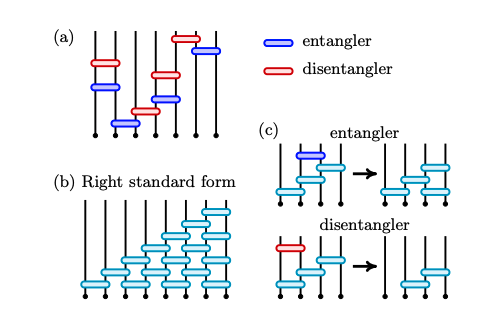
The behaviour of complex quantum systems frequently exhibits phase transitions, points at which the system’s properties change dramatically, often in response to external influences. Recent research explores these transitions within the framework of ‘unitary circuit games’, a theoretical construct where two opposing players attempt to manipulate a quantum state. Raúl Morral-Yepes, Marc Langer, Adam Gammon-Smith, Barbara Kraus, and Frank Pollmann, from the Technical University of Munich and the University of Nottingham, investigate these games using ‘matchgate’ dynamics, a specific type of quantum evolution equivalent to the behaviour of non-interacting fermions. Their work, detailed in the article “Disentangling strategies and entanglement transitions in unitary circuit games with matchgates”, introduces a novel representation of quantum states and an algorithm for tracking their evolution under disentangling operations, revealing distinct phase transition behaviours dependent on the specific rules governing the game.
Investigations within condensed matter physics increasingly extend beyond conventional states of matter to encompass more exotic quantum phases, including spin liquids. Understanding the stability of these phases and the transitions between them remains a central objective, with recent research focusing on dynamical phases and transitions arising within random quantum circuits, where quantum operations are applied in a seemingly disordered manner. A particular area of interest lies in measurement-induced phase transitions, where the act of measuring a quantum system disrupts entanglement growth and potentially drives a transition to a phase exhibiting area-law entanglement—where entanglement scales with the surface area of the system—compared to volume-law entanglement, where it scales with the system volume.
Research into quantum computation increasingly prioritises simulating complex physical systems, and a recent study details a novel methodological approach to analysing the efficiency of matchgate circuits in generating entanglement, a crucial resource for such simulations. Matchgates are specifically designed to represent the behaviour of fermions—particles like electrons that obey the Pauli exclusion principle—offering a promising avenue for modelling fermionic systems which are notoriously difficult to simulate using classical computers. The research centres on a method for representing and manipulating fermionic Gaussian states—specific types of quantum states fully characterised by their mean and covariance—using minimal matchgate circuits, allowing researchers to systematically track how entanglement changes as unitary operations—transformations that preserve quantum probabilities—are applied to the system.
A key innovation lies in the development of
A key innovation lies in the development of an algorithm based on a generalized Yang-Baxter relation, a concept borrowed from mathematical physics relating to the consistency of scattering amplitudes, providing a powerful tool for updating the representation of the fermionic Gaussian state as it evolves under unitary operations. This algorithm efficiently determines how the matchgate circuit representing the state must be modified to reflect the effects of the applied transformation, representing a significant improvement over previous methods which often required computationally expensive calculations to determine entanglement properties after each operation.
This research investigates the capabilities of matchgate circuits in generating entanglement, framing the problem within the context of ‘unitary circuit games’ where competing parties attempt to either create or destroy entanglement in a quantum system. The authors demonstrate that these circuits, intrinsically linked to the simulation of non-interacting fermions, exhibit phase transitions dependent on the rate at which entanglement is disrupted.
Crucially, this method allows researchers to quantify the entanglement contained within the system and to define a ‘disentangling’ procedure that actively reduces the number of gates required to prepare a given state. The study explores two distinct scenarios for disrupting entanglement: one utilising braiding gates—a combination of Clifford and matchgates—and another employing generic matchgates, revealing qualitatively different entanglement transitions in each scenario, characterised through numerical simulations and analytical calculations. The authors establish that the type of gate used significantly impacts the behaviour of the system and the nature of the observed phase transitions.
The developed disentangling procedure proves instrumental in quantifying entanglement reduction, offering a practical method for analysing circuit complexity and resource allocation. By systematically decreasing the number of gates required to prepare a given state, the authors demonstrate a direct correlation between circuit size and entanglement content, with implications for optimising quantum algorithms and designing more efficient quantum circuits. This ability to track and manipulate entanglement provides a valuable tool for understanding the fundamental properties of quantum information processing, highlighting the importance of considering the interplay between circuit structure and entanglement dynamics.
The observed differences in entanglement transitions between the
The observed differences in entanglement transitions between the braiding gate and generic matchgate scenarios underscore the sensitivity of quantum systems to the specific operations applied, suggesting careful consideration must be given to gate selection when designing quantum algorithms and protocols. This study’s findings contribute to a deeper understanding of how to harness entanglement as a resource for achieving specific computational goals, with future work likely focusing on extending this analysis to more complex systems and exploring the potential for utilising these insights to develop novel quantum algorithms. Investigating the scalability of the developed disentangling procedure and its applicability to larger circuits represents a key area for further research, alongside exploring the connection between these findings and other areas of quantum information theory, such as quantum error correction and quantum cryptography.
🗞 Disentangling strategies and entanglement transitions in unitary circuit games with matchgates
🧠 DOI: https://doi.org/10.48550/arXiv.2507.05055