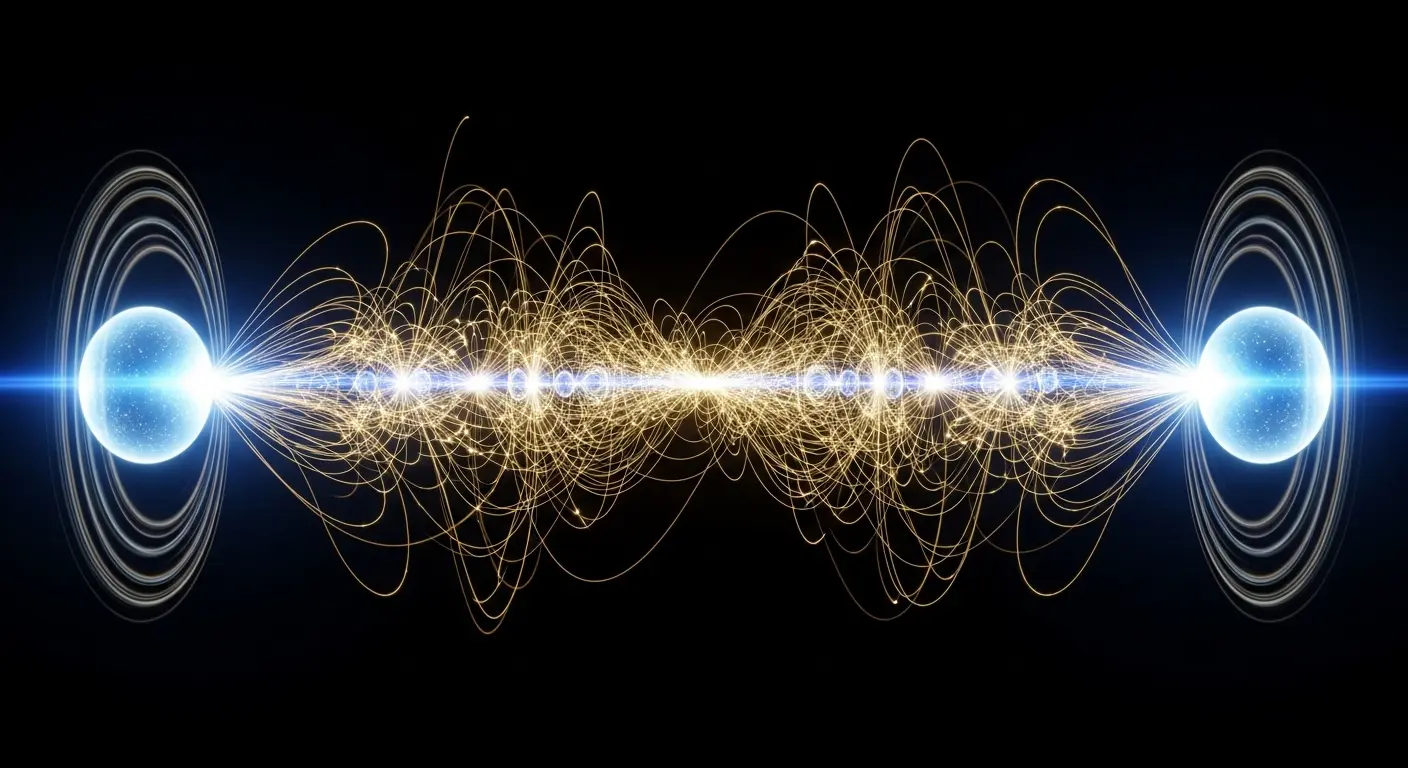
Scientists at the Centre for Nuclear Theory, led by Sebastian Grieninger, have undertaken a detailed investigation into quantum entanglement within the vacuum state of the massive Schwinger model, yielding new insights into the behaviour of quantum fields at finite angles. The researchers compute the entanglement entropy and spectrum, employing a sophisticated chirally rotated lattice Hamiltonian to ensure both mathematical consistency and accuracy in their calculations. This study clarifies a previously observed enhancement of entanglement entropy at a specific angle, θ=π, and elucidates its physical origin by relating it to the competition between distinct vacuum branches and maximal quantum fluctuations. The research demonstrates a narrowing of the entanglement gap near a critical mass ratio, and validates the use of entanglement observables as sensitive probes of vacuum structure, with potential implications for understanding complex condensed matter systems such as topological insulators and quantum wires.
Entanglement spectrum analysis reveals vacuum structure transition at critical fermion mass ratio
A significant narrowing of the entanglement gap, a crucial indicator of transitions in vacuum structure, has been observed to decrease by a factor of approximately three near a critical mass ratio of m/g ≃ 0.33. Traditionally, detailed analysis of the Schwinger model’s vacuum structure has relied on computationally intensive calculations of energy branches. However, computing the entanglement entropy and spectrum provides a sensitive, direct probe of the θ-dependent vacuum, clarifying the aforementioned enhancement at θ=π. This enhancement arises from the competition between distinct electric-flux vacuum branches, each representing a different configuration of the quantum fields, and is accompanied by maximised quantum fluctuations, a phenomenon previously difficult to characterise precisely. The Schwinger model, a simplified model of quantum electrodynamics in one spatial dimension, allows for analytical and numerical studies inaccessible in higher-dimensional theories. Specifically, a pronounced narrowing of the entanglement gap, a measure of the quantum connectedness between spatial regions, occurs when the ratio of fermion mass to gauge coupling reaches approximately 0.33, as revealed through detailed analysis of the entanglement spectrum. This spectrum demonstrates how quantum states are linked and provides a fingerprint of the vacuum structure.
The lattice Bisognano-Wichmann entanglement Hamiltonian, a discretised form of the Hamiltonian used to calculate entanglement, showed strong agreement with the exact modular Hamiltonian derived from the reduced density matrix, validating the computational approach’s accuracy, particularly within the infrared sector. The infrared sector represents the low-energy physics of the theory, where long-wavelength fluctuations dominate. This agreement confirms that the lattice formulation accurately captures the essential physics of entanglement in this regime. A clear link between entanglement and vacuum structure offers a powerful new tool for theoretical physics, enabling the investigation of non-perturbative phenomena, those that cannot be described by standard approximation techniques. However, limitations remain in extending this approach beyond the specific Schwinger model, as the complexities of more realistic gauge theories pose significant computational challenges. Successful computation of entanglement properties relied on a chirally rotated lattice Hamiltonian, a technique that preserves mathematical consistency by ensuring that the lattice formulation respects chiral symmetry, a fundamental property of the Schwinger model, and maintains the correct massless limit without introducing θ-dependent lattice artifacts, which could distort the results.
Currently, the agreement between lattice calculations and exact modular Hamiltonians holds only within the low-energy, or infrared, sector of the theory. Extending these calculations to higher energies requires significantly more computational resources and improved theoretical understanding. A method linking entanglement, where particles become intrinsically interconnected regardless of distance, with the fundamental structure of the vacuum, the seemingly empty space pervading the universe and possessing inherent quantum fluctuations, has been established. This provides a novel pathway for exploring theoretical physics, offering a complementary approach to traditional methods based on energy calculations and perturbation theory. Despite current limitations restricting its application to simpler models like the Schwinger model, a simplified theory of quantum electrodynamics, the potential for extending this methodology to more complex systems is a key area of ongoing research. The Schwinger model serves as a valuable testing ground for developing and validating new techniques before applying them to more realistic scenarios.
Entanglement measurement establishes a new and powerful method for investigating quantum vacuum structure, a quantum connection linking particles and defining the ground state of the theory. Within the massive Schwinger model, computing the entanglement entropy and spectrum clarified an enhancement at a specific angle, revealing the competition between differing vacuum branches; this offers a sensitive probe beyond traditional energy calculations, which often struggle to capture subtle features of the vacuum. The findings demonstrate that entanglement observables can accurately map the internal structure of quantum fields, potentially extending to the study of materials like topological insulators, which exhibit unique electronic properties due to their surface states, and quantum wires, which confine electrons to one dimension. Simultaneously, this work opens important questions regarding the limits of this technique in more complex systems, such as those with multiple particle species or higher spatial dimensions, and necessitates further investigation into the computational challenges associated with extending these calculations to more realistic scenarios. Understanding the relationship between entanglement and vacuum structure could provide crucial insights into the behaviour of strongly correlated quantum systems and the emergence of novel quantum phenomena.
The research computed the entanglement entropy within the massive Schwinger model, revealing an enhancement at a θ angle of π due to competition between distinct vacuum branches. This demonstrates that entanglement observables serve as sensitive probes of vacuum structure, offering a complementary approach to traditional energy-based calculations. The study showed agreement between lattice and modular Hamiltonians in the infrared sector, validating the methodology. Researchers clarified this enhancement occurs across a range of masses and is most pronounced near a critical mass ratio of m/g ≈ 0.33.
👉 More information
🗞 Entanglement in the $θ$-vacuum
🧠 ArXiv: https://arxiv.org/abs/2603.29287