Estimating the strength of interactions between mechanical and electromagnetic vibrations is crucial for developing advanced quantum technologies, and a team led by Adnan Naimy and Abdallah Slaoui, from LPHE, alongside Abderrahim Lakhfif and Rachid Ahl Laamara, now demonstrates a pathway to significantly improve this estimation process. The researchers develop a method for simultaneously determining the strength of these interactions within a magnomechanical cavity, revealing that a combined estimation strategy outperforms attempts to measure each interaction individually. Their analysis shows that employing a specific mathematical approach, based on the right logarithmic derivative, yields more precise results, effectively enhancing the system’s ability to process information. By identifying key parameters, such as increasing the rate of energy exchange and reducing energy loss, the team proves that it is possible to optimise the system’s sensitivity and bring practical, high-precision measurements of these fundamental couplings closer to the theoretical limits of accuracy.
Quantum Precision Beyond Classical Limits
This collection of research comprehensively explores quantum metrology, the science of achieving measurement precision beyond what is possible with classical techniques. The work focuses on utilizing quantum resources to enhance estimation of physical parameters, drawing upon principles from quantum information theory and estimation theory. Key concepts include the Quantum Fisher Information, a measure of achievable precision, and the Cramér-Rao Bound, a fundamental limit on estimation accuracy. The research emphasizes continuous variable systems, utilizing properties like the amplitude and phase of light, offering a practical pathway for experimental realization.
Researchers investigate mathematical tools crucial for precise estimation, including techniques for solving complex equations and analyzing data using information geometry. Studies span diverse physical systems, including optomechanical devices, cavity magnonics, and spin systems, offering potential for highly sensitive sensors. A central theme is overcoming the challenges posed by loss and noise, and developing robust estimation strategies that maintain precision in realistic experimental conditions. The collection suggests a strong focus on optimizing Gaussian states for maximizing measurement sensitivity.
The research explores potential advancements in hybrid quantum systems, combining the strengths of different physical platforms to achieve enhanced metrological performance. Investigations into resource theories for quantum metrology aim to identify the fundamental limits and resources required for optimal precision. Studies also delve into the role of quantum capacitance and non-Hermitian systems, exploring novel approaches to enhance sensing capabilities. This body of work establishes a foundation for pushing the boundaries of precision measurement, with implications for fundamental physics and advanced sensing technologies.
Magnon-Photon-Phonon Coupling in YIG Sphere
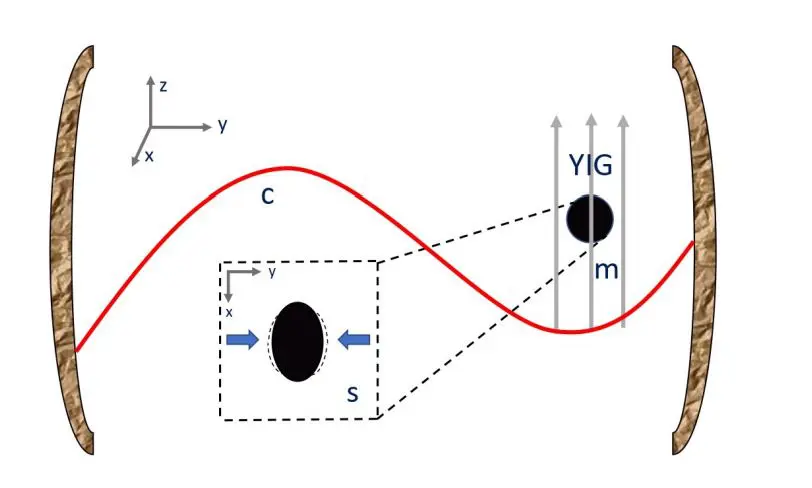
Researchers have developed a novel method for enhancing the precision of simultaneously estimating two crucial coupling parameters within a hybrid cavity magnomechanical system. The team constructed a system comprising interacting photons, magnons, and phonons, utilizing a sphere of yttrium iron garnet (YIG) placed within a microwave cavity. This sphere serves as a source of magnons, collective spin excitations, while the cavity facilitates photon interactions and the mechanical mode represents vibrational phonons. The magnon-photon interaction arises from magnetic coupling, and the magnon-phonon interaction through the sphere’s deformation induced by magnon excitation.
To drive the system, researchers excited the magnon mode with a microwave source, enhancing the magnomechanical coupling, and applied a static magnetic field to establish magnon-photon interaction. They then developed a mathematical model, based on quantum Langevin equations, to describe the system’s dynamics, accounting for damping, detuning, and quantum noise. These equations model the evolution of the system’s operators over time, enabling precise calculations of estimation precision. The team employed sophisticated mathematical techniques to compute the Fisher information matrices, crucial for determining the fundamental limit on estimation accuracy.
Analysis revealed that a specific mathematical approach consistently outperformed others, indicating superior estimation precision. This improvement reflects the system’s enhanced capacity to encode, transfer, and extract information, optimizing fundamental interactions. Furthermore, the study demonstrates that, under specific conditions, a detection technique called heterodyne detection can approach the ultimate precision set by the Fisher information matrix, suggesting a practical and efficient route for estimating the coupling parameters. Increasing the strength of interactions and reducing system noise further enhances the system’s sensitivity.
Enhanced Precision in Coupling Parameter Estimation
This work introduces an experimentally viable scheme to enhance the precision of simultaneously estimating couplings within a heterodyne detection system. Researchers demonstrate that a simultaneous estimation approach offers a notable advantage over individual estimation strategies. To support this, the team computed Quantum Fisher Information Matrices (QFIMs) using sophisticated mathematical techniques, revealing that a specific approach consistently provides a lower bound on estimation error, indicating superior estimation precision. The study shows that increasing the strength of interactions and the average number of photons and phonons, combined with reduced system noise, enhances the system’s sensitivity to the coupling parameters.
These mechanisms act on quantum resources such as entanglement and state purity, leading to more precise estimations. Analysis reveals that, under specific conditions, heterodyne detection can closely approach the ultimate precision set by the QFIM, suggesting an efficient and practical route for estimating the coupling parameters. Furthermore, the research establishes a foundation for high-precision hybrid quantum sensors by exploring the fundamental limits of parameter estimation and the role of quantum resources in optimizing measurement precision. The team’s calculations demonstrate the importance of maximizing the QFIM to enhance multiparameter estimation protocols, a key objective in achieving optimal measurement sensitivity. This work builds upon recent advancements in magnon-photon-phonon interactions, providing a pathway for exploring the quantum phenomena enabled by these hybrid systems.
Simultaneous Coupling Estimation Enhances Metrology Precision
This research presents a significant advance in the field of hybrid quantum metrology, specifically concerning the precise estimation of coupling strengths within cavity magnomechanical systems. Scientists have demonstrated that simultaneously estimating both the magnon-photon and magnon-phonon couplings yields improved precision compared to estimating them individually, a finding with implications for optimizing device performance and understanding fundamental interactions. The team achieved this by calculating the Fisher information matrices using sophisticated mathematical techniques, revealing that a specific approach consistently provides a lower bound on estimation error. The analysis indicates that the precision of estimating these coupling strengths is influenced by several key parameters.
Increasing the strength of interactions and reducing system noise all contribute to a lower estimation error, effectively enhancing the amount of accessible information. Furthermore, the research highlights the effectiveness of heterodyne detection as a practical measurement strategy, showing its performance closely approaches the ultimate precision limits set by the quantum Fisher information. While acknowledging that estimation precision decreases under specific conditions, the findings demonstrate that careful control of system parameters can significantly improve the accuracy of coupling strength estimation in these hybrid quantum systems, paving the way for advancements in quantum technologies and high-precision sensing. This study is theoretical, providing a framework for future experimental investigations.
🗞 Optimal Multiparameter Quantum Estimation of Magnonic Couplings in a Magnomechanical Cavity
🧠 ArXiv: https://arxiv.org/abs/2511.12352